A research team is designing a novel architecture with a custom, non-standard training loop that changes behavior based on intermediate outputs. They choose PyTorch over a high-level framework like Keras. What is the main advantage driving that choice?
Select an answer to reveal the explanation.
Short Explanation and Infographic
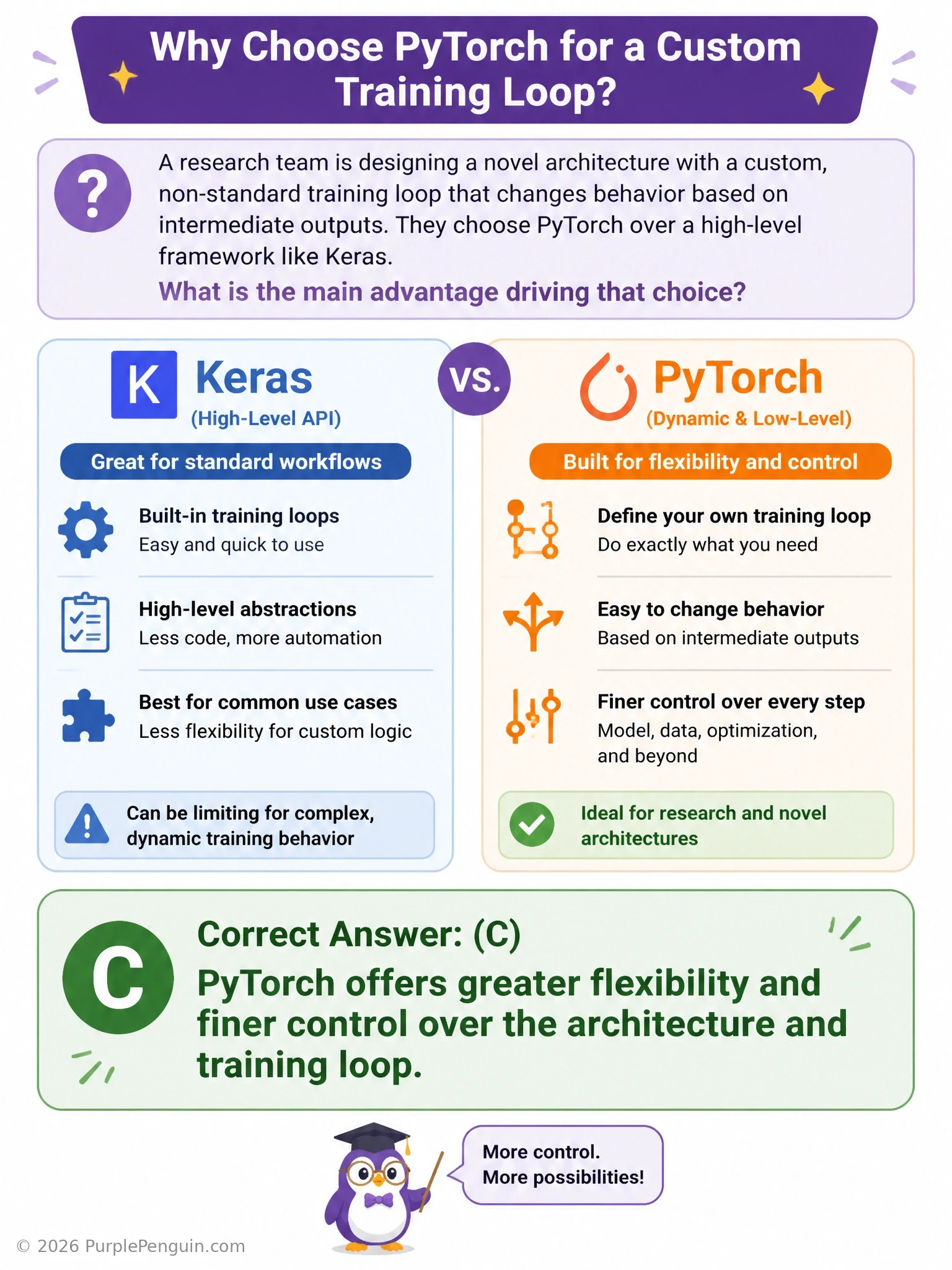
Think of Keras as a well-organized kitchen with pre-set recipes — great for getting a solid meal out fast. PyTorch hands you the raw ingredients and lets you cook however you want. When a team needs a training loop that branches based on what an intermediate layer just produced, or an architecture that doesn't fit the standard 'stack some layers and call fit()' mold, they need to write the loop by hand — forward pass, loss, backward, optimizer step, all explicit. That's exactly what PyTorch is built for, so 'greater flexibility and finer control' is the answer. It's not about writing less code — Keras usually wins there for standard cases. PyTorch definitely runs on GPUs, that's core to it. And no framework picks your hyperparameters for you automatically; that still takes tuning.
Full explanation below image
Full Explanation
PyTorch's defining advantage over higher-level frameworks like Keras is the flexibility and fine-grained control it gives developers over both model architecture and the training process. PyTorch uses an imperative, 'define-by-run' programming style, meaning the computation graph is built dynamically as operations execute. This makes it straightforward to write custom training loops with conditional logic, dynamic architectures (such as networks whose structure changes based on input), non-standard loss computations, or novel gradient manipulation — situations that are cumbersome or impossible to express cleanly with the more declarative, fit()-based API that Keras provides for common cases. Because the training loop in PyTorch is just Python code the developer writes explicitly (forward pass, loss computation, backward call, optimizer step), researchers can insert arbitrary logic anywhere in that sequence.
The claim that PyTorch requires far less code for standard tasks is generally the opposite of reality: Keras's high-level fit()/compile() API is specifically designed to minimize boilerplate for common architectures and training regimes, and PyTorch typically requires more explicit code to achieve the same standard training loop. This is a reasonable trade a team makes for control, not a benefit of less code.
The claim that PyTorch automatically selects optimal hyperparameters is false; hyperparameter tuning (learning rate, batch size, architecture choices) still requires manual specification or a separate tuning process (such as grid search, random search, or a dedicated tuning library) regardless of framework.
The claim that PyTorch cannot run on GPUs is simply incorrect — PyTorch has first-class, well-optimized GPU support via CUDA and is widely used for GPU-accelerated training; GPU support is unrelated to ease of debugging.
In short, the correct distinguishing factor for choosing PyTorch in research settings with novel or non-standard training procedures is architectural and training-loop flexibility, not code brevity, automatic tuning, or GPU limitations.