During model development, a team checks performance on a held-out validation set after every epoch and adjusts hyperparameters based on the results. What is the primary purpose of that validation set?
Select an answer to reveal the explanation.
Short Explanation and Infographic
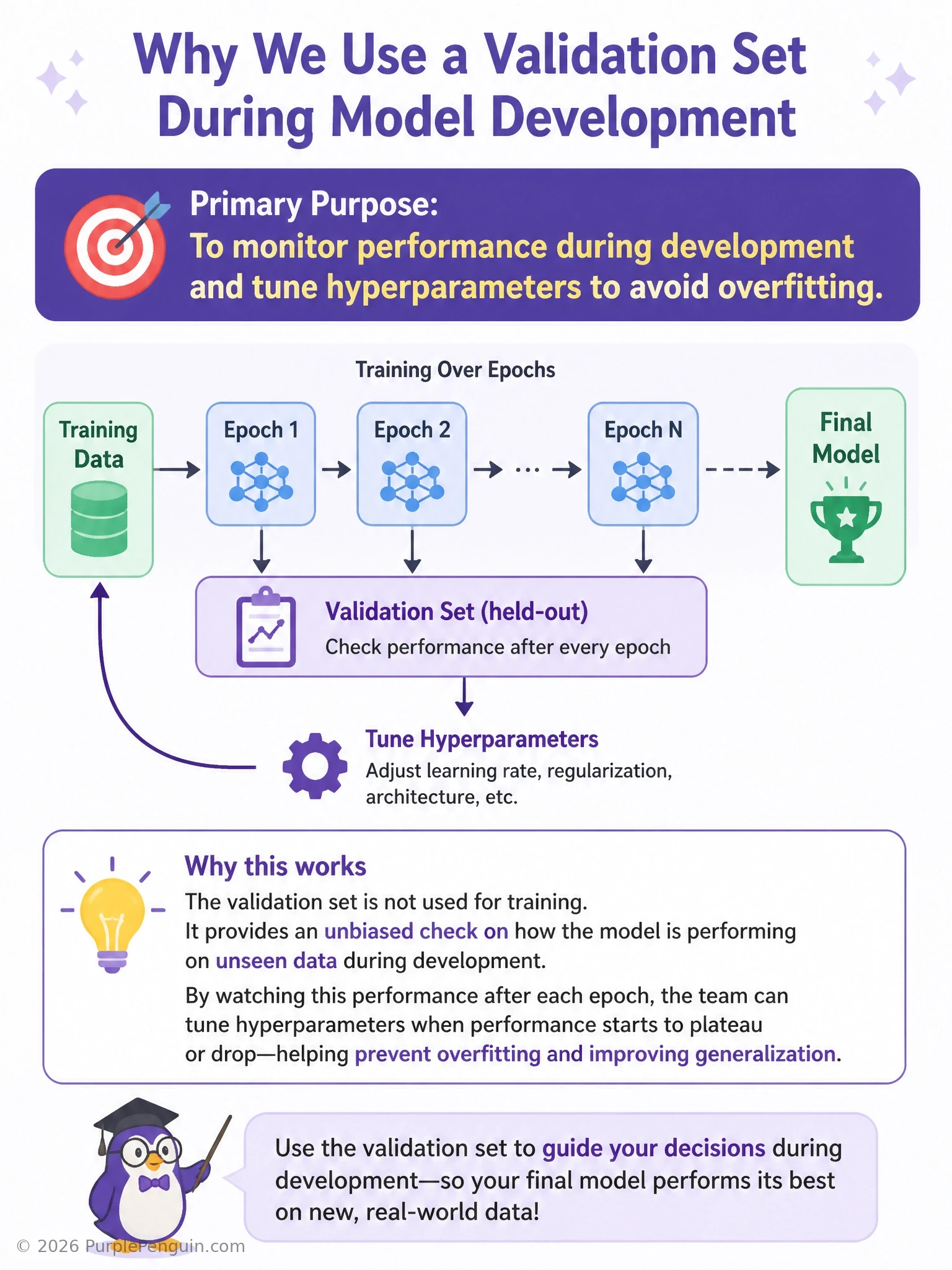
Here's the deal: your training set is what the model actually learns from, but you need a separate slice of data to check its work along the way without cheating. That's the validation set — you run it after every epoch, watch whether validation loss is tracking training loss or starting to diverge, and use that signal to tune things like learning rate, number of layers, or when to stop training. So 'monitor performance and tune hyperparameters to avoid overfitting' is spot on. The final unbiased score is the test set's job, held back until the very end so tuning decisions can't leak into it. The validation set never replaces the training data — the model doesn't train on it. And it's not for generating synthetic samples; that's data augmentation, a completely separate technique.
Full explanation below image
Full Explanation
The validation set serves as an ongoing diagnostic tool during model development. After training on the training set for some period (commonly each epoch), the model's performance is evaluated on the validation set, which it has not been trained on. This provides an estimate of how well the model generalizes to unseen data at that point in training. Practitioners use these validation metrics to make development decisions: deciding when to stop training (early stopping) if validation loss stops improving or starts rising while training loss keeps falling (a sign of overfitting), comparing different hyperparameter configurations (learning rate, number of layers, regularization strength, batch size), and selecting which model checkpoint to keep. Because the validation set is used repeatedly to guide these decisions, the model or its configuration is indirectly shaped by it, which is precisely why it cannot serve as the final, unbiased performance measure.
That final, one-time, unbiased evaluation is the role of the separate test set, which is held out entirely from both training and any tuning decisions and is only evaluated once development is complete, precisely to avoid the same information leakage that would occur if it were used for tuning.
The validation set does not replace the training set at any point; the model continues to learn its weights exclusively from the training set throughout the training process, while the validation set is used purely for evaluation and decision-making, never for weight updates via backpropagation.
Generating additional synthetic training samples is the role of data augmentation techniques (such as flips, rotations, or crops for images), which is an entirely separate concept from the train/validation/test split and is applied to expand or diversify the training data itself, not to create or serve the purpose of a validation set.
The train/validation/test split, and the discipline of using the validation set only for tuning while reserving the test set for a single final check, is one of the most important practices for producing models that generalize well rather than models that have merely been tuned to look good on a specific slice of data.