In a typical deep learning workflow, what role does the pandas library primarily serve?
Select an answer to reveal the explanation.
Short Explanation and Infographic
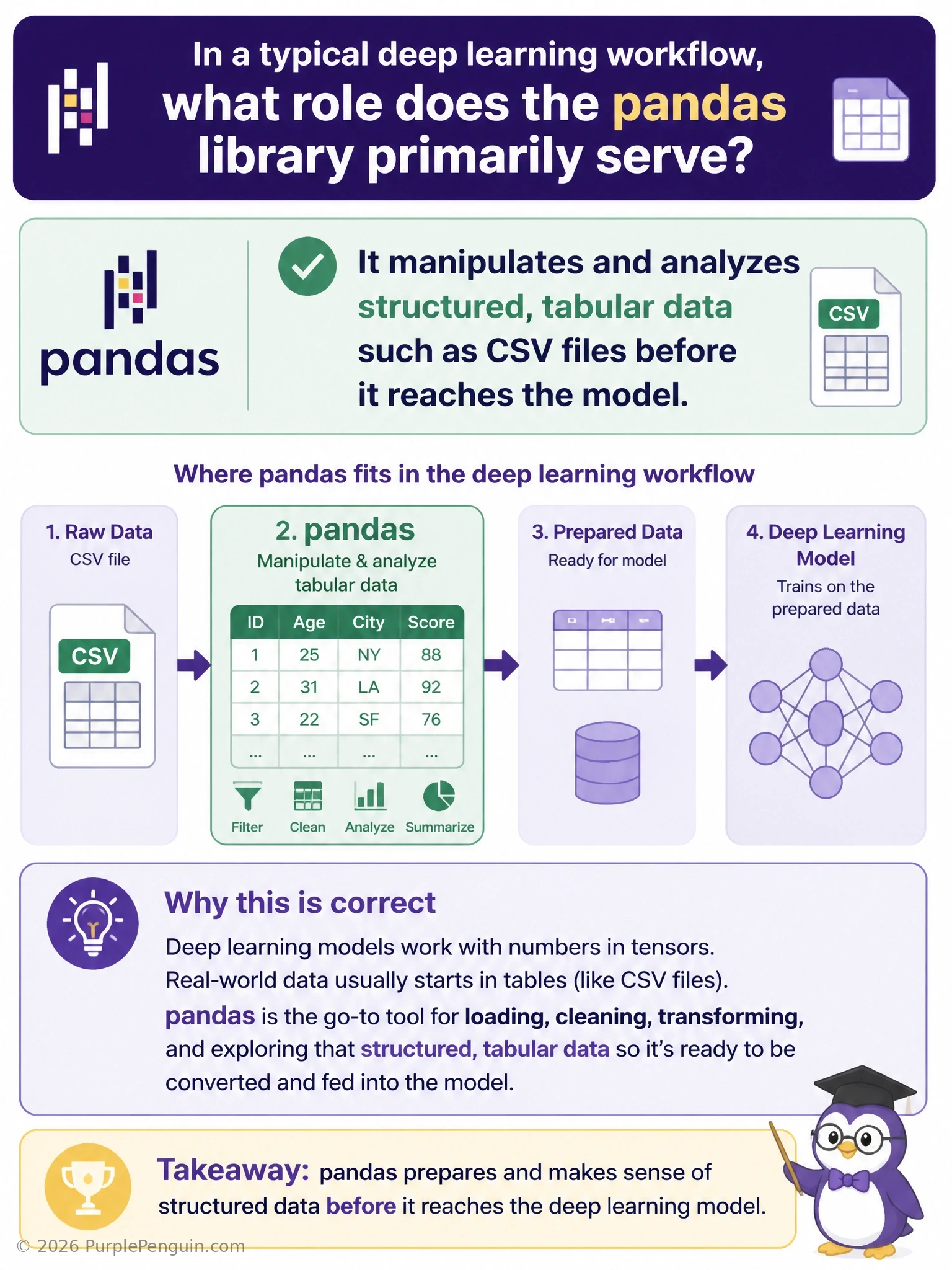
Pandas is your data-wrangling workhorse before anything ever touches a neural network. It reads in CSVs, spreadsheets, and other tabular data, and gives you DataFrames you can filter, clean, join, group, and reshape — all the unglamorous but essential prep work that happens upstream of training. That structured-data manipulation is exactly pandas' job, and that's the right answer. It's not defining or training your network — that's TensorFlow, Keras, or PyTorch's territory. It's not computing gradients either; pandas doesn't do autodiff or backpropagation at all. And it's not a plotting library for visualizing model internals — for that you'd reach for something like Matplotlib, Seaborn, or TensorBoard. Pandas lives entirely on the data side of the workflow, before modeling begins.
Full explanation below image
Full Explanation
Pandas is a Python library built for manipulating and analyzing structured, tabular data, and in a deep learning workflow it typically sits early in the pipeline, handling tasks such as reading CSV or Excel files into DataFrames, filtering and cleaning rows, handling missing values, merging or joining multiple data sources, grouping and aggregating data, and performing exploratory data analysis before that data is converted into the tensor format required by a deep learning framework. Its core data structures, Series (1-D) and DataFrame (2-D, labeled), make it especially well suited for handling heterogeneous, labeled tabular data, which is common in many real-world datasets before they are transformed into NumPy arrays or framework-specific tensors for model consumption.
Defining and training neural network layers is the responsibility of deep learning frameworks such as TensorFlow/Keras or PyTorch. These libraries provide the building blocks — layers, activation functions, loss functions, and training loops — needed to construct and optimize a model. Pandas has no built-in mechanism for defining network architecture or running a training loop; its scope is strictly data handling, not modeling.
Computing gradients during backpropagation is handled by a framework's automatic differentiation engine, such as PyTorch's autograd or TensorFlow's GradientTape. Pandas performs no differentiation and has no concept of computational graphs, gradients, or backward passes; it operates purely on static tabular data using standard array and table operations.
Rendering visualizations of a trained model's internal weights is typically done with dedicated visualization libraries (Matplotlib, Seaborn) or specialized tools (TensorBoard, Weights & Biases). While pandas DataFrames are sometimes used to organize data that is later plotted with a separate plotting library, pandas itself does not provide model-introspection or weight-visualization capabilities.
Memory aid: pandas answers the question 'how do I load, clean, and explore my structured data?' — it operates strictly before or alongside modeling, transforming raw tabular data into a clean, well-structured form that downstream deep learning frameworks can further process into trainable tensors.