A junior engineer proposes tuning the model's hyperparameters directly against the test set to save time, skipping a separate validation set. What is the main problem with this approach?
Select an answer to reveal the explanation.
Short Explanation and Infographic
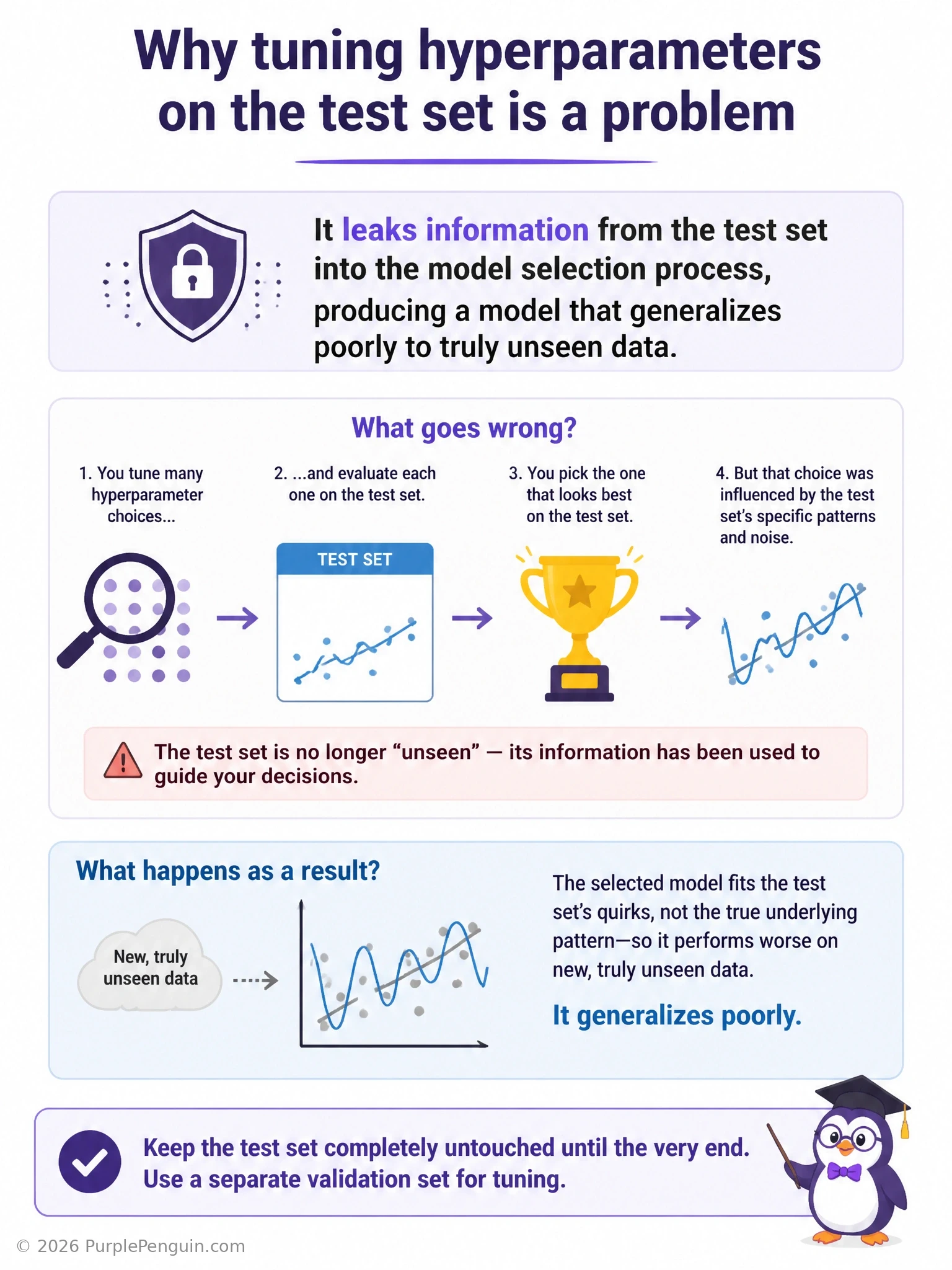
Here's the problem: the test set only means something if it stays completely untouched until the very end, as a stand-in for truly unseen, real-world data. The moment you start tuning hyperparameters based on test-set performance, you're indirectly fitting your choices to that specific data — you've smuggled information from the test set into the model-building process. That's called data leakage, and it means your final 'test' score is no longer an honest estimate of how the model will do on new data; it's inflated. That's the correct answer. It's not really about needing more compute — you're just moving where you measure performance, not adding real workload. It has nothing to do with training loop speed or logging overhead. And it definitely doesn't touch the differentiability of your loss function — the loss function's math doesn't change based on which dataset you evaluate against.
Full explanation below image
Full Explanation
The core problem with tuning hyperparameters directly against the test set is data leakage, which occurs when information about supposedly unseen data influences decisions made during model development. The entire purpose of a held-out test set is to provide one final, unbiased estimate of how a model will perform on genuinely new data it has never influenced in any way. When hyperparameters (learning rate, architecture choices, regularization strength, and so on) are selected based on test-set performance, the engineer is effectively fitting decisions to that specific test data, even without directly training on it. As a result, the test set no longer represents truly unseen data from the model's perspective, and the reported test performance becomes an overly optimistic, inflated estimate of real-world generalization. This is precisely why standard practice uses a three-way split: a training set to fit model parameters, a validation set to guide hyperparameter tuning and model selection, and a test set reserved exclusively for a single, final evaluation after all tuning decisions are locked in.
Requiring significantly more compute is not the fundamental issue; tuning against the test set does not inherently demand more computation than tuning against a validation set of similar size. The problem is methodological (data leakage and biased evaluation), not computational cost.
Causing the training loop to run more slowly due to extra logging is unrelated. Logging overhead, if any, is a minor implementation detail and has nothing to do with which dataset is used for hyperparameter selection, nor does it explain why using the test set for tuning is problematic.
Causing the loss function to become non-differentiable is not a real consequence of this practice. The mathematical properties of a loss function (differentiability) depend on its formula and the type of computations involved, not on which dataset (validation vs. test) is used to evaluate or guide hyperparameter choices.
Memory aid: the test set should be treated like a single-use, sealed envelope — opened only once, at the very end, to report final performance. Any repeated peeking to make decisions (including hyperparameter tuning) turns that final number into a leaked, overly rosy estimate rather than a trustworthy measure of generalization.