A vision team applies random rotations, flips, and slight color jitter to their training images before each epoch. What is the main goal of this technique?
Select an answer to reveal the explanation.
Short Explanation and Infographic
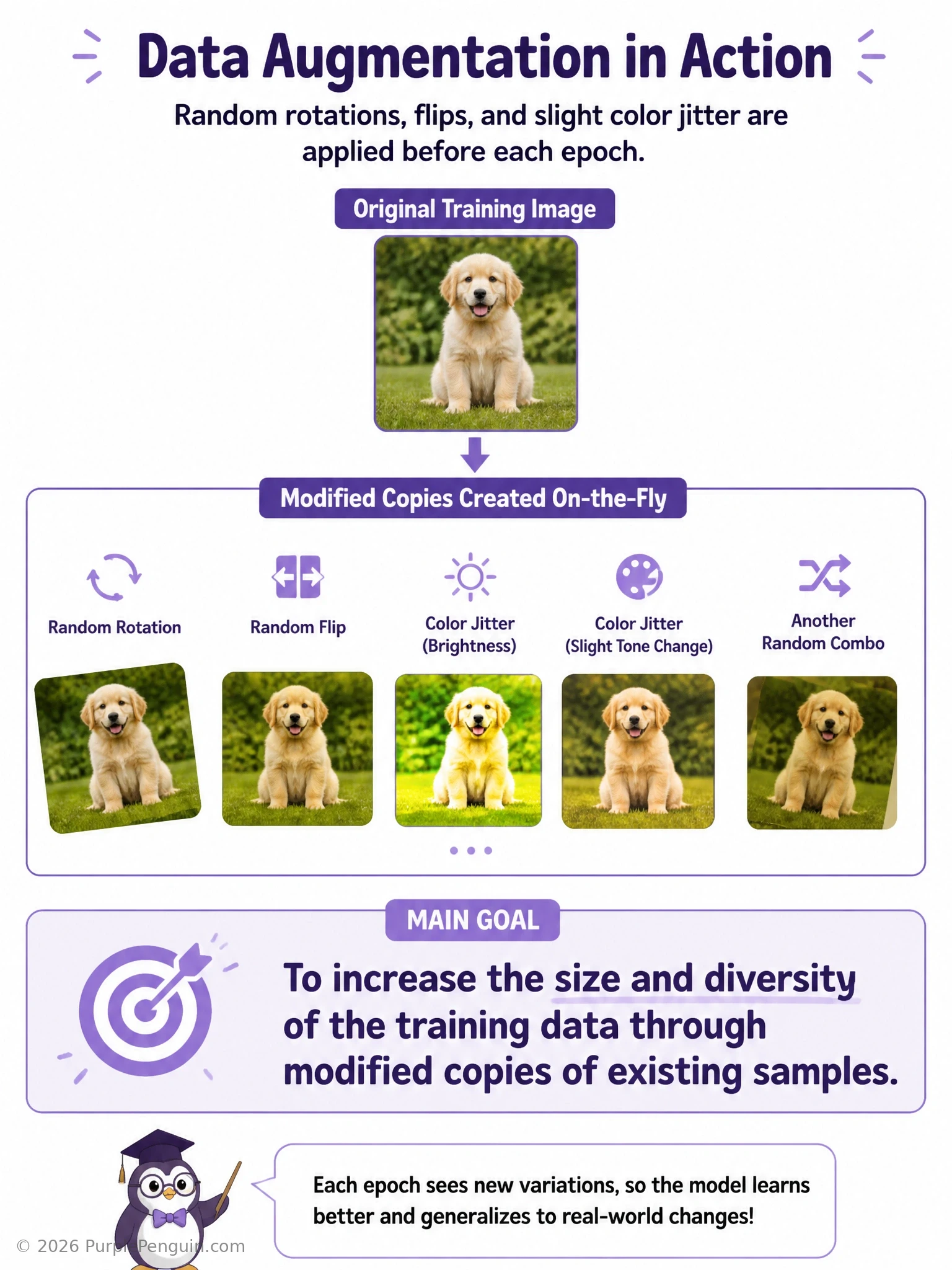
This is data augmentation, and the whole point is to make your model see more variety without having to go collect a single new photo. By rotating, flipping, and jittering colors, you're generating modified versions of the same images, effectively growing and diversifying your training set on the fly. That helps the model generalize better and resist overfitting, since it learns the pattern isn't tied to one exact orientation or lighting condition. That's the correct answer. It doesn't reduce how many unique images you need — if anything, it works with what you already have to stretch its value further. It has nothing to do with fixing incorrect labels — that's a data-quality issue, not a transformation technique. And it's not about file size or loading speed either; these transformations are about the pixel content teaching the model robustness, not about compression.
Full explanation below image
Full Explanation
Data augmentation is a technique used to artificially increase the size and diversity of a training dataset by applying label-preserving transformations — such as random rotations, horizontal or vertical flips, color jitter, cropping, or slight zooms — to existing training samples, generating new, modified variants without needing to collect additional raw data. The primary goal is to expose the model to a wider range of variations it might encounter in real-world data (different orientations, lighting conditions, or minor distortions), which improves generalization and helps reduce overfitting, since the model learns to recognize the underlying pattern rather than memorizing specific pixel arrangements, backgrounds, or exact object positions present in the original limited dataset.
Reducing the number of unique training images needed to reach convergence misrepresents the mechanism: augmentation does not shrink the dataset requirement; rather, it works with the existing set of unique images and expands the effective variety seen during training by generating altered copies. It is a way to get more value out of a given set of unique images, not a way to need fewer of them in the first place.
Automatically relabeling incorrectly labeled training images describes a data-quality correction process, sometimes handled through manual review or specialized label-cleaning techniques, and is entirely unrelated to augmentation. Augmentation transformations are applied to correctly labeled images and are explicitly chosen to be label-preserving (a flipped photo of a cat is still a photo of a cat); they do nothing to detect or fix mislabeled data.
Compressing images into a smaller file size for faster loading describes a storage or I/O optimization concern, unrelated to the purpose of augmentation. While some augmentation pipelines happen to resize images, that is incidental to enabling batching or matching input dimensions, not the goal of the augmentation technique itself, which is about increasing effective training diversity, not reducing storage footprint.
Memory aid: augmentation trades compute time (for generating transformed copies on the fly) for improved generalization, effectively simulating a larger and more varied dataset than what was originally collected, which is especially valuable when labeled data is scarce or expensive to obtain.