Why does the file size and parameter count of a trained model matter so much specifically when deploying to a mobile phone?
Select an answer to reveal the explanation.
Short Explanation and Infographic
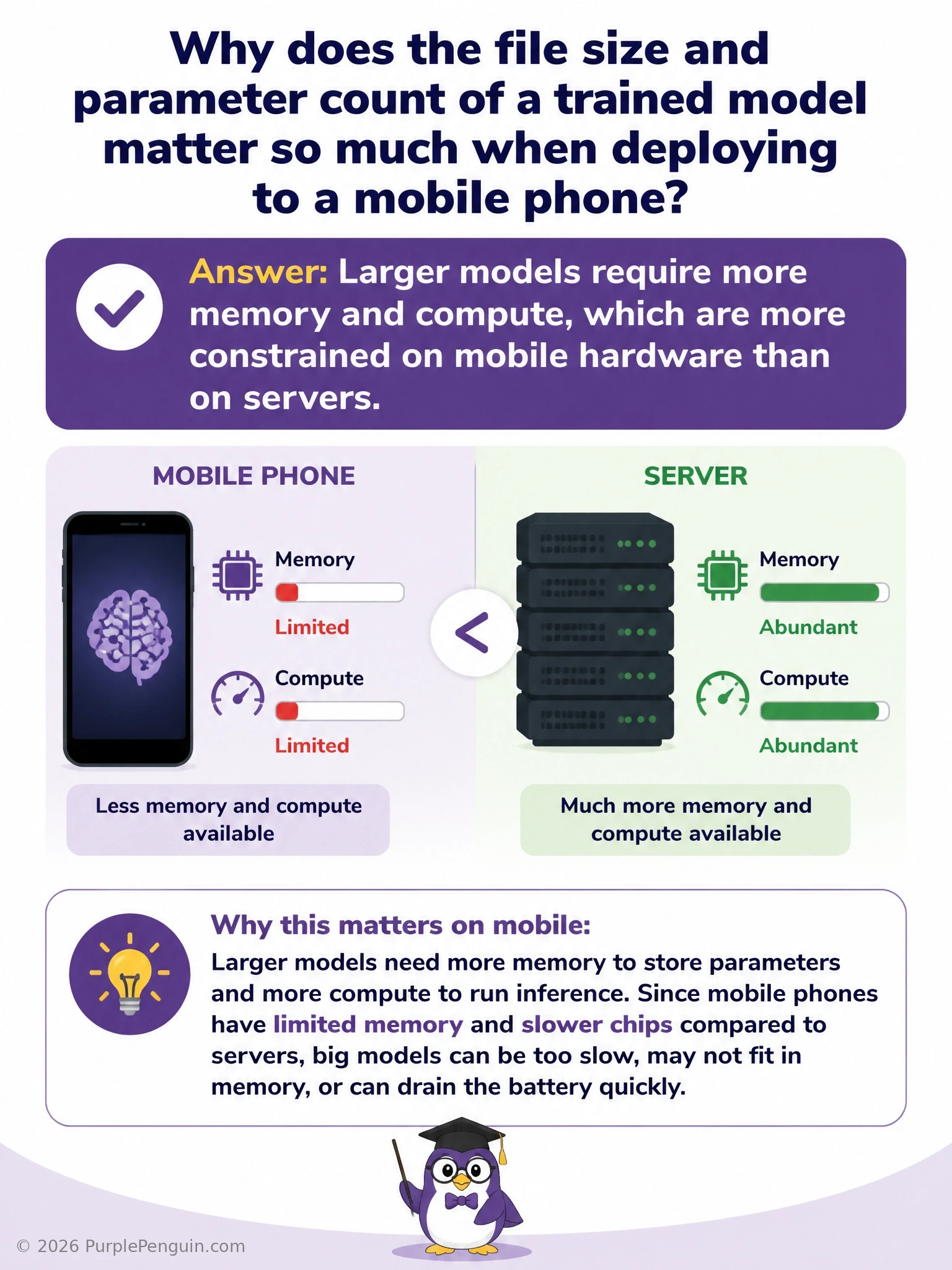
Phones just don't have the same muscle a server or a GPU rack has — limited RAM, limited processing power, and a battery to worry about. A bigger model means more parameters to store in memory and more computation per prediction, and on constrained mobile hardware that translates directly into slower predictions, higher battery drain, and sometimes the app just not being able to load the model at all. That's why size matters so much here, and that's the correct answer. There's no single universal OS-enforced size cap — it's a resource constraint, not a fixed rule. Model size doesn't directly cause better or worse accuracy either; a smaller distilled model can sometimes perform nearly as well as a larger one. And training time is a separate concern from deployment — training happens once, often on powerful hardware, well before the model ever reaches the phone.
Full explanation below image
Full Explanation
Model size and parameter count matter significantly for mobile deployment because mobile devices have substantially more limited memory (RAM), storage, and compute capability compared to servers or dedicated training hardware like GPU clusters. A larger model requires more memory just to hold its weights during inference, more compute (multiply-accumulate operations) per forward pass, and often more storage space in the installed app bundle. On a resource-constrained device, this translates into slower inference latency, increased battery consumption, potential thermal throttling, and in extreme cases, an inability to even load the model if it exceeds available memory. This is precisely why techniques like quantization, pruning, knowledge distillation, and conversion to lightweight runtimes (TensorFlow Lite, Core ML, ONNX Runtime Mobile) are commonly applied before shipping a model to mobile.
The claim that mobile operating systems enforce a fixed universal size limit on models is incorrect; there is no single hard cutoff imposed by iOS or Android for model size. What actually constrains deployment is the practical availability of memory, storage, and compute on a given device, which varies by device model and by how much of those resources the app and OS are already using.
The claim that model size directly determines prediction accuracy conflates capacity with performance. While very small models can sometimes underfit complex tasks, a well-designed smaller or distilled model can often achieve accuracy close to that of a much larger model, and a large model is not automatically more accurate — it depends on architecture, training data, and regularization, not merely parameter count.
The claim that larger models always take longer to train regardless of environment addresses a different question altogether. Training time is influenced by hardware, model size, dataset size, and training duration, but it is a separate concern from inference constraints on a deployed mobile device; training typically happens once, often on well-resourced hardware such as GPUs or cloud infrastructure, well before the resulting model is deployed to a resource-constrained phone.
The underlying principle: deployment-target hardware constraints (memory, compute, power) directly govern how much model size and complexity is practical, which is why mobile and edge deployment pipelines emphasize compression techniques that reduce size and computational cost while trying to preserve as much accuracy as possible.