A dataset has a feature that ranges from 1 to 1000, with no significant outliers, and the team wants all input features bounded within a fixed, known range for a neural network. Which scaling technique fits best?
Select an answer to reveal the explanation.
Short Explanation and Infographic
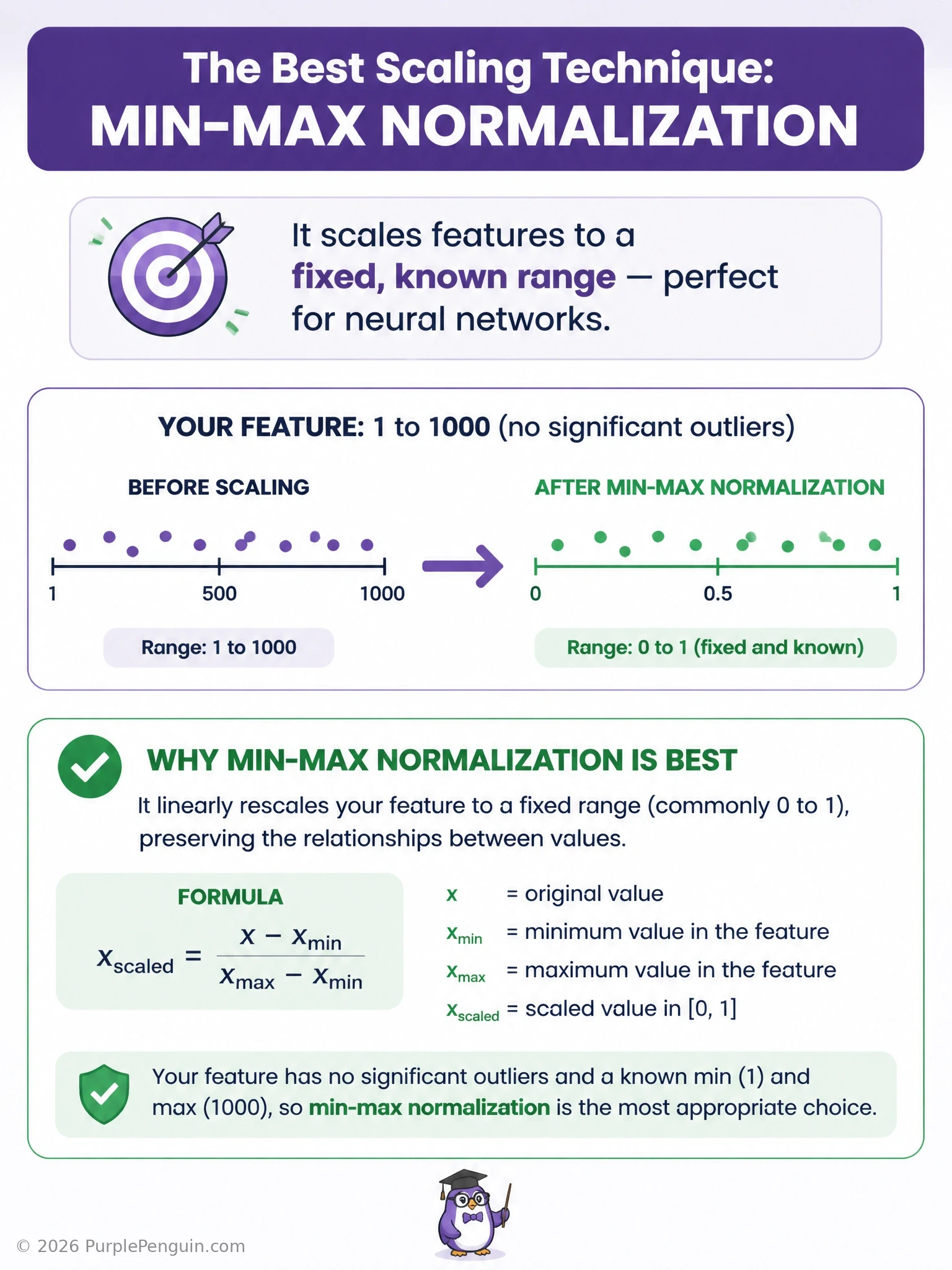
When you know the range of a feature and there aren't wild outliers messing things up, min-max normalization is a natural fit. It takes your 1-to-1000 range and squeezes it down to a fixed window, usually [0, 1], using the actual min and max of the data. Since the range is known and clean here, this works great and gives you that fixed, bounded output the team wants — that's the right answer. One-hot encoding is for categorical data, not a continuous numeric range like this one. Label encoding just assigns arbitrary integers to categories, which doesn't even apply to an already-numeric feature like this. And leaving it unscaled would let this feature's huge range dominate other features during training, since gradient-based optimizers are sensitive to differences in feature scale — exactly the problem scaling is meant to solve.
Full explanation below image
Full Explanation
Min-max normalization is the appropriate technique here because it rescales a numeric feature into a fixed, known range — most commonly [0, 1] — using the formula x_scaled = (x - min) / (max - min). Given a feature ranging from 1 to 1000 with no significant outliers, this transformation works cleanly: the true minimum and maximum reliably represent the actual spread of the data, so the resulting scaled values will be well-distributed across the target range without being distorted by extreme values. This is precisely why min-max normalization is favored when a bounded output range is explicitly desired and the data does not contain problematic outliers that would otherwise compress the majority of values into a narrow sub-region of that range.
One-hot encoding is designed for categorical (typically nominal, unordered) variables, converting each category into a binary indicator vector. It has no application to a continuous numeric feature like the one described, which already carries meaningful magnitude information that one-hot encoding would destroy.
Label encoding assigns an arbitrary integer to each distinct category in a categorical feature, which is meant to reduce categories to numeric codes for models that can handle ordinal-like inputs or for tree-based models. Since the feature in question is already numeric and continuous rather than categorical, label encoding is not a relevant or applicable transformation here.
Leaving the feature completely unscaled would be problematic for a neural network because features with much larger raw magnitudes (like this one ranging up to 1000) can dominate the loss landscape and gradient updates relative to smaller-scale features, slowing convergence and potentially destabilizing training. Since the team specifically wants a fixed, known range across input features for consistency, leaving this feature unscaled directly contradicts that requirement.
Memory aid: min-max normalization is the go-to choice when you want values bounded within a specific range and your data is reasonably free of extreme outliers; when outliers are present, standardization (z-score) or robust scaling methods (based on median and interquartile range) are generally preferred instead, since min-max scaling is highly sensitive to extreme values.