What is the fundamental purpose of hyperparameter tuning in a deep learning workflow?
Select an answer to reveal the explanation.
Short Explanation and Infographic
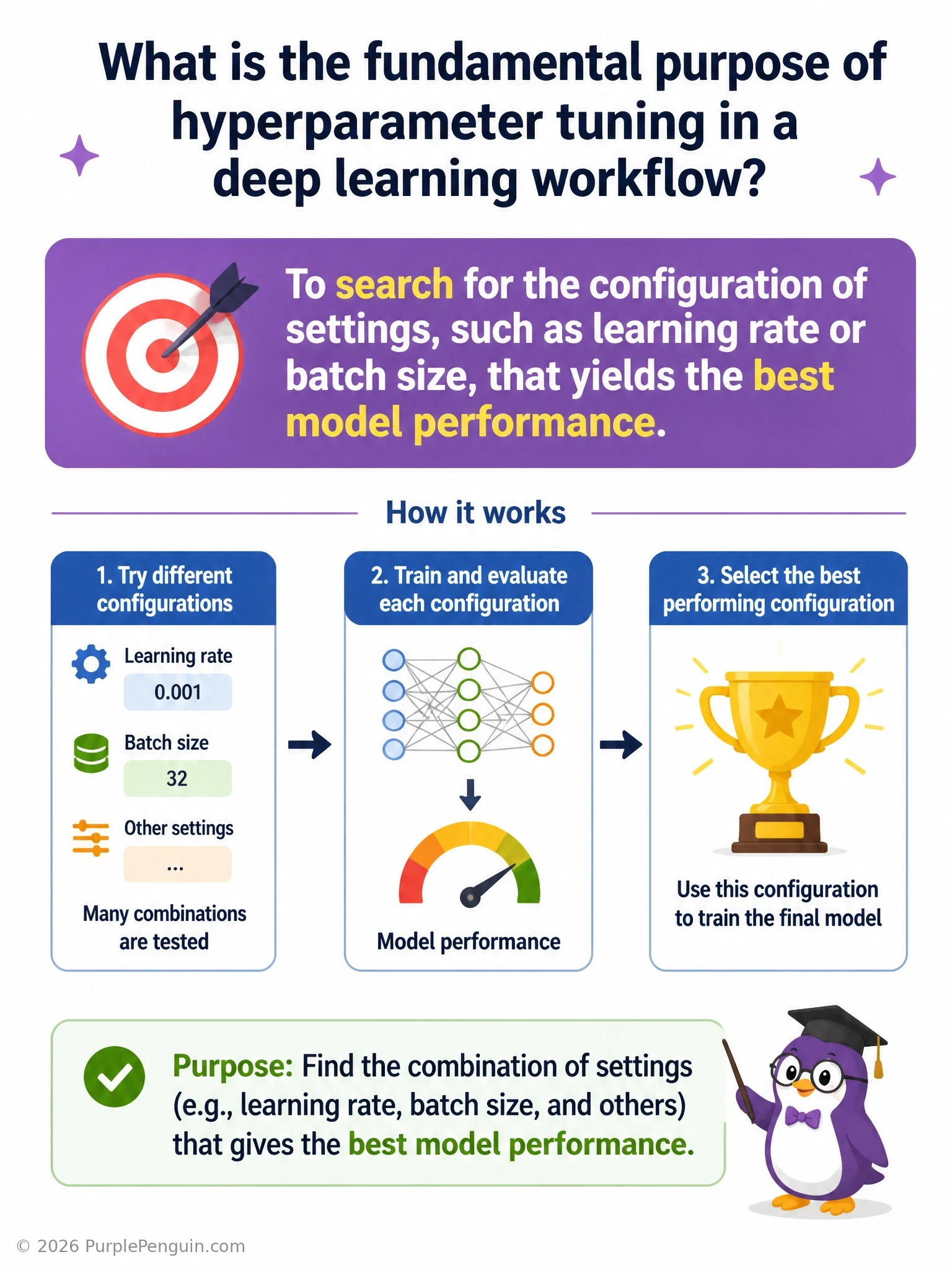
Hyperparameter tuning is basically a systematic search for the best 'settings dial' on your model — things like learning rate, batch size, number of layers, or dropout rate that you choose before training rather than things the model learns on its own. The goal is simple: try different combinations, measure performance (usually on a validation set), and land on the configuration that gives you the best results. That's the correct answer here. Fixing mislabeled data is a data-quality task, totally separate from tuning settings. Shrinking a model into a lighter deployment format is model conversion, a post-training deployment step. And creating synthetic samples through transformations is data augmentation, which grows your dataset rather than searching for the best training configuration. Tuning is about the knobs, not the data or the deployment package.
Full explanation below image
Full Explanation
Hyperparameter tuning refers to the systematic process of searching over a space of hyperparameters — settings chosen before training begins and not learned from data, such as learning rate, batch size, number of layers, number of units per layer, dropout rate, or choice of optimizer — to find the combination that produces the best model performance, typically measured on a validation set. Common tuning strategies include grid search (exhaustively trying predefined combinations), random search (sampling combinations randomly), and more sophisticated approaches like Bayesian optimization or population-based training. The fundamental goal is to identify settings that help the model learn effectively, generalize well, and avoid problems like slow convergence, underfitting, or overfitting, which is why 'finding the settings that yield the best model performance' correctly captures its purpose.
Manually inspecting and correcting mislabeled samples is a data-quality and data-cleaning task, part of the broader data preparation stage of a project. While a noisy or mislabeled dataset can absolutely hurt a model's ability to learn, addressing that problem is unrelated to hyperparameter tuning, which assumes reasonably clean and correctly labeled data and instead focuses on how the model is configured to learn from it.
Converting a trained model into a smaller deployment-ready format describes a post-training optimization and deployment step, often involving techniques like quantization, pruning, or conversion to a runtime such as TensorFlow Lite or ONNX. This happens after a satisfactory model has already been trained and tuned; it addresses inference efficiency and deployment constraints, not the search for the best training configuration.
Generating additional synthetic training samples through transformations describes data augmentation, a technique used to increase the size and diversity of a training set (e.g., flipping, rotating, or cropping images) to improve generalization and reduce overfitting. While augmentation strategies (like the degree of rotation applied) can themselves sometimes be treated as tunable hyperparameters, the core purpose of augmentation is expanding and diversifying data, which is distinct from searching for the best overall model configuration.
Memory aid: hyperparameters are the 'dials' you set before training (not learned weights), and tuning is the disciplined search process for the dial settings that produce the strongest validation performance.