In TensorFlow, what is a tf.Variable primarily used for?
Select an answer to reveal the explanation.
Short Explanation and Infographic
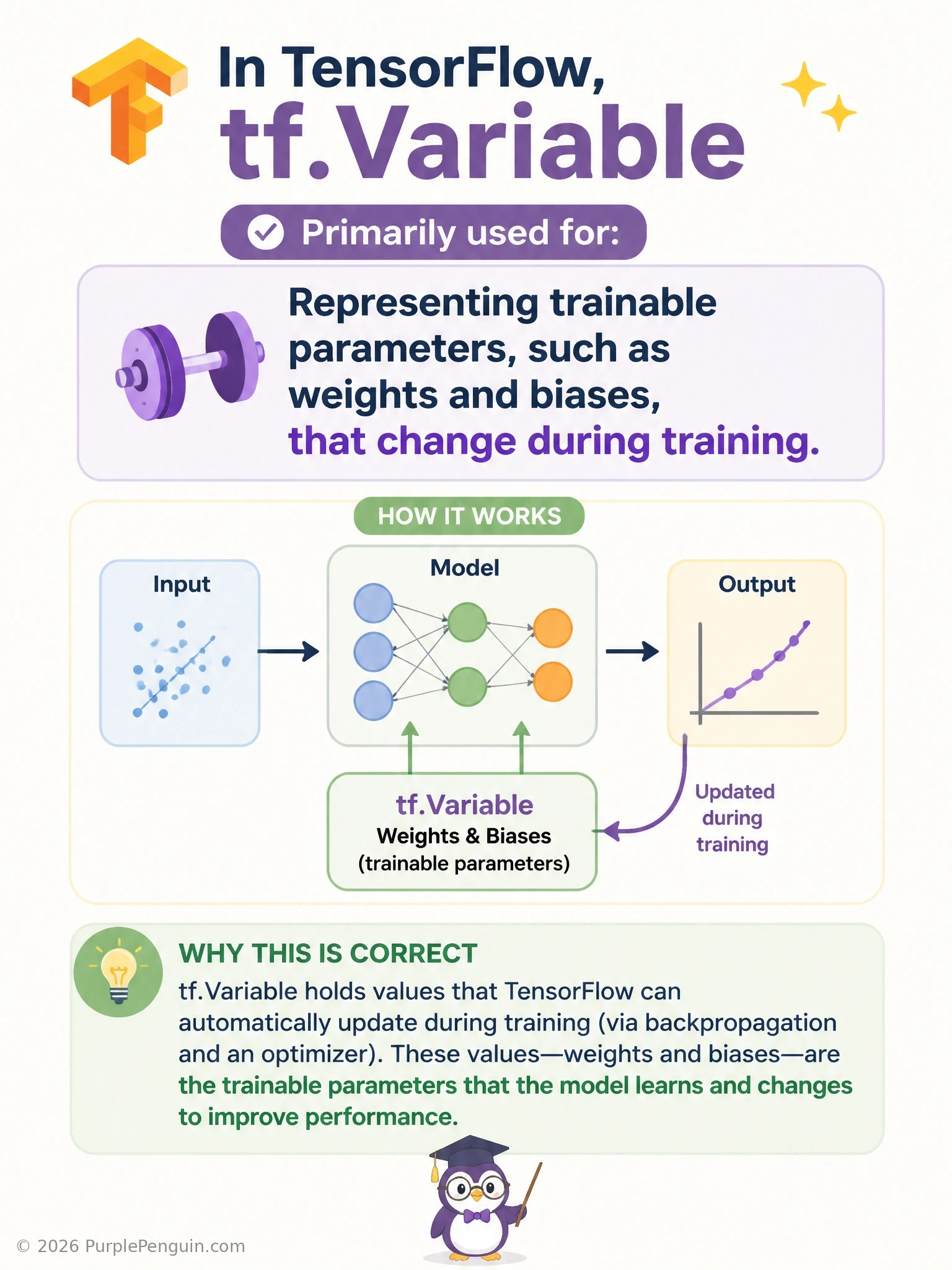
A tf.Variable is TensorFlow's way of saying 'this value is allowed to change over time and I need to track it.' That's exactly what weights and biases are — they start at some initial value and get nudged, step after step, by the optimizer during training. So tf.Variable is built specifically to hold those trainable parameters, and that's your answer. Input data doesn't need this — it's usually held in a regular tensor or fed through a dataset pipeline, since it isn't being updated by the optimizer. String labels are just data too, not something the model learns and adjusts. And hyperparameters like learning rate or batch size are decisions you make before training starts — they're config values, not learned parameters the network optimizes. tf.Variable is reserved for the stuff that actually gets trained.
Full explanation below image
Full Explanation
A tf.Variable in TensorFlow is a special tensor-like object designed to hold mutable state that persists across multiple calls and can be updated in place, most importantly the trainable parameters of a model — weights and biases. Unlike a regular tf.Tensor, which is immutable once created, a tf.Variable can be reassigned or updated (for example, via assign(), assign_add(), or automatically through an optimizer's apply_gradients() call). During training, TensorFlow's automatic differentiation (via tf.GradientTape) computes gradients of the loss with respect to these variables, and the optimizer then applies updates directly to them. This makes tf.Variable the correct mechanism for representing quantities that must both hold a current value and be updated over time based on gradients.
Storing the fixed input data fed into the model is incorrect because input data is not something the model learns or updates; it is typically represented as a regular tf.Tensor or streamed through a tf.data.Dataset pipeline. Since input batches change from step to step and are not modified by the optimizer, there is no need for the mutable, gradient-trackable behavior that tf.Variable provides.
Holding string labels for a classification dataset is also incorrect for similar reasons: labels are part of the dataset, not learnable parameters. They may be encoded as tensors (often converted to integer or one-hot form) but are not wrapped in a tf.Variable, since they are not updated during training.
Recording hyperparameters chosen before training, such as learning rate schedules, batch size, or number of epochs, is a configuration concern. While some hyperparameters (like an adaptive learning rate) may occasionally be implemented as a tf.Variable if they need to change during training in a tracked way, the general case of fixed, pre-chosen hyperparameters does not require this mechanism — they are typically plain Python values or configuration objects.
Memory aid: if a value needs to be updated by gradient descent and persist across training steps, it belongs in a tf.Variable; if it is fixed, computed fresh each step, or set once outside the training loop, a regular tensor or plain value suffices.