During data preprocessing with pandas, when is it most appropriate to use a Python lambda function with .apply()?
Select an answer to reveal the explanation.
Short Explanation and Infographic
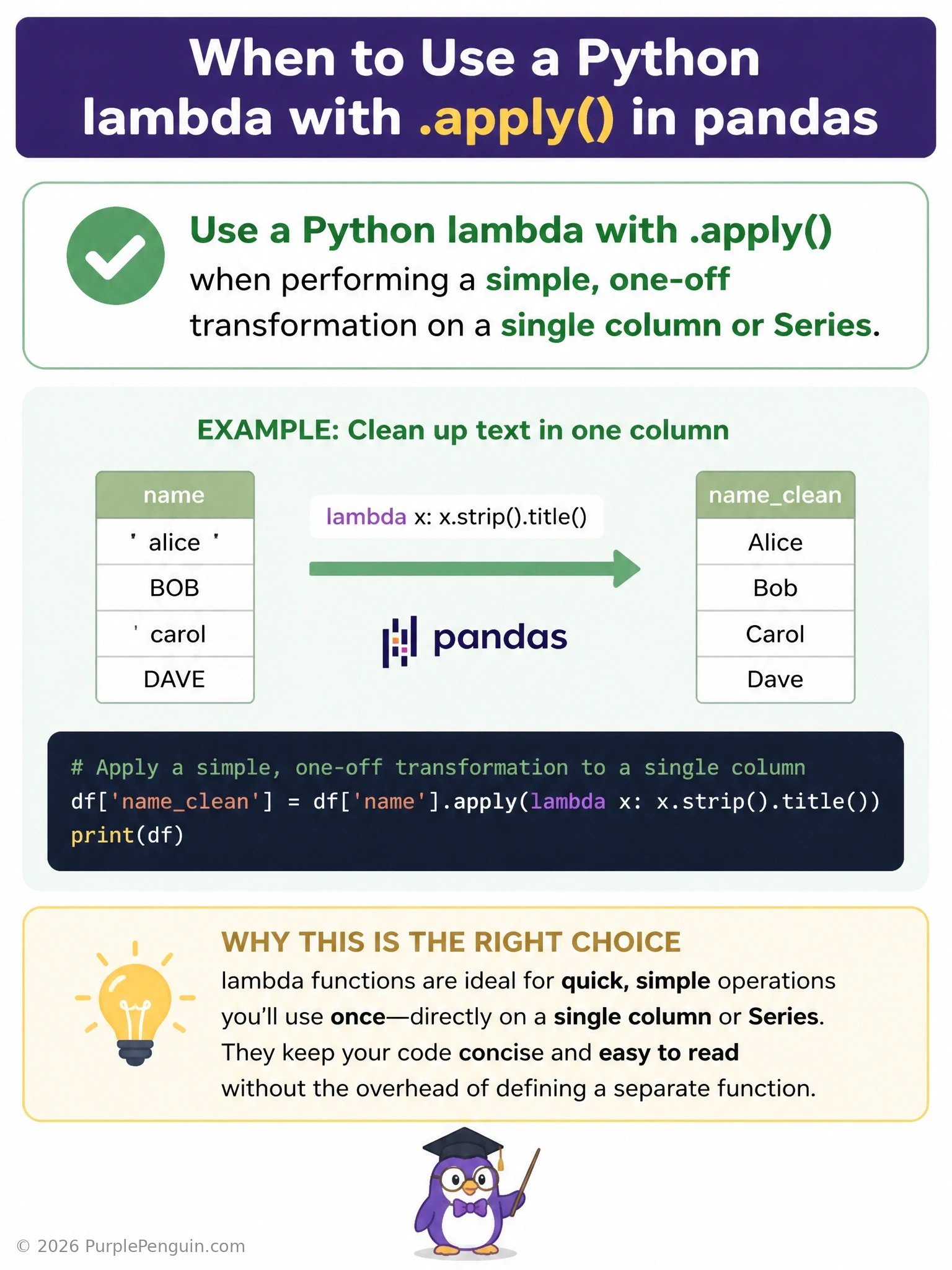
A lambda in pandas is your quick, throwaway tool for small jobs — you reach for it when you need to do one simple thing to a column, like stripping whitespace, converting units, or tweaking a value based on a quick condition, and it's not worth writing a whole named function for. That one-off, simple-transformation use case is exactly what lambdas are for, so that's the right answer. Training a full CNN is a massive, structured task involving layers, optimizers, and loops — nowhere near what a one-line anonymous function can or should handle. Saving model weights is a serialization task, usually handled by framework-specific save methods, not a row-by-row data transform. And designing an entire production ETL pipeline needs proper structure, testing, and maintainability — burying that logic in anonymous lambdas would make it a nightmare to debug and reuse.
Full explanation below image
Full Explanation
Python's lambda keyword creates small, anonymous, inline functions, and in a pandas preprocessing context they are most useful when applied via .apply() (or similar methods like .map()) to perform a simple, self-contained transformation on a column or Series — for example, lambda x: x.strip().lower() to clean a text column, or lambda x: x * 1.1 to apply a quick unit conversion. Lambdas shine here because the transformation is small enough that defining a full named function with def would add unnecessary verbosity for a single, throwaway use.
Training a full convolutional neural network from scratch is an entirely different order of complexity: it involves defining a multi-layer architecture, forward and backward passes, an optimizer, a training loop across many epochs, and validation logic. None of this can be reasonably expressed as a single-expression anonymous function, and doing so would violate basic software engineering principles around readability and maintainability.
Persisting a trained model's weights to disk is a serialization task typically handled by framework-provided methods, such as torch.save() in PyTorch or model.save() / the SavedModel format in TensorFlow/Keras. This operation has nothing to do with row- or column-wise data transformation and is not something a lambda inside .apply() would perform.
Defining an entire multi-stage ETL (extract, transform, load) pipeline for a production system requires modular, testable, well-documented code, often organized into classes, configuration files, and orchestration frameworks (such as Airflow or a custom pipeline library). Cramming this level of logic into anonymous lambda functions would harm readability, make debugging difficult, and violate best practices for production-grade code, even though individual steps within such a pipeline might still use small lambdas for specific column transformations.
The underlying principle: lambdas trade named-function clarity for brevity, so they are appropriate only for small, localized, easily-understood operations — exactly the kind of simple one-off column or Series transformation common in exploratory or lightweight preprocessing, not for complex or long-lived logic.