A new team member asks what the term 'pipeline' refers to in the context of a deep learning project. What is the best description?
Select an answer to reveal the explanation.
Short Explanation and Infographic
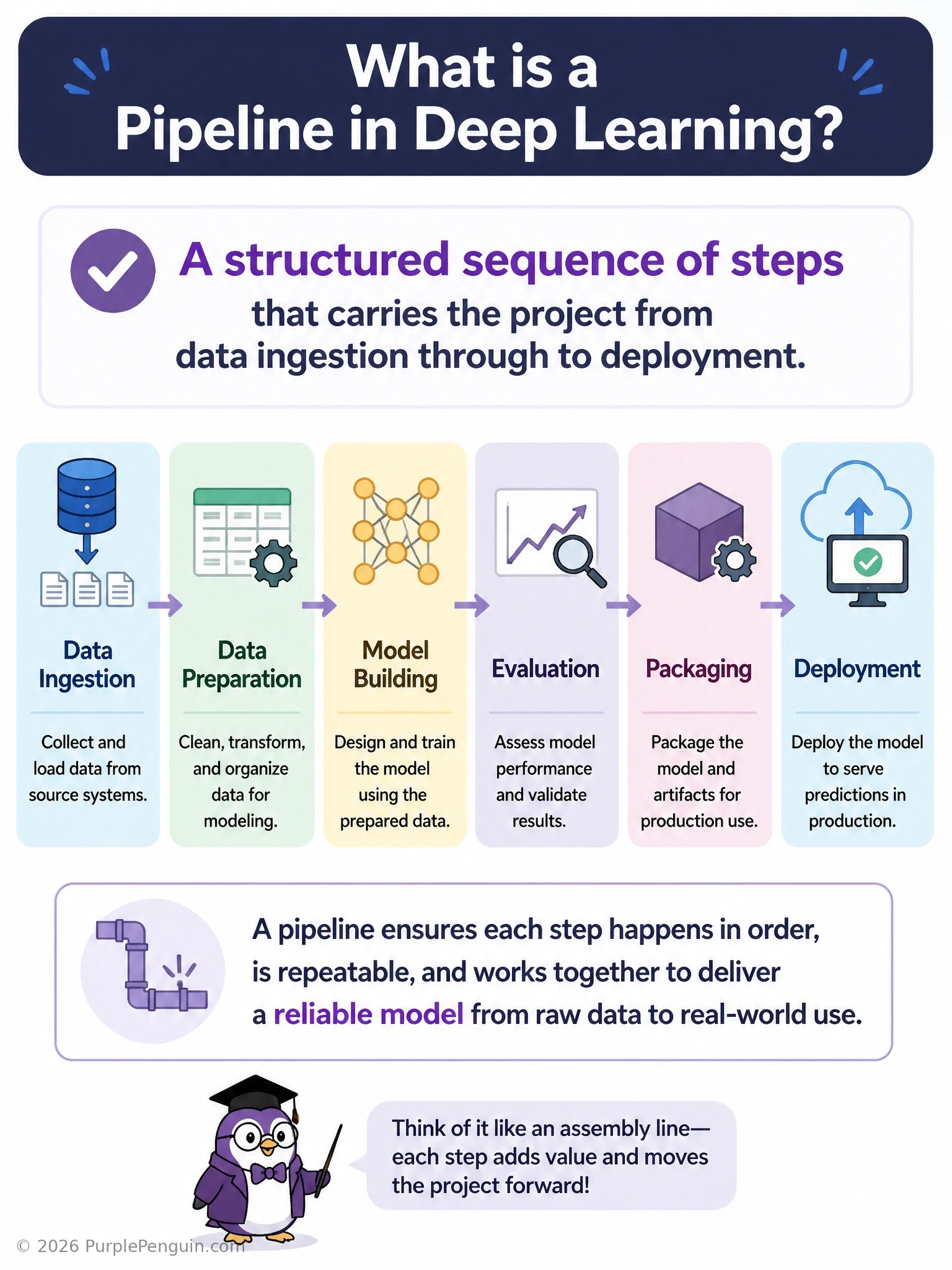
When someone says 'pipeline' on a deep learning project, they're talking about the whole journey your project takes — not one function, not one script. It's the structured sequence: pulling in raw data, cleaning and preprocessing it, splitting it, training the model, evaluating it, and eventually deploying it, often with each stage feeding cleanly into the next. That's the correct answer. A single loss-computing function is just one tiny piece of the training stage, way too narrow to be 'the pipeline.' Hardware configuration is infrastructure, not workflow — GPUs and machines support the pipeline but aren't what the term describes. And a plotting tool for training curves is just a monitoring utility, one small helper you might use during the training stage, not the end-to-end process itself. Pipeline means the whole road, start to finish.
Full explanation below image
Full Explanation
In a deep learning project, a pipeline refers to the structured, often automated, sequence of stages that takes a project from raw data all the way to a deployed model. A typical pipeline includes data ingestion (pulling data from sources such as files, databases, or APIs), preprocessing and cleaning, feature engineering, splitting into train/validation/test sets, model training, evaluation against validation and test metrics, and finally packaging and deploying the trained model for inference. Well-designed pipelines are often reproducible and modular, meaning each stage can be rerun or swapped independently, and many teams formalize pipelines using tools such as scikit-learn Pipeline objects, TensorFlow Extended (TFX), Kubeflow Pipelines, or custom orchestration scripts.
Describing a pipeline as a single Python function that computes the loss for one batch conflates the pipeline with one small piece of the training loop. Loss computation is an important but narrow operation that happens repeatedly within the training stage; it says nothing about data ingestion, preprocessing, evaluation, or deployment, all of which the term 'pipeline' is meant to capture.
Describing it as the specific hardware configuration confuses infrastructure with workflow. GPUs, TPUs, or CPU clusters are the physical or virtual resources that execute pipeline stages, but the pipeline itself is the logical sequence of steps, independent of which hardware ultimately runs them. The same pipeline could, in principle, run on different hardware.
Describing it as a visualization tool for training curves mistakes a monitoring utility (such as TensorBoard or a custom plotting script) for the entire workflow. Visualization tools are useful during the training and evaluation stages to observe metrics like loss and accuracy over epochs, but they are diagnostic aids within one stage, not the end-to-end process.
The underlying principle: a pipeline is the architecture of the whole project's data and model lifecycle, encompassing ingestion, preprocessing, training, evaluation, and deployment as connected, sequential (or parallelizable) stages — not any single function, machine, or tool used along the way.