What is the main objective when a data scientist applies standardization to a numeric feature before training?
Select an answer to reveal the explanation.
Short Explanation and Infographic
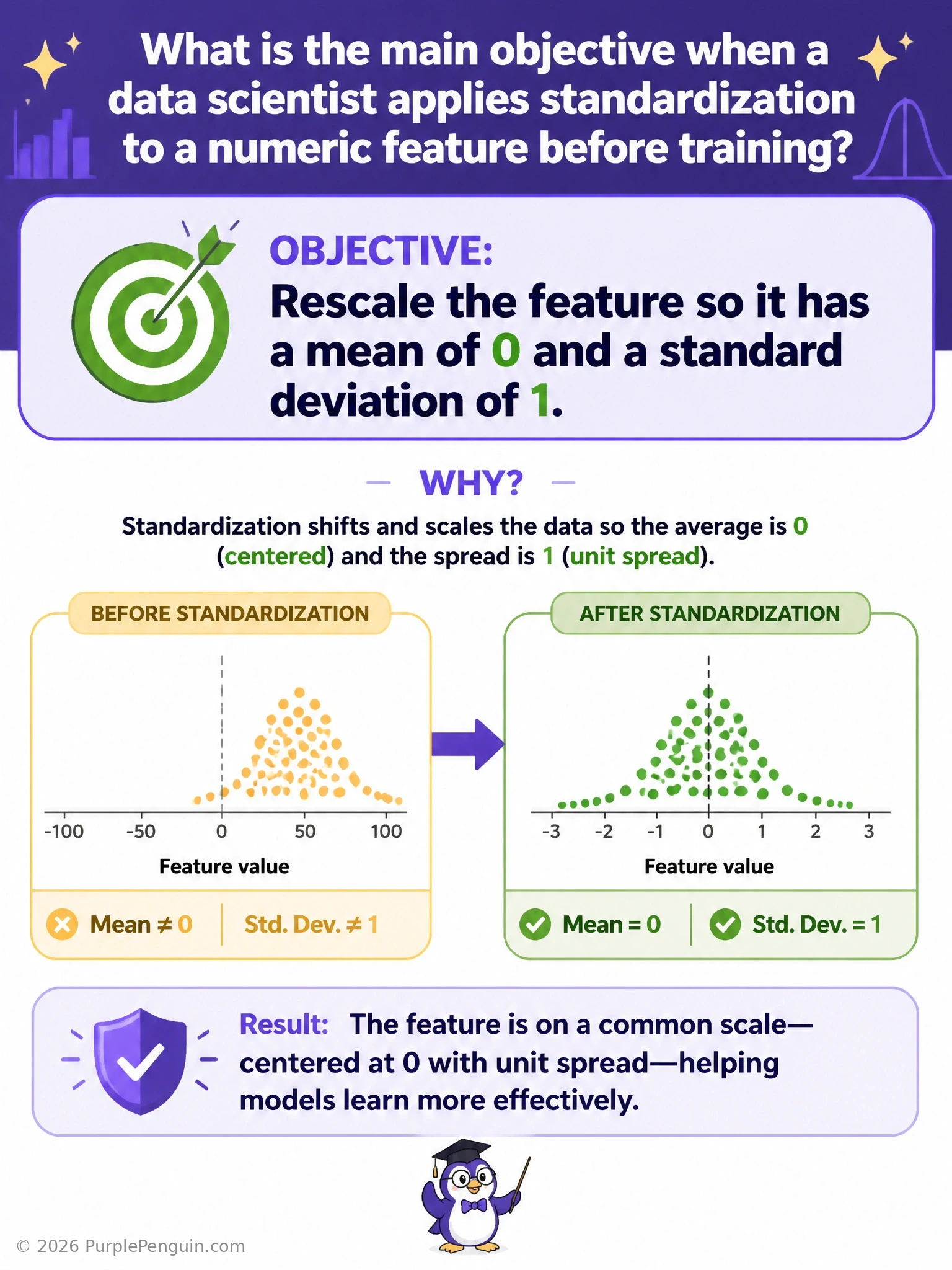
Standardization has one job: take a feature and reshape its distribution so it's centered at 0 with a spread of 1 standard deviation. You do this by subtracting the mean and dividing by the standard deviation for every value — that's the z-score transform. That's the correct answer. It's easy to mix this up with min-max normalization, which squashes values into [0, 1] instead — that's a different technique with a different formula and a different goal. Filling in missing values with the median is imputation, a totally separate preprocessing concern about handling gaps in your data, not about scale. And binning continuous values into discrete categories is discretization, again a different tool for a different job. Standardization is specifically about mean and spread — nothing else.
Full explanation below image
Full Explanation
Standardization, also known as z-score normalization, transforms a numeric feature so that its resulting distribution has a mean of 0 and a standard deviation of 1. This is achieved with the formula z = (x - mean) / standard_deviation, applied independently to each feature (typically using statistics computed only from the training set, then applied to validation/test sets to avoid data leakage). The purpose is to put features on a comparable scale so that no single feature dominates a model's learning simply because of its raw numeric magnitude, and to help gradient-based optimizers converge more smoothly since loss surfaces tend to be better conditioned when inputs share a similar scale.
Compressing values into the range [0, 1] describes min-max normalization, a different scaling technique using the formula (x - min) / (max - min). It shares the general goal of rescaling features but produces a different distribution shape and does not guarantee any particular mean or standard deviation — it is bounded by range, not by moments of the distribution.
Replacing missing values with the column median is a data-imputation technique, addressing missing data rather than scale. Imputation and standardization are often both applied in a preprocessing pipeline, but they solve different problems and are not interchangeable steps.
Converting a continuous feature into discrete bins describes discretization or bucketing, used when a model benefits from treating a continuous variable as categorical (for example, converting age into age-group buckets). This changes the feature's fundamental type and is unrelated to adjusting the scale of a continuous distribution.
Memory aid: standardization aims for mean 0, standard deviation 1 (think 'z-score'); normalization (min-max) aims for a bounded range like [0, 1]. Knowing which formula produces which property is essential for choosing the right preprocessing step for a given model and dataset.