A spam filter classifies a legitimate email as spam. In classification terminology, what is this specific kind of mistake called?
Select an answer to reveal the explanation.
Short Explanation and Infographic
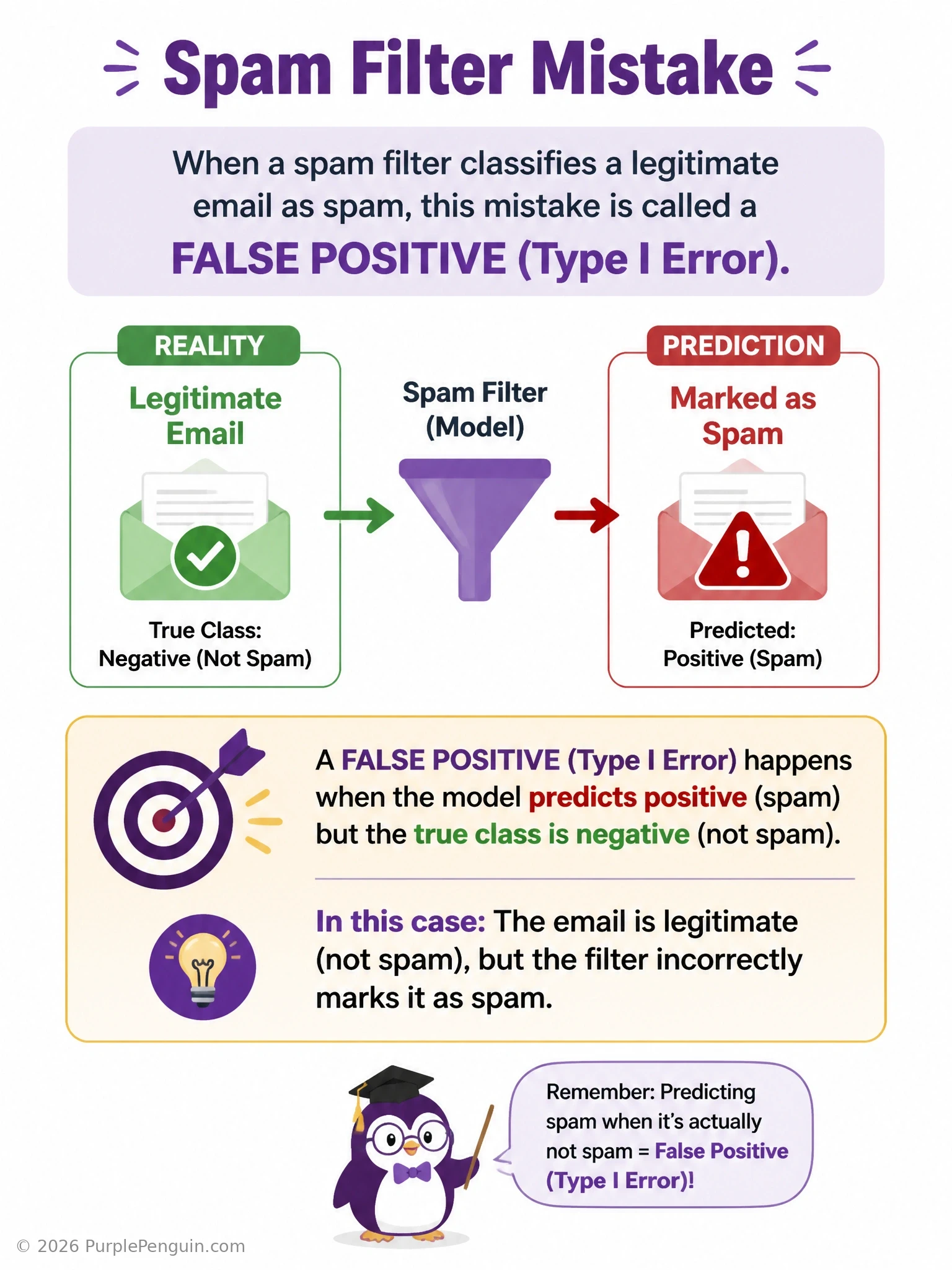
Let's walk through this one carefully, because the terminology trips people up constantly. In a spam filter, 'positive' usually means 'spam' — that's the class the model is watching for. Here, the model predicted spam (positive) but the email was actually legitimate (negative). Predicted positive, true negative — that's the textbook definition of a false positive, which statisticians also call a type I error. That's answer A. A false negative (type II error) would be the opposite mistake: real spam that slipped through into your inbox because the model predicted negative when it should've said positive. A true negative would mean the model correctly said 'not spam' about a legitimate email, which isn't what happened here since the model got it wrong. And calibration error is a totally different animal — that's about whether a model's confidence scores are trustworthy, not about which specific label it assigned.
Full explanation below image
Full Explanation
In binary classification, four outcomes are possible when comparing a model's prediction to the true label: true positive (predicted positive, actually positive), true negative (predicted negative, actually negative), false positive (predicted positive, actually negative), and false negative (predicted negative, actually positive). A false positive, also called a type I error in classical statistics, occurs specifically when the model raises a positive alarm on a case that is actually negative. In the spam filter scenario, if 'spam' is treated as the positive class, a legitimate email being classified as spam is exactly this situation: the model predicted positive (spam) while the ground truth was negative (not spam, i.e. legitimate).
The first distractor describes the opposite error: a false negative, or type II error, would occur if actual spam were classified as legitimate, meaning the model predicted negative when the true class was positive; that is not what happened in this scenario, since the mistake here involved a legitimate (negative) email being mislabeled as spam (positive). The third distractor is incorrect because a true negative requires the model's prediction to match the true label, both being negative (a legitimate email correctly classified as legitimate); since the model made an incorrect prediction here, it cannot be counted as any kind of 'true' (correct) outcome. The fourth distractor describes a concept from probability calibration, which concerns whether a model's predicted confidence scores (e.g., 'I'm 90% sure this is spam') actually reflect the true likelihood of correctness across many predictions; this is a distinct and separate issue from which discrete label a single classification error falls under, and calibration problems do not have their own named error type equivalent to false positive/false negative.
A reliable memory aid: type I error (false positive) is a 'false alarm,' crying wolf about something that wasn't actually there, while type II error (false negative) is a 'missed detection,' failing to notice something that really was there. Which error type matters more depends heavily on context: in spam filtering, false positives (legitimate mail marked as spam) are often considered worse since users may miss important messages, whereas in medical screening, false negatives (missed disease) are often considered far more costly, which is why precision and recall are tracked separately rather than relying on accuracy alone.