An object detection model trains on images where the background class vastly outnumbers rare foreground objects. Which loss function was specifically designed to address this kind of imbalance?
Select an answer to reveal the explanation.
Short Explanation and Infographic
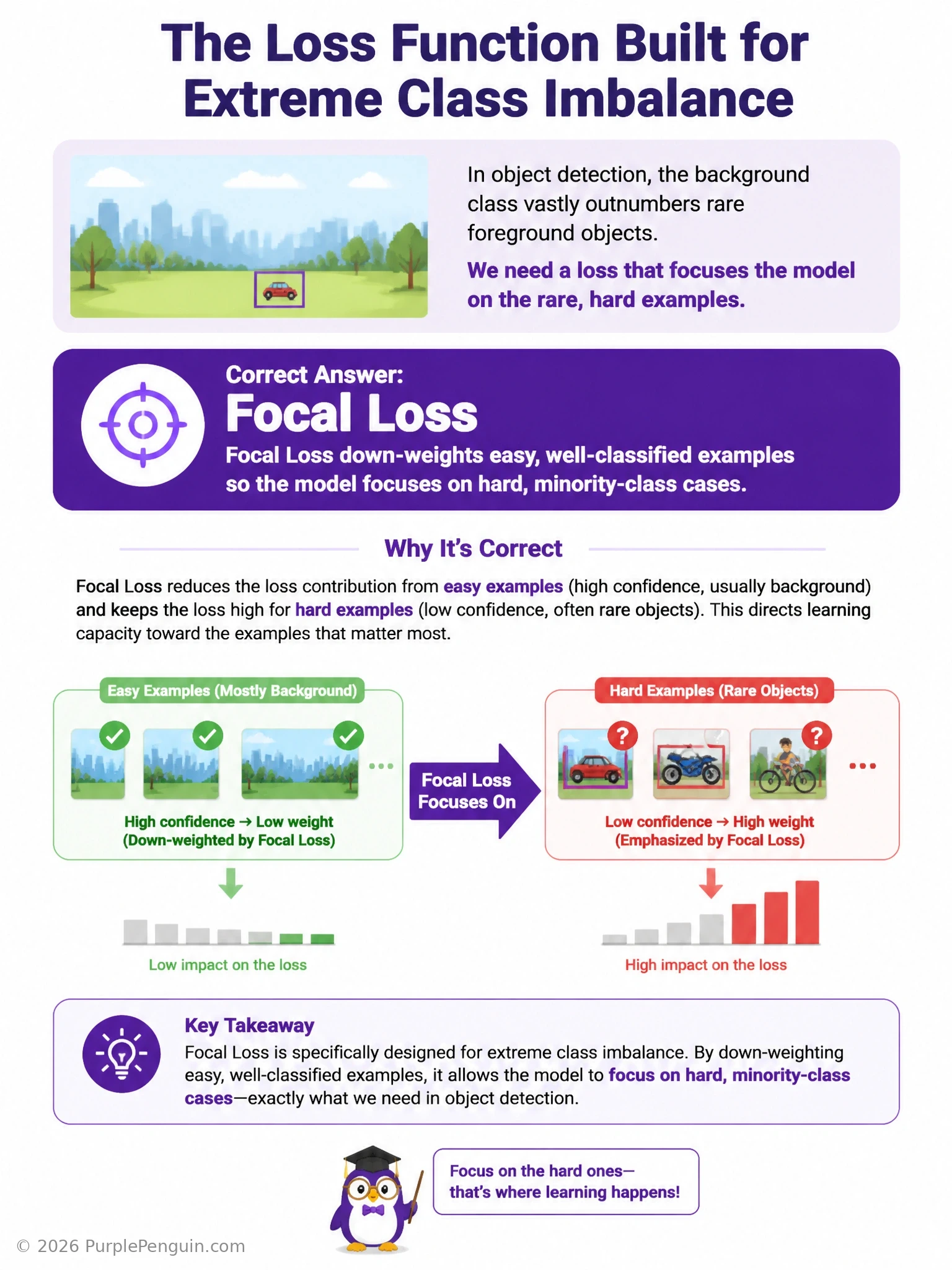
Picture a detector staring at thousands of background pixels and just a handful of actual objects. With standard cross-entropy, all those easy background examples pile up and dominate the loss, even though the model already nails them — wasting effort instead of learning the hard, rare cases. Focal Loss fixes this by adding a modulating factor that shrinks the loss from easy, well-classified examples so harder, minority examples carry more weight. That's answer B, exactly why it caught on in object detection with heavy background-versus-foreground imbalance. Mean squared error has no such mechanism — it treats every error the same regardless of class frequency. Hinge loss isn't restricted to balanced-only problems, and it doesn't tackle imbalance either. Cosine similarity loss measures directional similarity between vectors, useful for embeddings, but unrelated to reweighting hard versus easy examples.
Full explanation below image
Full Explanation
Focal Loss was introduced specifically to combat extreme class imbalance in dense object detection, where the number of easy background (negative) examples can vastly outnumber the rare foreground (positive) object examples in a single image. Standard cross-entropy loss treats every example's contribution equally regardless of how confidently it is already classified, meaning the large volume of easy, correctly-classified background examples can collectively overwhelm the gradient signal and drown out the comparatively few, harder-to-classify foreground examples. Focal Loss modifies cross-entropy by adding a modulating factor, typically written as (1 - p_t)^gamma multiplied against the standard cross-entropy term, where p_t is the model's estimated probability for the correct class and gamma is a tunable focusing parameter; when an example is easy and already classified with high confidence (p_t close to 1), the modulating factor shrinks toward zero, down-weighting its contribution, while hard or misclassified examples (low p_t) retain a much larger loss contribution, focusing training effort where it is needed most.
The first distractor is incorrect because mean squared error, commonly used in regression tasks, applies no special weighting scheme based on classification confidence or class frequency; every squared error contributes proportionally to its magnitude, with no mechanism to suppress the influence of an overwhelming majority of easy examples, making it poorly suited to counter imbalance in classification-style detection tasks. The third distractor mischaracterizes hinge loss, which is used in margin-based classifiers such as support vector machines and is not restricted to, nor specifically designed for, balanced multi-class problems; more importantly, hinge loss has no imbalance-correcting reweighting mechanism analogous to Focal Loss's modulating factor. The fourth distractor describes cosine similarity loss, typically used to encourage or penalize the directional alignment between embedding vectors (common in metric learning or retrieval tasks), which addresses a completely different objective (vector direction similarity) rather than class imbalance in a classification or detection setting.
A helpful memory aid: Focal Loss 'focuses' the model's attention on hard examples by literally down-weighting easy ones, hence the name. It's especially associated with the RetinaNet object detector, where it directly addressed the extreme foreground-background imbalance that had historically limited the accuracy of single-stage detectors compared to two-stage approaches that used explicit sampling heuristics to manage the same problem.