What is the primary objective the Adam optimizer is trying to achieve during training?
Select an answer to reveal the explanation.
Short Explanation and Infographic
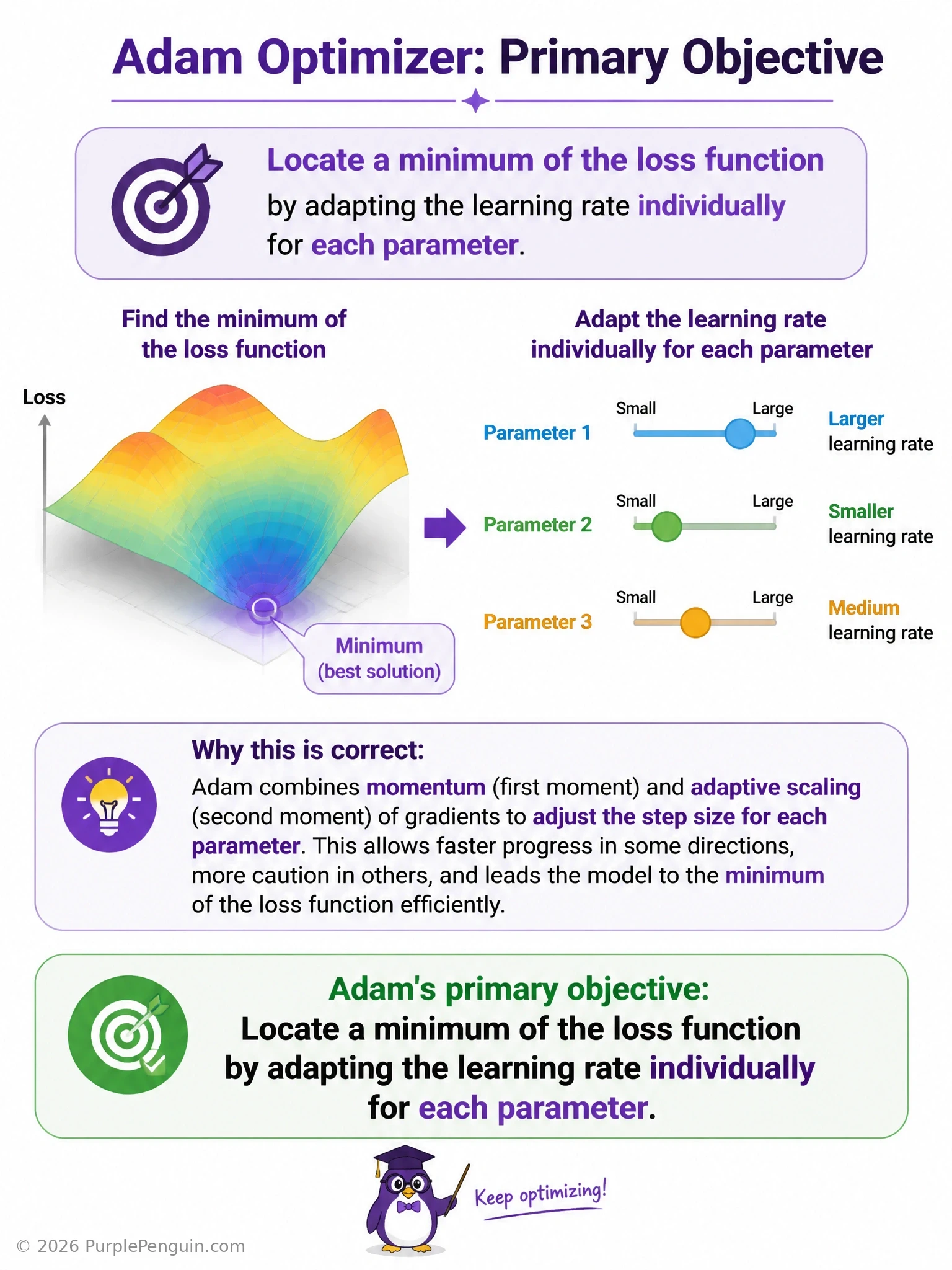
At its core, Adam has one job: help the network find a minimum of the loss function efficiently, by giving each parameter its own adaptive learning rate instead of forcing every weight to use the same step size. Some weights need bigger updates, others need to tread carefully, and Adam figures that out on the fly using running averages of gradients and squared gradients. That's answer D. It doesn't guarantee the global minimum — nothing in deep learning can promise that on non-convex loss landscapes, you can still get stuck in a local minimum or saddle point. It doesn't make validation sets obsolete either — you still need one to catch overfitting. And it's still a gradient-based method built on backpropagation, not a replacement for it.
Full explanation below image
Full Explanation
Adam's primary goal, like all gradient-based optimizers, is to iteratively adjust a model's weights to minimize a loss function. What distinguishes Adam is how it pursues that goal: rather than applying one single global learning rate uniformly to every parameter, Adam computes an adaptive, per-parameter learning rate by combining a decaying average of past gradients (for directional smoothing) with a decaying average of past squared gradients (for magnitude scaling). This lets parameters that have historically received large or noisy gradients take smaller, more cautious steps, while parameters that have received small or infrequent gradients take relatively larger steps, generally leading to faster and more stable convergence toward a minimum than plain SGD with a single fixed rate.
The first distractor is incorrect because no gradient descent variant, including Adam, can guarantee convergence to the global minimum of a non-convex loss surface, which is the norm in deep neural networks; Adam can still become stuck in local minima, plateaus, or saddle points, though its adaptive step sizes and momentum-like smoothing often help it escape shallow saddle regions in practice, this is a practical benefit, not a mathematical guarantee. The second distractor is incorrect because Adam has no built-in mechanism to detect or prevent overfitting; overfitting is a separate concern addressed through techniques like regularization, dropout, or early stopping, all of which typically still rely on monitoring a validation set, a step Adam does not eliminate. The third distractor is incorrect because Adam is very much a gradient-based method; it computes its adaptive updates directly from gradients produced by backpropagation, and cannot function as a gradient-free optimizer. The correct answer accurately describes Adam's actual mechanism: its per-parameter adaptive learning rate is exactly the tool it uses to pursue efficient minimization of the loss function.
A good mental model is that Adam's mission is 'efficient descent with per-parameter common sense': instead of treating every weight identically, it tailors the step size to that weight's own gradient history, which is precisely why it has become a default choice for training deep networks across many domains, from computer vision to NLP.