What is the main strength of the F1 score as an evaluation metric for a classifier trained on imbalanced classes?
Select an answer to reveal the explanation.
Short Explanation and Infographic
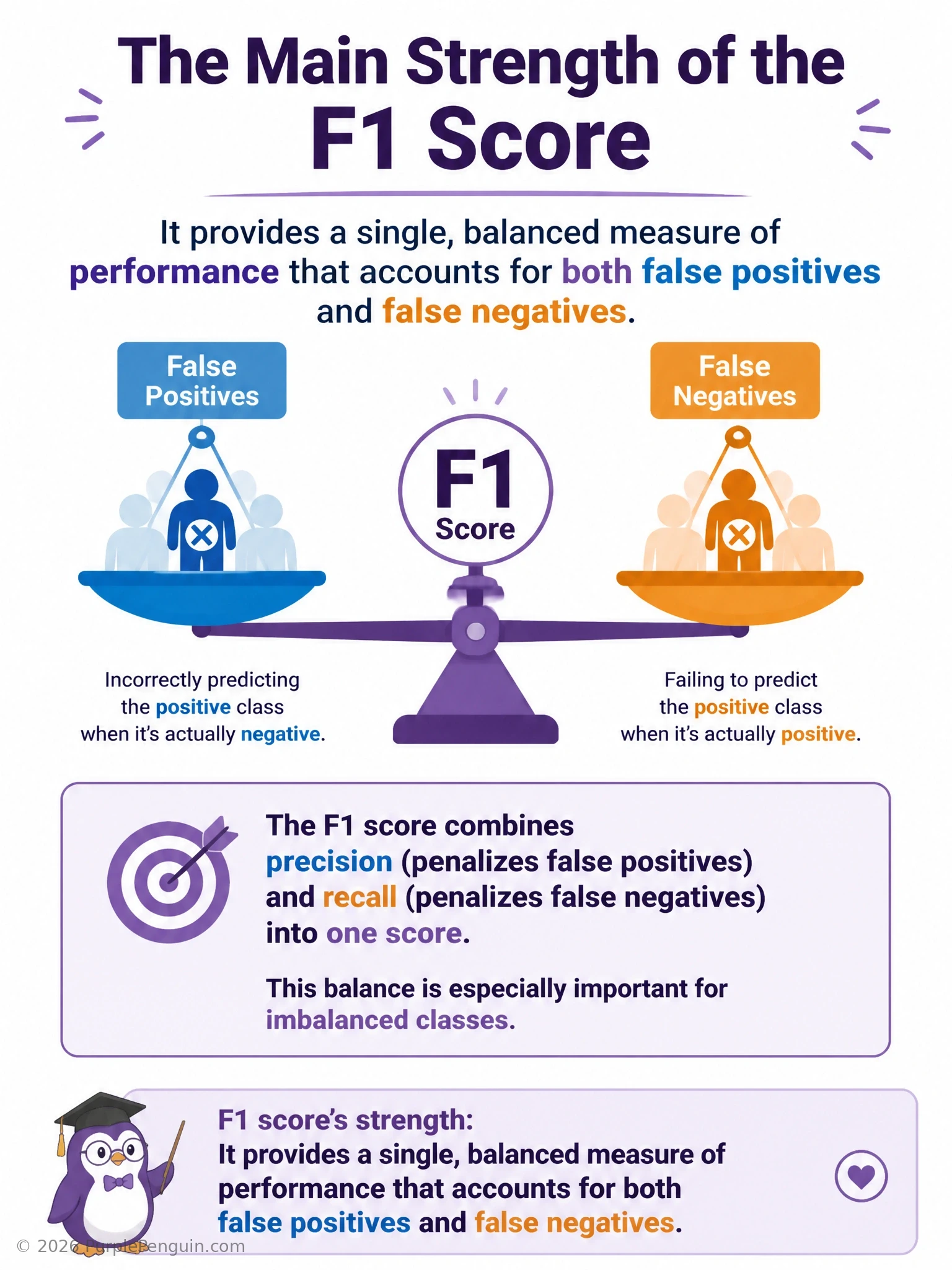
The F1 score's superpower is giving you one number that doesn't let a model get away with lopsided performance. It's the harmonic mean of precision and recall, and because it's a harmonic mean rather than a plain average, F1 punishes the score hard if either precision or recall is weak — a model can't just crush it on one and coast on the other. That makes F1 a genuinely balanced measure that's honest about both false positives and false negatives at once. That's answer B. It doesn't only reward the majority class — quite the opposite, F1 is specifically built to expose weak minority-class performance that accuracy would hide. It doesn't ignore the minority class either, it's centered on the positive class's precision and recall. And it's not tied directly to training loss — a model's F1 score on validation or test data can behave very differently from its training loss curve, since one measures classification quality and the other measures optimization progress.
Full explanation below image
Full Explanation
The F1 score is defined as the harmonic mean of precision and recall: F1 = 2 (precision recall) / (precision + recall). Because the harmonic mean is dominated by the smaller of its two inputs, the F1 score drops sharply if either precision or recall is low, even if the other is high. This property makes F1 a genuinely balanced single-number summary of a classifier's performance on the positive class, which is especially valuable on imbalanced datasets where accuracy is misleading and where looking at precision or recall alone can hide a serious weakness in the other.
The first distractor is incorrect because the F1 score is computed with respect to the positive (often minority) class's precision and recall, not the majority class — it is specifically designed to surface how well a model handles the class that's harder or rarer to predict correctly, not to reward majority-class performance. The second distractor (ignoring the minority class) is the opposite of what F1 does; F1 exists precisely because metrics that ignore or dilute minority-class performance, like plain accuracy, are inadequate on imbalanced data, whereas F1 centers its calculation on the positive class's outcomes. The third distractor is incorrect because F1 is an evaluation metric computed from model predictions versus true labels on a held-out set — it is not mathematically or empirically guaranteed to track training loss, since training loss reflects optimization progress on the training objective while F1 reflects classification quality (often on validation or test data), and the two can diverge, for example when a model overfits.
F1 is especially useful when there is no clear preference between minimizing false positives (favoring precision) and minimizing false negatives (favoring recall), and a single balanced metric is needed for model comparison or hyperparameter selection. Variants exist for different needs: the F-beta score generalizes F1 by weighting recall beta times as much as precision (useful when one error type genuinely matters more than the other), and macro/micro/weighted F1 averaging schemes extend the concept to multi-class classification problems.