A classifier achieves a recall of 1.0 on the positive class. What does this tell you?
Select an answer to reveal the explanation.
Short Explanation and Infographic
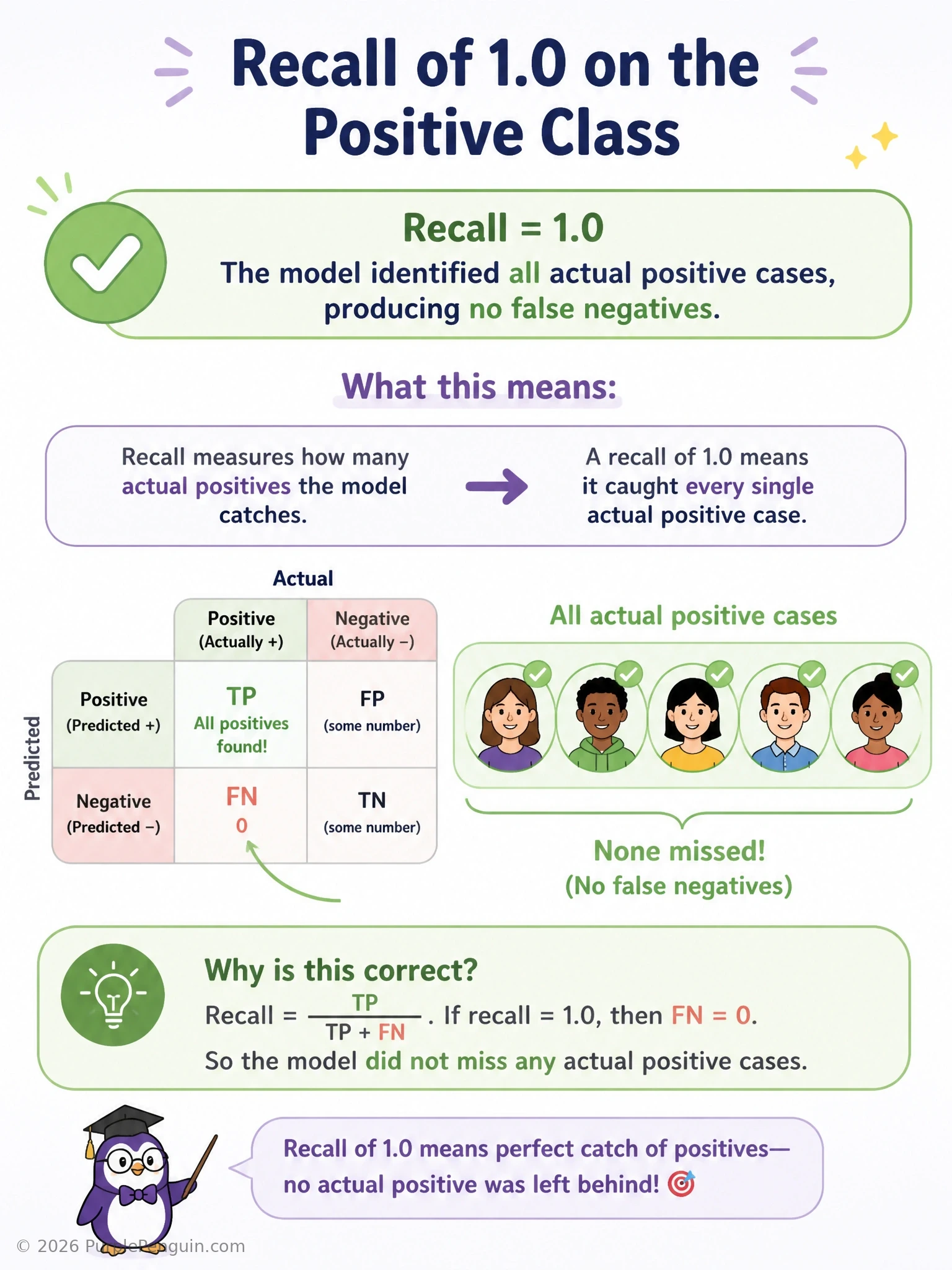
A recall of 1.0 means the model caught every single actual positive case out there — zero false negatives, full stop. Nothing positive slipped through undetected. That's answer B. But here's the trap in this question: recall of 1.0 says nothing about how many false positives the model also produced along the way. A model that just predicts "positive" for absolutely everything would also score a perfect recall of 1.0, because it never misses a true positive — it just also floods you with false alarms. That's why the first option is wrong: perfect recall doesn't mean every prediction was correct, it only means every actual positive was caught. And precision being 1.0 too is definitely not guaranteed — recall and precision are independent axes, you can max one out while the other tanks. The negative-class option is also wrong; the model absolutely could still predict negative sometimes, recall only tracks what happens to the actual positive cases.
Full explanation below image
Full Explanation
Recall is defined as TP / (TP + FN), the proportion of actual positive cases that the model correctly identifies. A recall of 1.0 means that every true positive case in the evaluated data was correctly flagged by the model, and the false negative count is zero — no actual positive case was missed. This is a statement purely about the model's coverage of the positive class; it says nothing about how many negative-class examples were incorrectly flagged as positive.
The first distractor is incorrect because it conflates recall with overall predictive correctness. A trivial model that predicts "positive" for every single example would achieve a perfect recall of 1.0 (since it never misses any actual positive), while simultaneously producing a false positive for every actual negative example, meaning far from "every prediction" being correct. The third distractor is incorrect because precision (TP / (TP + FP)) and recall are computed from different quantities and are not mathematically linked in a way that guarantees one from the other; a model can achieve perfect recall while having very poor precision (as in the always-predict-positive example above), demonstrating that recall of 1.0 does not imply precision of 1.0. The fourth distractor is incorrect because recall says nothing about whether or how often the model predicts the negative class; a model could still correctly (or incorrectly) predict negative for various examples while still achieving perfect recall, as long as it never misses an actual positive case — recall is entirely defined in terms of the actual positive population, not the model's negative predictions.
In practice, recall of 1.0 is often trivially achievable (by predicting positive for everything) and is therefore rarely meaningful in isolation; it must be considered alongside precision to understand the real tradeoff being made. This is precisely why combined metrics like the F1 score, or an explicit look at the precision-recall curve, are used to evaluate classifiers meaningfully rather than optimizing recall (or precision) alone without regard to the other.