In classification evaluation, what is a false negative (type II error)?
Select an answer to reveal the explanation.
Short Explanation and Infographic
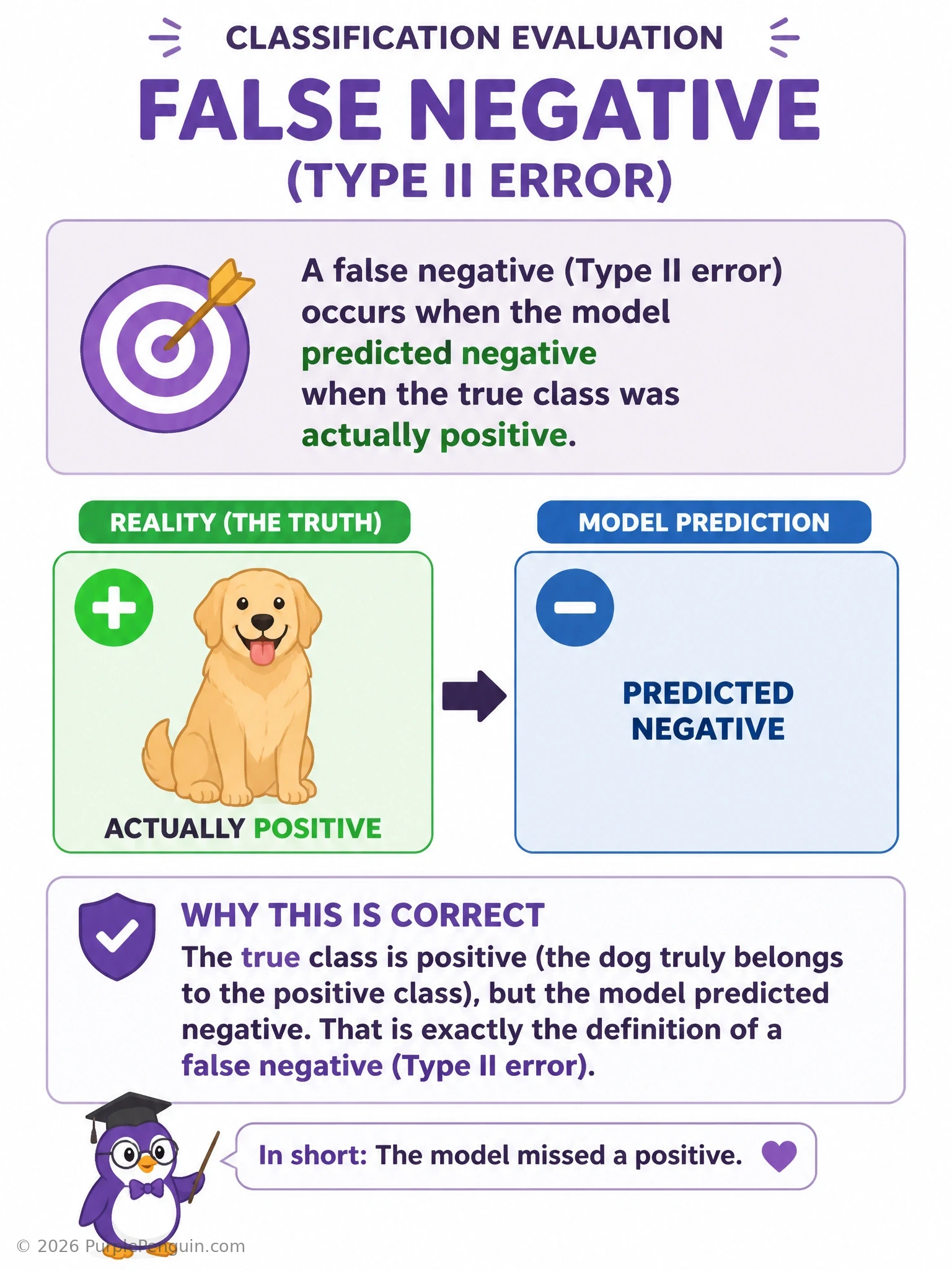
A false negative is when your model says "nope, nothing here" but there actually WAS something there — it predicted negative when the true class was positive. Think of a medical test that comes back clear on a patient who actually has the disease; the test missed it, that's a false negative, that's answer B. Predicting positive when the truth is negative is the opposite mistake — that's a false positive, type I error. Predicting negative when the truth is genuinely negative isn't an error at all, that's a true negative, a correct call. And predicting positive when the truth is genuinely positive is also a correct call — a true positive. The word "false" tells you the model was wrong, and "negative" tells you which way it was wrong: it said no when the answer was actually yes.
Full explanation below image
Full Explanation
A false negative, also known as a type II error, occurs when a classification model predicts the negative class for an instance whose true label is actually positive. In other words, the model fails to detect a real positive case, incorrectly labeling it as negative. Classic examples include a disease-screening model that classifies a sick patient as healthy, or a fraud-detection model that classifies an actual fraudulent transaction as legitimate — in both cases, the model missed something it should have caught.
The first distractor describes a false positive (type I error): the model predicts positive when the true class is actually negative, such as flagging a healthy patient as sick or a legitimate transaction as fraudulent. This is the complementary error type to a false negative and represents a different kind of mistake with different real-world costs. The third distractor describes a true negative, a correct prediction in which the model predicts negative and the true class is indeed negative — this is not an error at all, but one of the two "correct" outcomes tracked in a confusion matrix. The fourth distractor describes a true positive, the other correct outcome, where the model predicts positive and the true class is indeed positive.
These four outcomes — true positive, true negative, false positive, and false negative — form the entries of a confusion matrix and are the building blocks for virtually every classification metric: precision (TP / (TP + FP)), recall (TP / (TP + FN)), specificity (TN / (TN + FP)), and accuracy ((TP + TN) / total). Understanding false negatives specifically matters because different applications weigh this error type very differently: in medical diagnosis or fraud detection, false negatives (missed positives) are often far costlier than false positives, which is why recall — the metric that directly penalizes false negatives — is frequently prioritized in those domains over precision or accuracy alone.