A classifier is trained on a dataset where 98% of examples belong to the negative class. Which pair of metrics gives a more informative picture of performance than accuracy alone?
Select an answer to reveal the explanation.
Short Explanation and Infographic
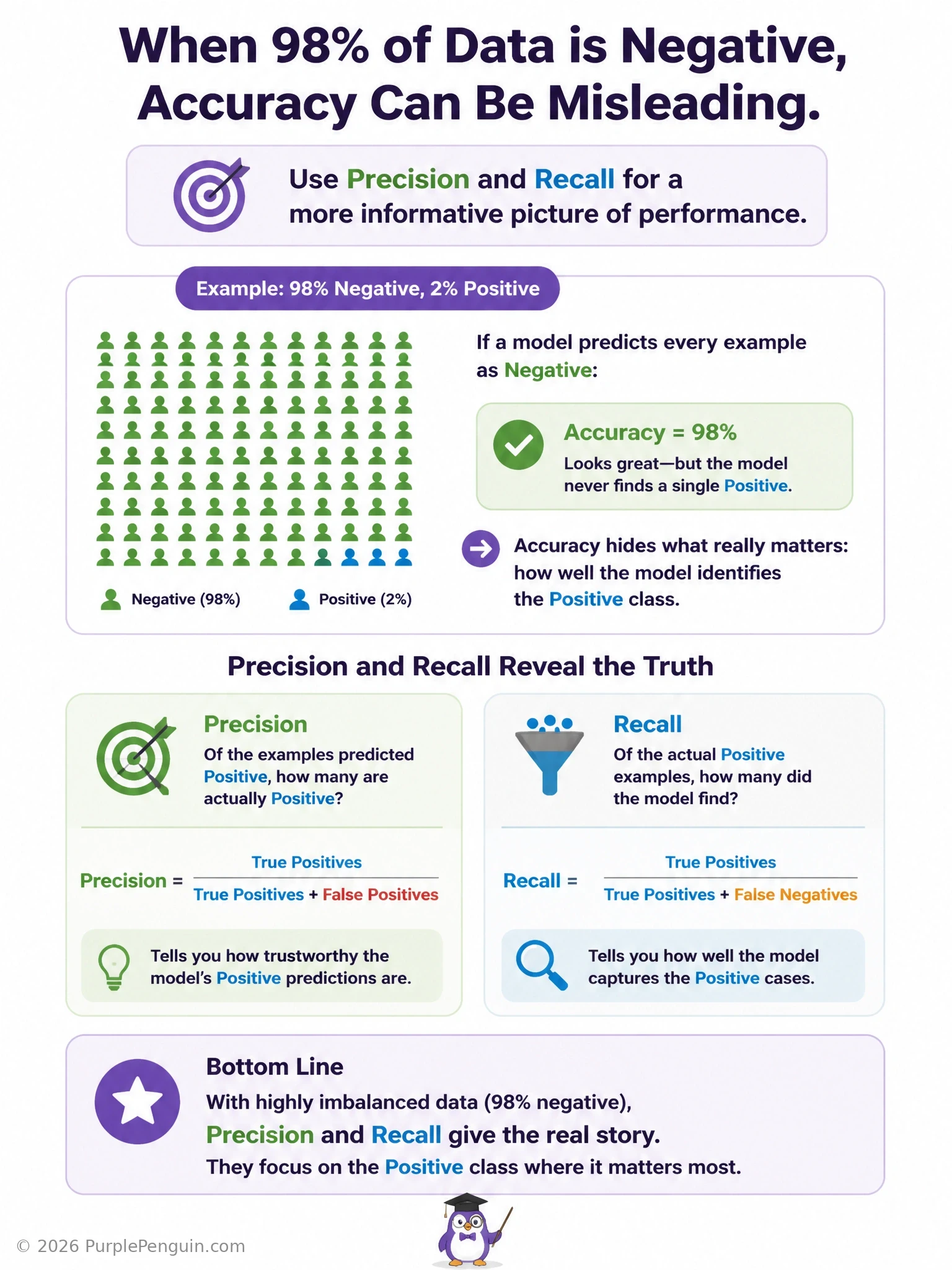
With a dataset that's 98% one class, accuracy becomes almost meaningless — a lazy model that just predicts the majority class every single time would score 98% accuracy while being completely useless at catching the minority class. That's why you turn to precision and recall instead. Precision tells you how trustworthy your positive predictions are, and recall tells you how many of the actual positive cases you actually caught. Together they expose exactly what accuracy hides on imbalanced data. That's answer B. Mean squared error and mean absolute error are regression metrics — they don't even apply to a classification problem like this. Learning rate and batch size are training hyperparameters, not evaluation metrics at all. And epoch count and training time tell you about the training process itself, not how well the model actually performs on the task.
Full explanation below image
Full Explanation
On a severely imbalanced dataset, where one class dominates (here, 98% negative), accuracy becomes a misleading metric because a trivial model that always predicts the majority class can achieve very high accuracy (98% in this case) while providing zero practical value at identifying the minority class. Precision and recall, by contrast, are computed relative to the positive class specifically and expose exactly this kind of failure: a model that never predicts positive would have a recall of 0% (catching none of the actual positive cases), immediately revealing that the model is useless for the task at hand, even though its accuracy looks excellent.
The first distractor, mean squared error and mean absolute error, are regression metrics used to evaluate numeric prediction error and do not apply to a classification task with discrete class labels; they measure the wrong kind of output entirely for this scenario. The third distractor, learning rate and batch size, are training hyperparameters that govern how the optimizer updates weights during training — they are configuration choices made before or during training, not metrics used to evaluate a trained model's predictive performance. The fourth distractor, epoch count and training time, describe how long or how many passes training took; they speak to training cost and duration, not to how well the resulting model actually classifies new examples.
In practice, precision and recall are often examined together via the precision-recall tradeoff, since improving one frequently comes at the expense of the other, and are commonly summarized into a single number using the F1 score (their harmonic mean) when a balanced view is needed. For severely imbalanced problems, practitioners may also examine the precision-recall curve directly (rather than the ROC curve, which can look misleadingly good on imbalanced data), use class weighting or resampling techniques (oversampling the minority class or undersampling the majority class) during training, and consider specialized losses such as focal loss, which down-weights the contribution of easy, well-classified majority-class examples so the model focuses more of its learning capacity on the harder, rarer minority-class examples.