What is cross-validation?
Select an answer to reveal the explanation.
Short Explanation and Infographic
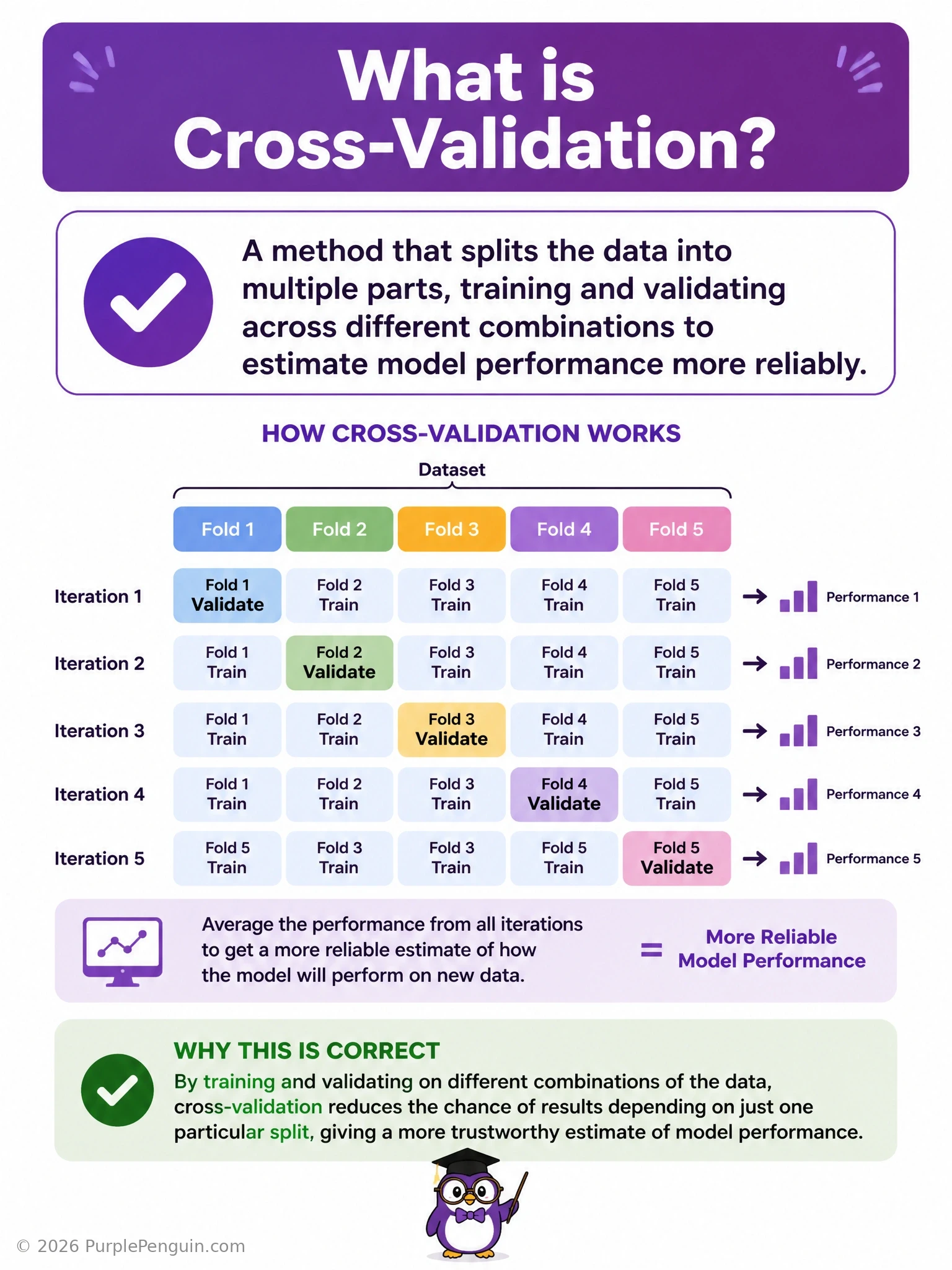
Cross-validation is about getting a trustworthy read on how your model actually performs, instead of relying on just one lucky (or unlucky) train/validation split. Here's the deal: you divide your dataset into several parts, or "folds," then you rotate through them — train on some folds, validate on the one you held out, and repeat until every fold has had a turn being the validation set. Then you average the results. That gives you a much more robust performance estimate than a single static split would. That's answer B. Adding a squared penalty on weights is L2 regularization, not cross-validation. Manually inspecting predictions for bias is a separate fairness/audit process. And automatically reducing the learning rate when validation accuracy drops describes a learning-rate scheduler like ReduceLROnPlateau, a training-time technique, not a data-splitting evaluation strategy.
Full explanation below image
Full Explanation
Cross-validation is a model evaluation technique in which the dataset is partitioned into multiple subsets, commonly called folds, and the model is trained and validated repeatedly across different combinations of those folds. In the most common form, k-fold cross-validation, the data is split into k equally sized folds; the model is trained on k-1 folds and validated on the remaining fold, and this process is repeated k times so that each fold serves as the validation set exactly once. The final performance estimate is typically the average (and sometimes the variance) of the metric across all k runs, giving a more reliable and less variance-prone estimate of how the model will generalize to unseen data than a single train/validation split would provide, since every data point gets used for both training and validation across the process.
The first distractor describes L2 regularization (or weight decay), which adds a penalty term based on the squared magnitude of the model's weights directly into the loss function to discourage overly large weights — an entirely different concept from partitioning data for evaluation. The second distractor describes a manual bias or fairness audit, a qualitative human-review process for checking model outputs for problematic patterns, which is unrelated to the statistical resampling procedure that defines cross-validation. The third distractor describes a learning-rate scheduling technique (such as ReduceLROnPlateau) that automatically lowers the learning rate when a monitored metric stagnates — this happens during a single training run and adjusts an optimizer hyperparameter, whereas cross-validation is about how you structure multiple training/evaluation runs across data splits to estimate generalization performance.
Cross-validation is especially valuable when the dataset is limited in size, since a single fixed train/validation split might, by chance, produce an unusually easy or unusually hard validation set, skewing the performance estimate. Variants include stratified k-fold (which preserves class proportions in each fold, important for imbalanced classification problems), leave-one-out cross-validation (an extreme case where k equals the number of samples), and time-series-aware cross-validation (which respects temporal ordering rather than shuffling data randomly). In large-scale deep learning, full k-fold cross-validation is sometimes impractical due to the computational cost of repeated training, so a single held-out validation set is often used instead, but the underlying principle of cross-validation remains foundational to reliable model evaluation.