What is the 'latent space' in an autoencoder?
Select an answer to reveal the explanation.
Short Explanation and Infographic
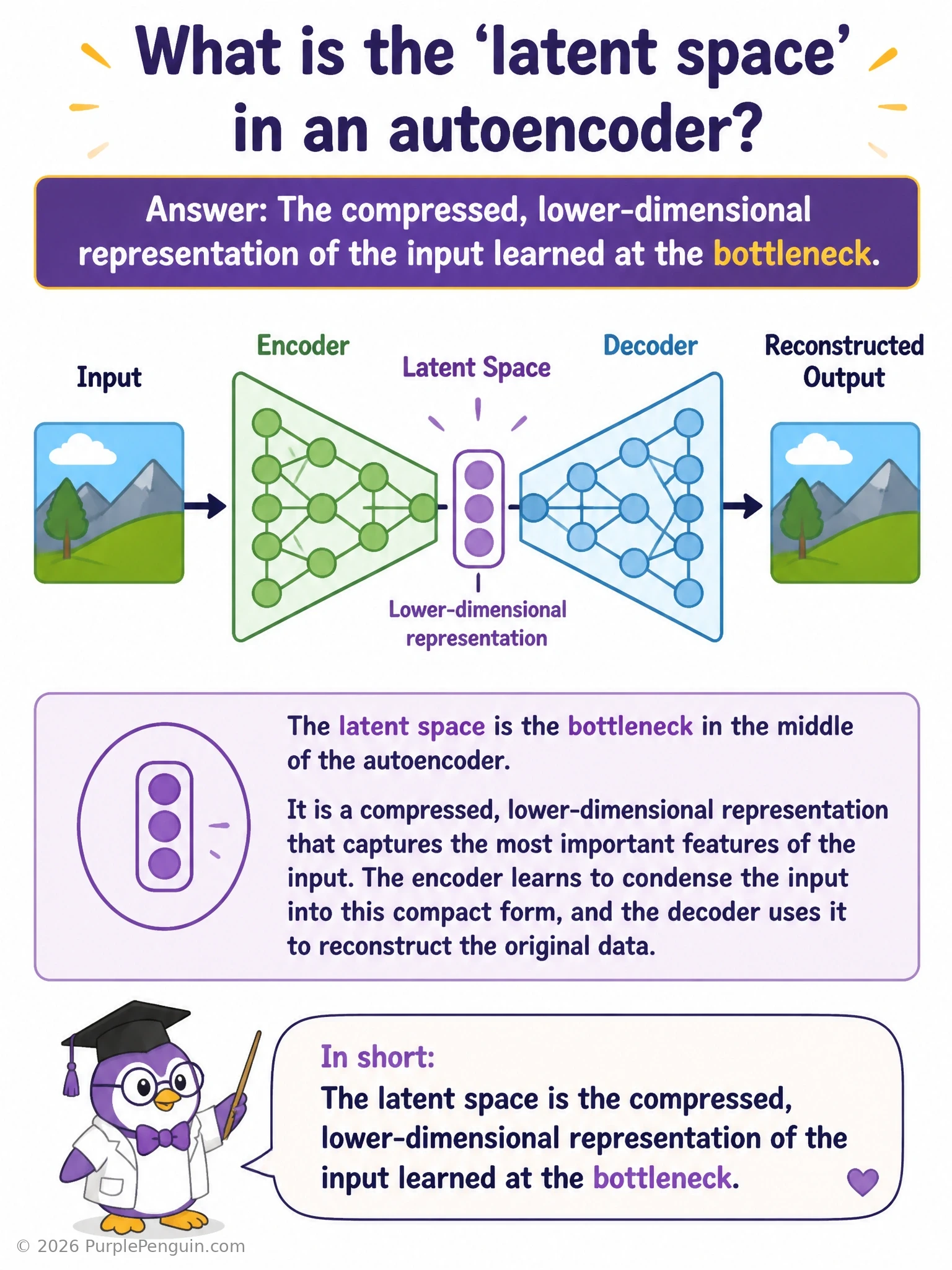
The latent space is basically the 'compressed summary' world that an autoencoder's encoder maps every input into. Instead of working with the full, high-dimensional original data, the network squeezes it down into a smaller set of numbers at the bottleneck, and that lower-dimensional space of possible compressed representations is what we call the latent space. Every input gets mapped to some point in that space, and the decoder's job is to expand a point in that space back out into something resembling the original input. That's why the compressed-representation answer is correct. It's not the training set itself, that's just the raw data used to teach the model. It's not the final reconstructed output either, that's what comes out of the decoder after using a point in latent space, not the space itself. And it's definitely not a list of hyperparameters, those are settings you choose before training, unrelated to the internal representation the network learns.
Full explanation below image
Full Explanation
The latent space of an autoencoder refers to the lower-dimensional space of compressed representations that the encoder learns to map inputs into, centered at the network's bottleneck layer. When an input passes through the encoder, it is progressively transformed and compressed until it becomes a single point (a vector of values) in this lower-dimensional latent space; this point is often called the latent code, latent vector, or embedding for that input. Because the latent space has far fewer dimensions than the original input, the encoder is forced to discard redundant or less important information and retain only the features most useful for reconstructing the input, which means the latent space effectively captures the essential underlying structure or 'concepts' present across the training data. The decoder then takes a point from this latent space and expands it back out, attempting to reconstruct data resembling the original input. In well-trained autoencoders, especially variational autoencoders, the latent space often exhibits useful properties, such as similar inputs mapping to nearby points, which supports downstream uses like clustering, interpolation between examples, anomaly detection (since anomalous inputs tend to map to unusual regions of the latent space or reconstruct poorly), and, for VAEs, sampling new data by drawing points from this space.
The first distractor, the set of all training examples used, describes the original dataset itself, which exists in the original (typically higher-dimensional) input space, not the compressed representation space the network learns internally; the training set is what is fed into the autoencoder, not the internal representation it produces.
The second distractor, the final reconstructed output from the decoder, describes the result of decoding a latent-space point back into the original data format; this reconstructed output exists in the same space as the original input (for example, a reconstructed image), not in the lower-dimensional latent space itself.
The third distractor, a list of hyperparameters, refers to configuration choices made before training (such as learning rate, number of layers, or latent dimension size), which are external settings governing how the model is built and trained, not the internal learned representation the network produces for its inputs.
Memory aid: think of latent space as the 'compressed map' the autoencoder draws of its data, every input gets a coordinate on that map, and the decoder's job is to look up a coordinate and redraw the full picture from it.