In a neural network, what are 'weights'?
Select an answer to reveal the explanation.
Short Explanation and Infographic
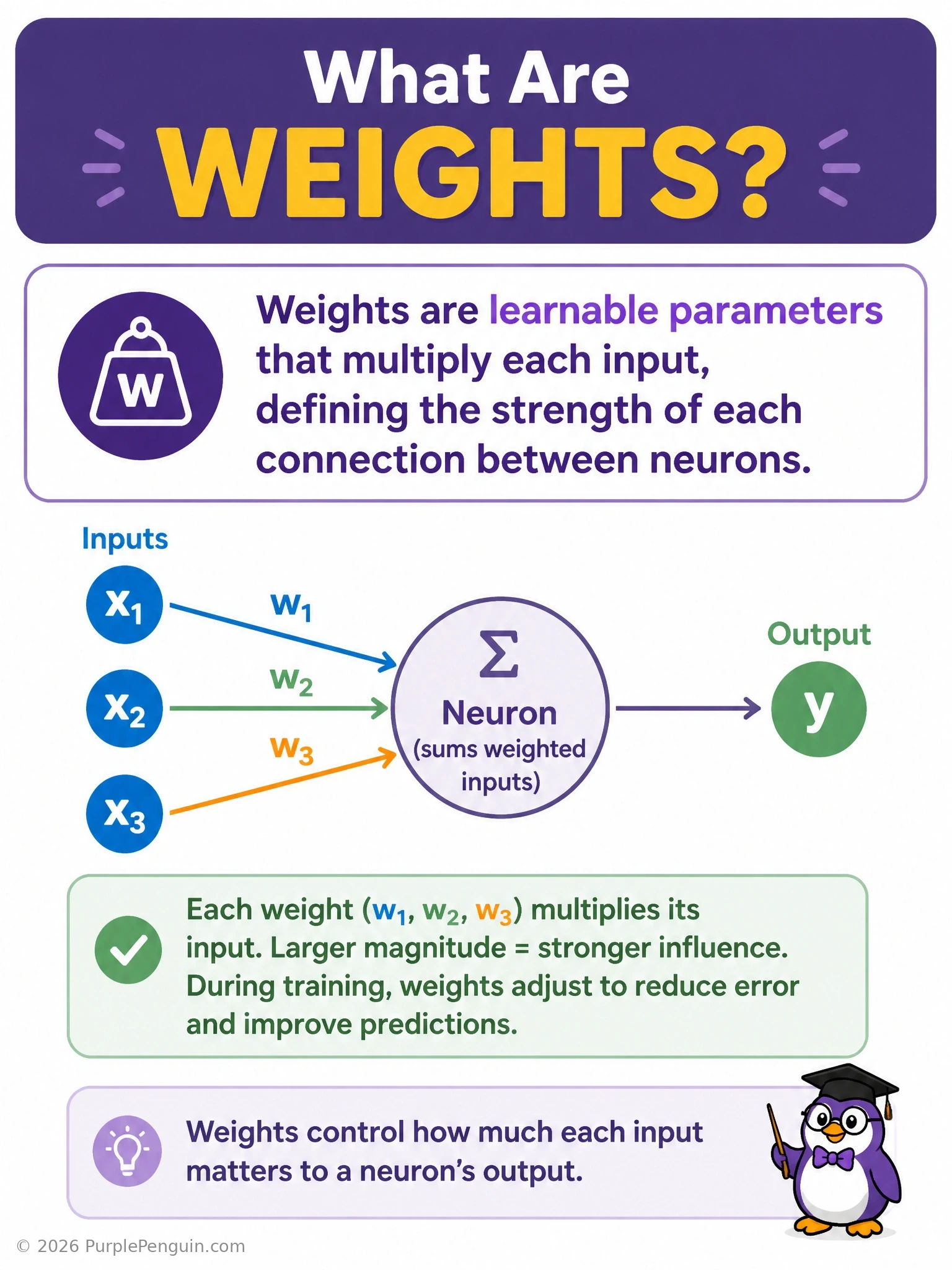
Weights are the actual numbers the network learns during training, and they sit on every connection between neurons, multiplying whatever signal is coming across that connection. A bigger weight means that particular input matters more to the neuron receiving it; a weight near zero means it barely matters at all. That's the whole game of training a neural network: adjusting these weights, layer by layer, connection by connection, so the network's outputs get closer to what you want. That's why 'learnable connection-strength parameters' is the right answer. Weights are not fixed hyperparameters chosen once and left alone, quite the opposite, they're updated constantly during training via backpropagation and gradient descent. They're also not the activation function, that's a separate non-linear transformation applied after the weighted sum. And weights have nothing to do with counting neurons per layer, that's architecture, not the learned parameters themselves.
Full explanation below image
Full Explanation
In a neural network, weights are the learnable numerical parameters associated with each connection between neurons (or, in the case of convolutional layers, the values that make up each filter/kernel). When an input value travels along a connection to a neuron, it is multiplied by that connection's weight before being summed with the other weighted inputs (and a bias term) to produce the neuron's pre-activation value, which is then passed through an activation function. The magnitude and sign of a weight determine how strongly, and in what direction, a given input influences the neuron it feeds into: a large positive weight amplifies that input's contribution, a large negative weight strongly inverts it, and a weight near zero effectively suppresses that input's influence. Training a neural network is fundamentally the process of adjusting these weights (along with biases) so that the network's outputs increasingly match the desired targets, typically accomplished through backpropagation, which computes the gradient of a loss function with respect to each weight, and an optimization algorithm such as gradient descent, which updates the weights in the direction that reduces the loss.
The first distractor, fixed hyperparameters chosen manually and never updated, describes settings like the learning rate, number of layers, or batch size, values that are set before training and typically remain constant (or are adjusted according to a predefined schedule) rather than being learned from data; weights, in contrast, are precisely the parameters that are learned and continuously updated throughout the training process.
The second distractor, the activation function, describes a separate component of a neuron's computation; the activation function is a fixed (typically non-learnable, aside from parametric variants) non-linear transformation applied to the weighted sum plus bias, whereas weights themselves are the learnable multipliers applied to inputs before that transformation occurs.
The third distractor, a count of neurons per layer, describes the network's architecture or topology, a structural design choice made before training, not the learned numerical parameters that determine connection strength; the number of neurons in a layer does influence how many weights exist, but the weights themselves are the values, not the count.
Memory aid: think of weights as the 'volume knobs' on every wire connecting neurons, training is the process of turning those knobs up or down (via gradient descent) until the network's overall output matches what you want.