What is the primary purpose of a residual (skip) connection in a ResNet architecture?
Select an answer to reveal the explanation.
Short Explanation and Infographic
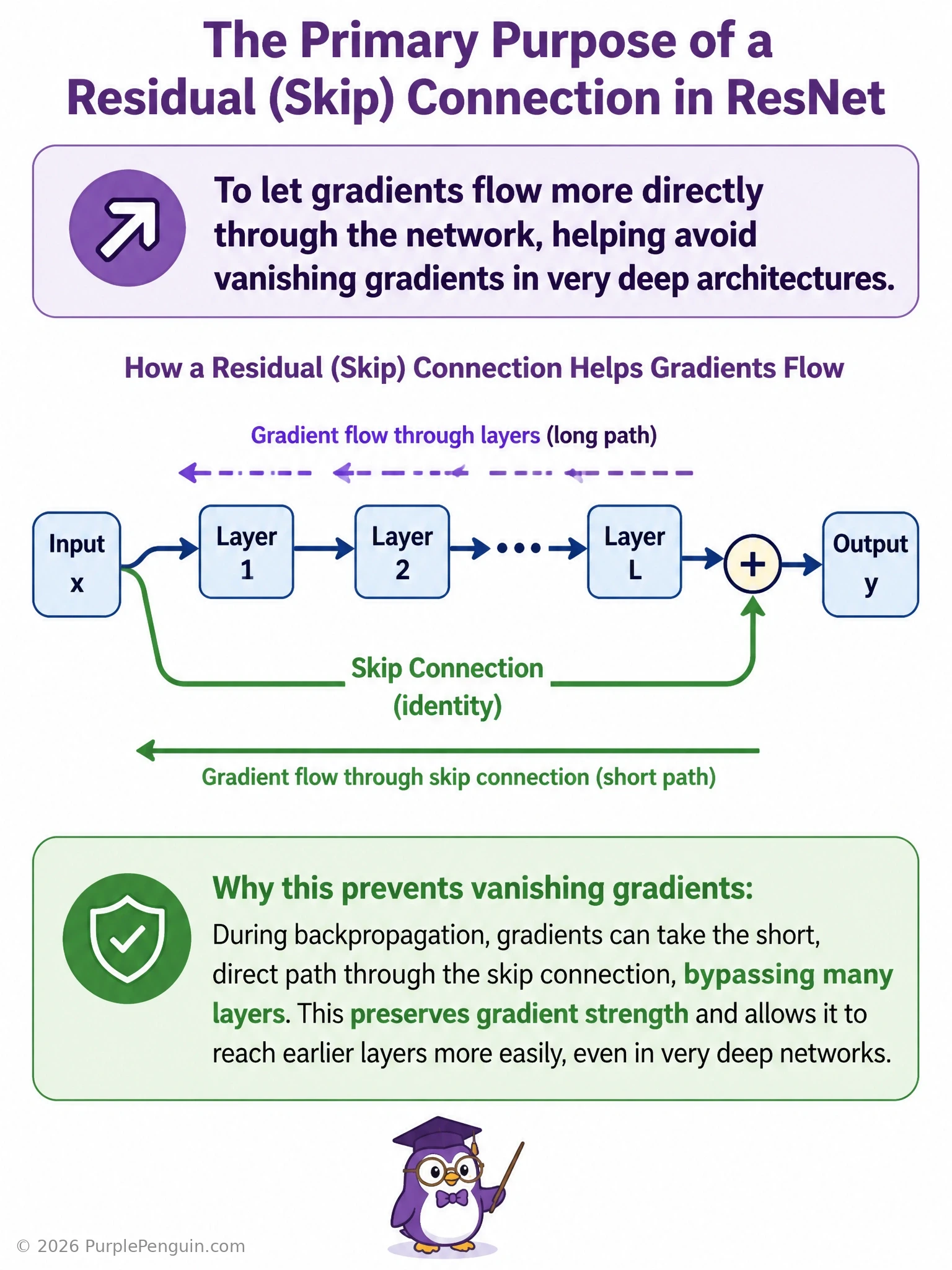
Before ResNet, stacking more and more layers into a network often backfired — training got harder, and gradients would shrink to almost nothing by the time they traveled all the way back through dozens of layers during backpropagation. Residual connections fix this with a clever trick: they add a shortcut that lets the input skip ahead and be added directly to a later layer's output, giving gradients a direct path back through the network instead of only the long way through every single layer. That's why very deep ResNets can actually train well, and it's exactly why the vanishing-gradient answer is correct here. Skip connections have nothing to do with randomly dropping neurons, that's dropout, a separate regularization method. They don't reduce how many layers you use either, ResNets are famous for going deeper, not shallower, thanks to this trick. And they're definitely not a flattening operation; flattening is what turns 2D feature maps into a 1D vector before dense layers, an unrelated step.
Full explanation below image
Full Explanation
The primary purpose of a residual, or skip, connection in a ResNet architecture is to address the vanishing gradient (and general degradation) problem that arises when training very deep neural networks. In a standard deep network without skip connections, gradients computed during backpropagation must pass through every single layer, and repeatedly multiplying by small derivative values at each layer can cause the gradient signal to shrink exponentially by the time it reaches the earliest layers, making those layers extremely slow or unable to learn effectively. A residual connection creates a shortcut path that allows the input to a block of layers to be added directly to that block's output, so instead of a layer or block having to learn a full transformation from scratch, it only needs to learn the 'residual,' the difference between the desired output and the original input. Critically, during backpropagation, gradients can flow backward directly through these skip connections without being forced through every intermediate transformation, which substantially mitigates vanishing gradients and allows successful training of networks with far more layers (ResNet architectures with over a hundred layers) than was practical before this innovation.
The first distractor describes dropout, a regularization technique that randomly deactivates a fraction of neurons during training to reduce overfitting; this is a completely different mechanism from residual connections, which are deterministic architectural shortcuts present in every forward and backward pass, not a stochastic training-time intervention.
The second distractor, reducing the total number of layers needed, is essentially the opposite of what ResNets are known for; residual connections are precisely what enable networks to be built successfully with many more layers than would otherwise be trainable, not fewer.
The third distractor describes the flattening layer, which reshapes multi-dimensional convolutional feature maps into a 1D vector before passing them into fully connected layers; this is an unrelated architectural component that has nothing to do with the gradient-flow purpose of residual connections.
Memory aid: think of a residual connection as an 'expressway' running alongside the normal city streets of the network, gradients that would otherwise get stuck in slow traffic passing through every layer can instead take the direct expressway back to the earlier layers, keeping the signal strong even in very deep networks.