What is the main purpose of a variational autoencoder (VAE), as opposed to a standard (vanilla) autoencoder?
Select an answer to reveal the explanation.
Short Explanation and Infographic
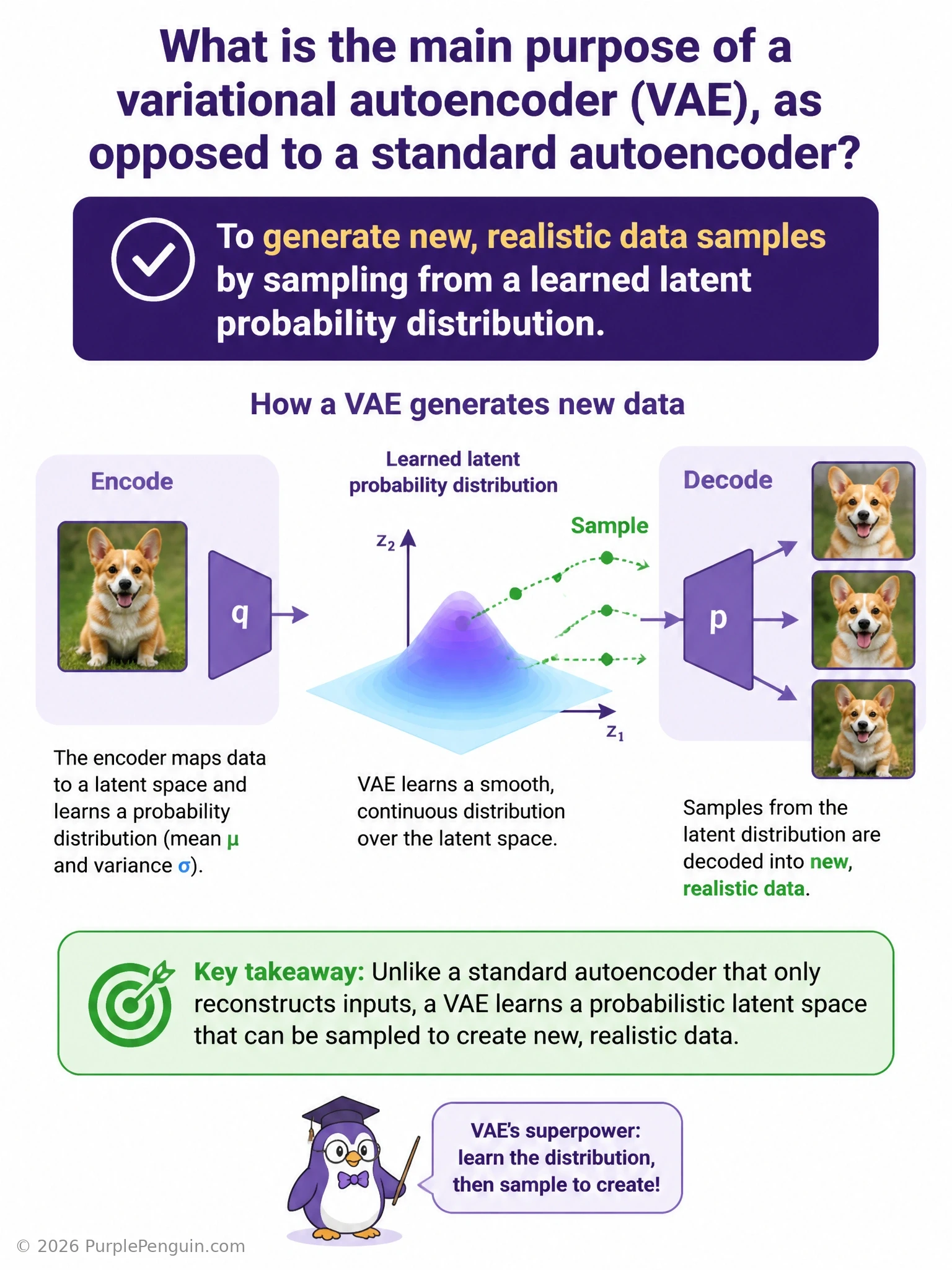
A standard autoencoder just compresses input down to a fixed code and reconstructs it back out — useful, but it's not really built for generating brand-new samples, because that latent space isn't smooth or structured for sampling. A VAE changes the game by having the encoder learn a probability distribution, mean and variance, over the latent space instead of one fixed point. That means you can sample new points from that distribution and decode them into new, realistic data the network never saw before, which is exactly the generation power that's the real point of a VAE. That makes the sampling-and-generating answer correct. Classifying images into fixed categories is a supervised classification task, not what a VAE is for. Reducing channel counts is a convolutional-layer concern, unrelated to VAEs. And a VAE absolutely still needs a decoder — it's the decoder that turns the sampled latent point back into actual data.
Full explanation below image
Full Explanation
The main purpose of a variational autoencoder (VAE) is to serve as a generative model: it learns a smooth, continuous, and probabilistic latent space from which new, realistic data samples can be generated. Unlike a standard autoencoder, whose encoder maps each input to a single fixed point in latent space (purely for compression and reconstruction), a VAE's encoder outputs the parameters (typically a mean and variance/log-variance) of a probability distribution, commonly assumed Gaussian, for each input. During training, a sample is drawn from this distribution (using the reparameterization trick to keep the sampling step differentiable) and passed to the decoder to reconstruct the input, while a regularization term (the KL divergence) encourages the learned latent distributions to stay close to a simple prior, often a standard normal distribution. This regularized, structured latent space is what allows a VAE, after training, to generate novel samples: one can simply sample a random point from the prior distribution and pass it through the decoder to produce a new, plausible data instance that was never in the training set, unlike a standard autoencoder's latent space, which typically has gaps and irregularities that make it unreliable for this kind of sampling-based generation.
The first distractor, classifying images into predefined categories, describes a supervised classification task, typically solved with a CNN trained with labeled data and a softmax output layer; a VAE is fundamentally a generative, largely unsupervised architecture, not a classifier.
The second distractor, reducing the number of channels in a convolutional feature map, describes an operation relevant to CNN design (such as 1x1 convolutions for channel reduction), unrelated to a VAE's core generative purpose.
The third distractor is incorrect because a VAE still requires a decoder; the decoder is precisely the component that takes a point sampled from the latent distribution and transforms it back into data space to produce a reconstruction or a new generated sample. Removing the decoder would eliminate the VAE's ability to produce any output at all.
Memory aid: standard autoencoder equals 'compress and reconstruct what I gave you'; VAE equals 'learn the shape of the data's latent space well enough that I can sample fresh, brand-new, realistic examples from it.'