A team has a small dataset of only 800 labeled medical images and wants strong classification performance. They decide to start from a CNN such as VGG or ResNet that was pre-trained on a large general-purpose image dataset. What is the main goal of this transfer learning approach?
Select an answer to reveal the explanation.
Short Explanation and Infographic
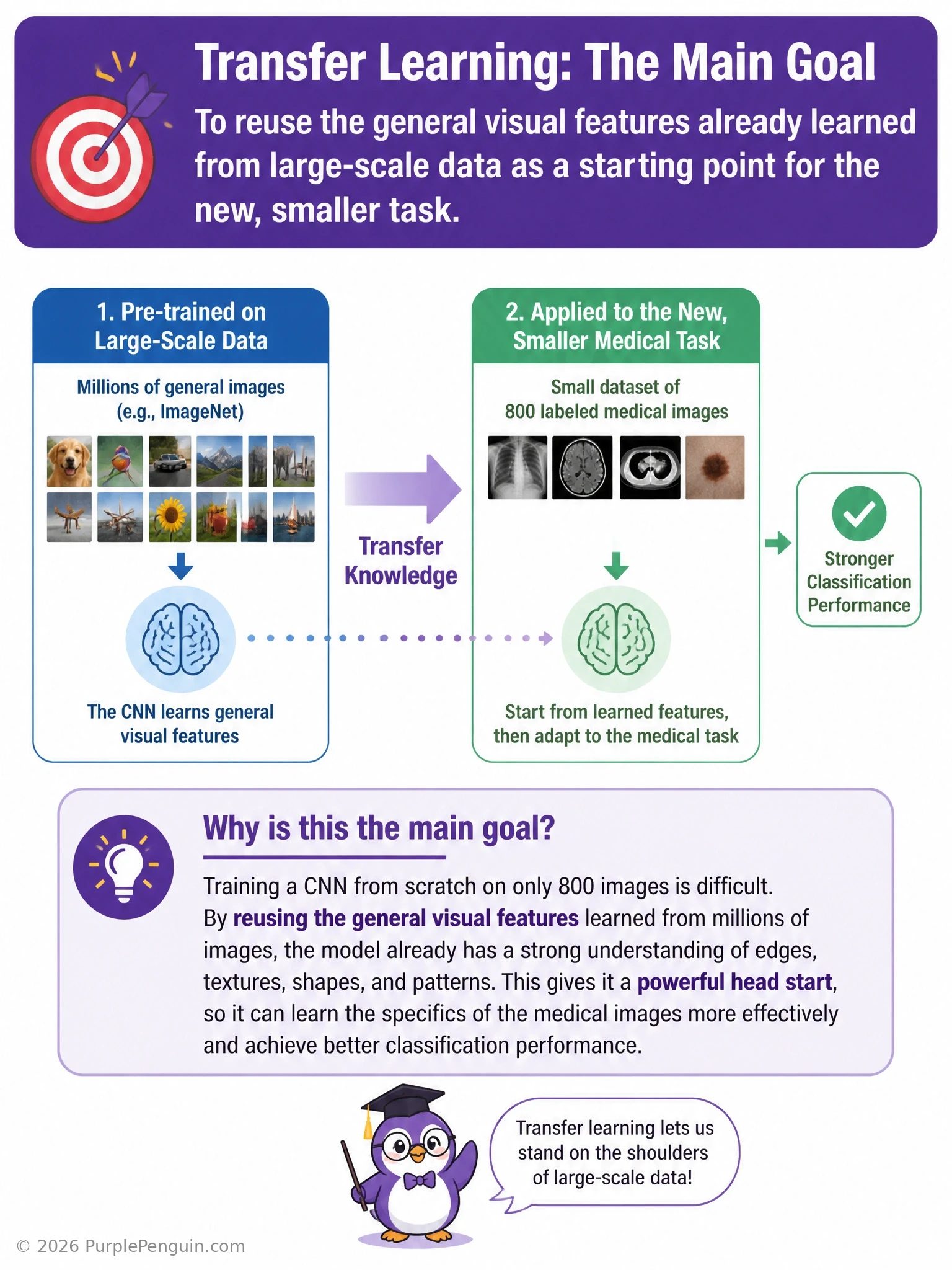
With only 800 images, training a big CNN from scratch is a losing battle — there's just not enough data to learn good features on your own. That's exactly the problem transfer learning solves. A network like VGG or ResNet, already trained on millions of general images, has learned a rich hierarchy of visual features, edges, textures, shapes, that turn out to be broadly useful for almost any image task. You reuse those learned features as your starting point, then fine-tune on your small dataset, giving your model a massive head start. That reuse-of-features goal is the correct answer. Transfer learning helps with overfitting, but it doesn't guarantee it can never happen — you can still overfit a small dataset if you're not careful. You still need labeled data for your new task, just less of it than training from scratch would require. And the whole point is that you replace and retrain the final layers so the model learns your new classes, not that it's stuck only recognizing the original dataset's categories.
Full explanation below image
Full Explanation
Transfer learning with a pre-trained CNN, such as VGG or ResNet trained on a large dataset like ImageNet, aims to reuse the general visual features that the network has already learned, low-level features such as edges and textures in early layers, and increasingly complex features such as shapes and object parts in deeper layers, as a starting point for a new task with a much smaller labeled dataset. Rather than training all the network's weights from random initialization (which would require a huge amount of labeled data to avoid severe overfitting and to learn useful features from scratch), the team can keep most of the pre-trained convolutional layers (optionally freezing some of them) and replace/retrain the final classification layers to suit the new set of target classes. This approach leverages the fact that the low- and mid-level visual features learned from large, diverse datasets are broadly transferable across many vision tasks, giving a model trained on a small new dataset a substantial performance boost compared to training entirely from scratch.
The first distractor, guaranteeing the model will never overfit, is incorrect because transfer learning reduces the risk of overfitting on small datasets (by not requiring the network to learn all its features from a tiny sample) but does not eliminate the possibility entirely; overfitting can still occur, especially if too many layers are unfrozen and fine-tuned aggressively on a very small dataset without proper regularization.
The second distractor, eliminating the need for any labeled data, is incorrect because the new task still requires labeled examples (in this case, labeled medical images) to fine-tune the final layers and adapt the model to the new classification task; transfer learning reduces the amount of labeled data needed, but does not remove the requirement altogether.
The third distractor, forcing the model to only recognize the original dataset's classes, is incorrect and actually describes the opposite of what happens; in transfer learning, the final classification layer(s) of the pre-trained network are typically replaced and retrained to output predictions for the new task's specific classes, not the original dataset's categories.
Memory aid: think of a pre-trained CNN as an experienced 'visual feature detector' that already knows how to see edges, textures, and shapes from studying millions of images; transfer learning lets your small dataset borrow that expertise instead of teaching a network to see from zero.