A company wants to build an unsupervised model that learns to remove background noise from audio recordings, without relying on labeled clean/noisy pairs for every possible noise type. Which architecture is well suited to this?
Select an answer to reveal the explanation.
Short Explanation and Infographic
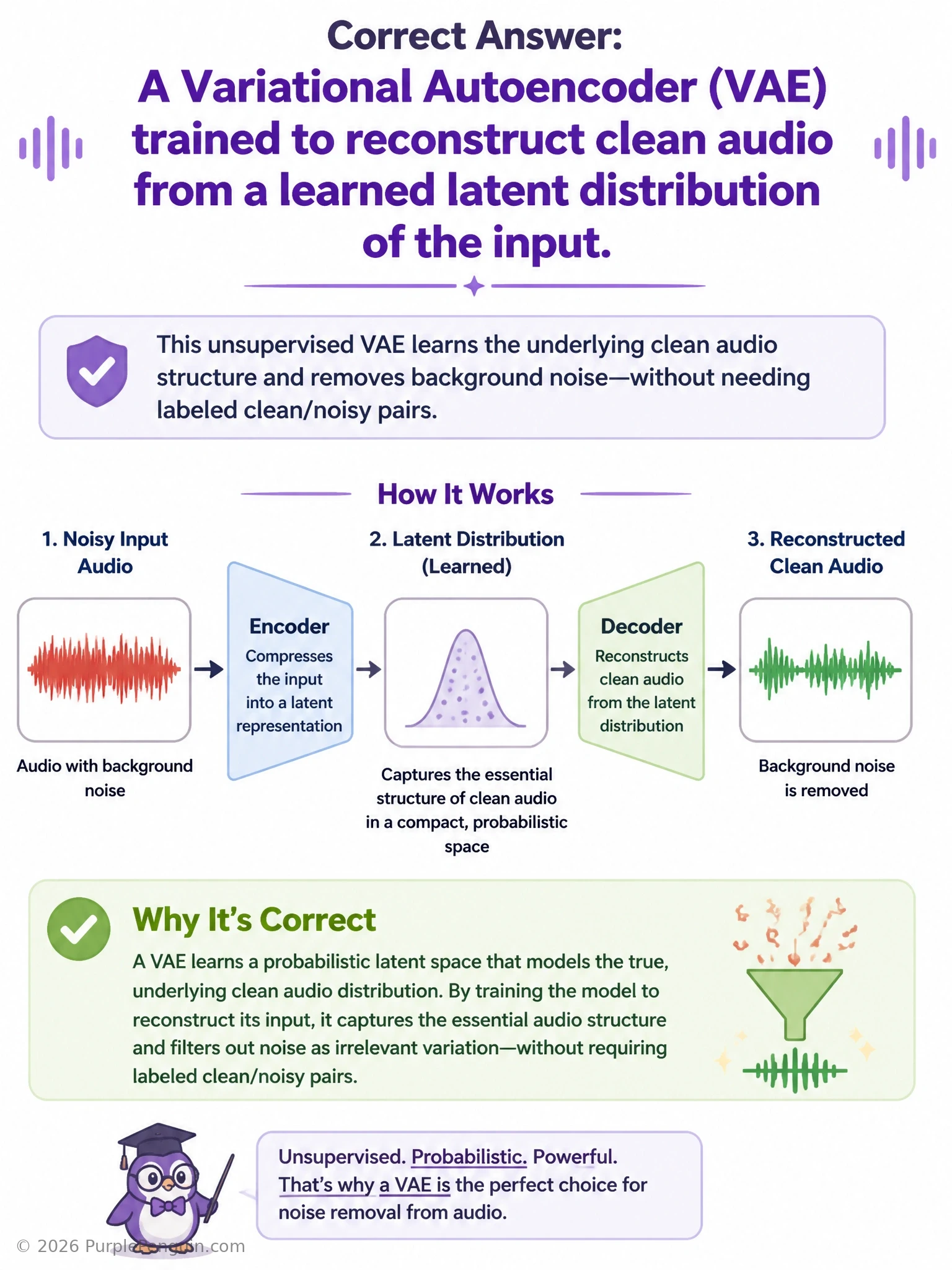
This is squarely an autoencoder-style problem, and specifically a variational autoencoder is a strong fit, because it's built to learn a compressed, probabilistic latent representation of your data in an unsupervised way, without needing hand-labeled clean/noisy pairs for every noise scenario. The VAE learns to encode noisy input into that latent distribution and then reconstruct a cleaner version from it, capturing the underlying structure of what 'good' audio looks like. That's why it's correct. A single dense layer trained with explicit noise-type labels is a supervised approach, exactly what the scenario says to avoid. A discriminator only tells real from fake — it's not built to produce cleaned-up output at all. And max pooling is just a downsampling operation; on its own it doesn't reconstruct or denoise anything.
Full explanation below image
Full Explanation
Denoising audio in an unsupervised setting, without needing exhaustively labeled clean/noisy pairs for every conceivable noise scenario, is a natural fit for autoencoder-based architectures, and variational autoencoders (VAEs) in particular. A VAE's encoder maps an input (in this case, noisy audio) to parameters (mean and variance) of a probability distribution over a compressed latent space, rather than to a single fixed point as a standard autoencoder would. Sampling from this learned distribution and passing it through the decoder produces a reconstruction. When trained appropriately (e.g., reconstructing clean audio from noisy input, or trained purely on clean audio so the latent space captures the structure of 'normal,' noise-free signal), the VAE learns a smooth, generative latent representation of the underlying clean audio structure, which the decoder can use to reconstruct a plausible, less noisy version of an input. This generative, distributional latent space also gives VAEs an advantage over plain autoencoders for tasks that benefit from smooth interpolation or sampling in latent space. Crucially, this approach does not require explicit labels identifying noise types, making it appropriate for the unsupervised constraint in the scenario.
The first distractor, a single dense layer trained with supervised labels for exact noise types, directly violates the unsupervised, label-free requirement stated in the scenario; it would require labeled data identifying every specific type of noise, which is explicitly what the team wants to avoid, and a single dense layer alone is also far too limited an architecture for this task.
The second distractor, a discriminator trained only to classify audio as real or synthetic, describes a component from a GAN setup whose sole output is a real/fake decision; a discriminator by itself does not produce a cleaned or reconstructed audio waveform, so it cannot perform denoising on its own.
The third distractor, a max pooling layer applied directly to raw audio, describes a simple downsampling operation with no learnable reconstruction capability; pooling reduces resolution but has no mechanism for learning to separate noise from signal or reconstructing a cleaner waveform.
Memory aid: whenever a task calls for unsupervised reconstruction or cleanup of data using a learned compressed representation, whether it's images or audio, think autoencoder family, and reach for a VAE specifically when you want a smooth, generative latent space to sample or interpolate from.