A model performs great on training data but noticeably worse on validation data. A colleague suggests adding a dropout layer. What is dropout actually doing to address this?
Select an answer to reveal the explanation.
Short Explanation and Infographic
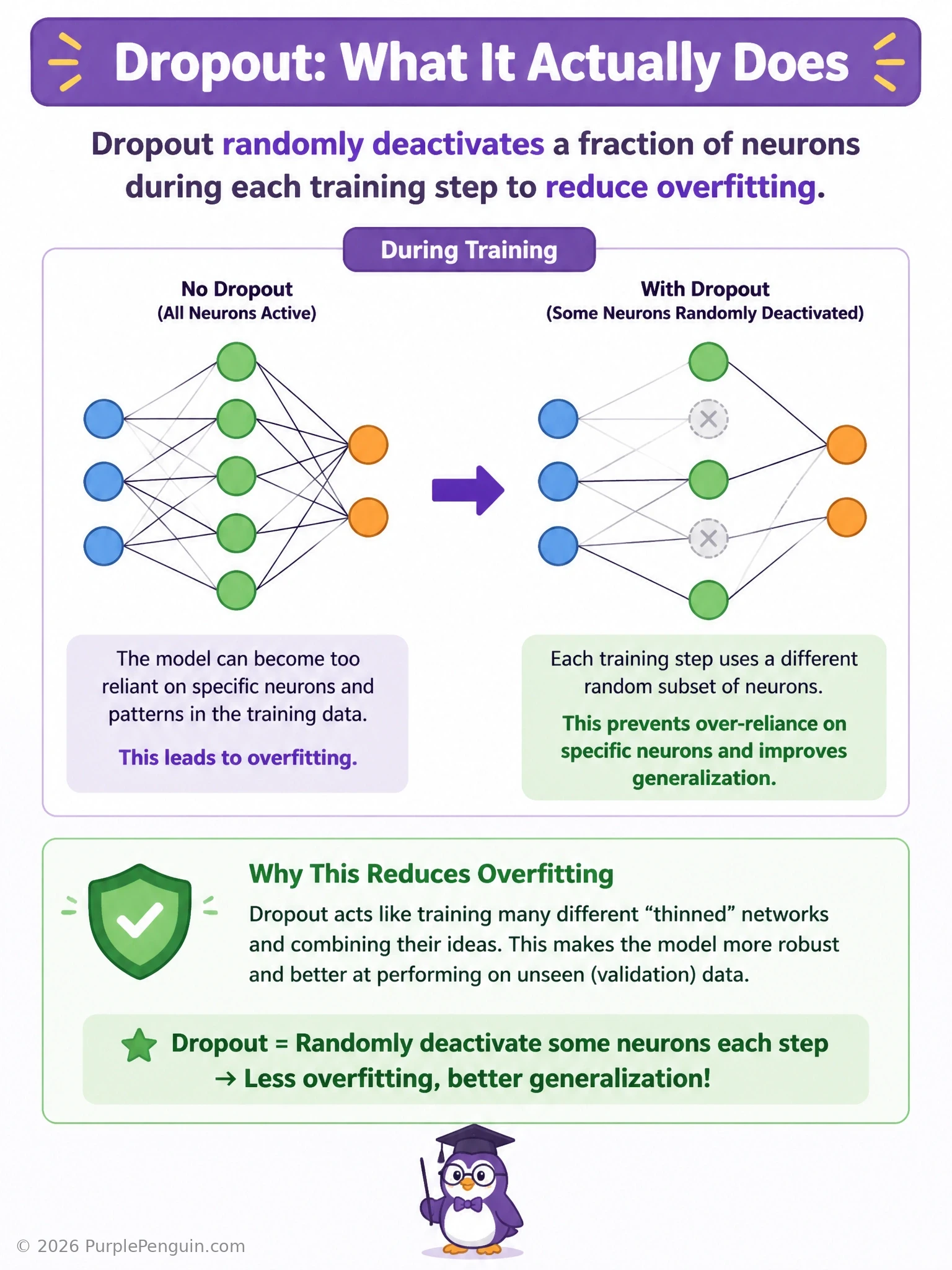
Dropout is basically forced teamwork training. During each training step, it randomly switches off a chunk of neurons, so the network can't lean too hard on any one path or memorize quirky details of the training set. Every pass, a different random subset gets dropped, which forces the remaining neurons to pick up the slack and learn more general, redundant features. Come test time, dropout turns off and the full network runs together. That's very different from permanently deleting neurons, which would just shrink your model, and it's not normalization or a learning-rate trick either, those solve different problems entirely.
Full explanation below image
Full Explanation
Dropout is a regularization technique that combats overfitting, the exact symptom described in the scenario where training performance is strong but validation performance lags, by randomly setting a fraction of neuron activations to zero during each forward and backward pass in training. The specific neurons dropped change randomly on every training step, according to a fixed dropout probability (commonly 0.2 to 0.5), which prevents the network from becoming overly reliant on any particular neuron or narrow co-adapted group of neurons. This forces the network to learn more robust, distributed, and redundant representations, since no single neuron can be guaranteed to be present on any given pass. At inference/test time, dropout is disabled and all neurons are used, typically with activations scaled to account for the fact that more neurons are active than during training.
The first distractor describes permanent pruning of weak neurons after training, which is a separate technique (network pruning or compression) aimed at reducing model size and inference cost; it is not what dropout does, and dropout does not permanently alter network architecture at all. The normalization distractor describes batch normalization, a different regularization and training-stabilization technique that standardizes layer inputs to have roughly zero mean and unit variance to speed up and stabilize training; while both dropout and batch normalization can improve generalization, they operate through completely different mechanisms and are often used together rather than being the same thing. The learning-rate distractor describes a technique sometimes used to escape poor local minima or plateaus (such as a learning-rate warm restart), which addresses optimization dynamics, not overfitting, and has nothing to do with randomly deactivating neurons.
A useful memory aid: dropout is like randomly benching different players from a sports team at every practice, so no single player becomes the sole reason the team performs well, and every player has to be capable of stepping up. This produces a more resilient, generalizable network less prone to memorizing training-set noise, directly addressing the training-versus-validation performance gap described in the scenario.