Mechanically, how is the output of an attention mechanism produced?
Select an answer to reveal the explanation.
Short Explanation and Infographic
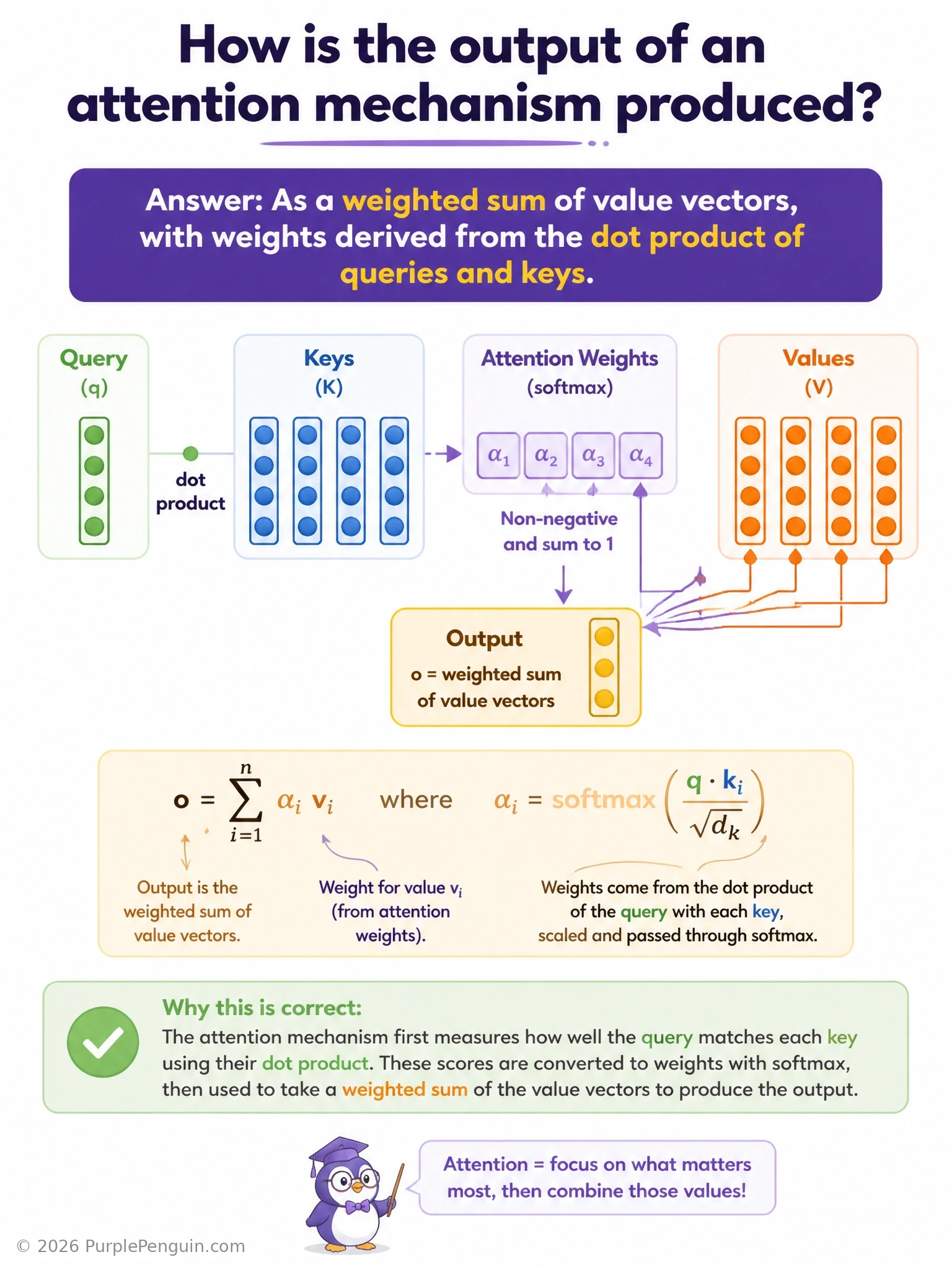
Attention boils down to three ingredients: queries, keys, and values. For each position, you take its query and compare it against every key using a dot product, that comparison tells you how relevant every other position is. Run those scores through a softmax to turn them into clean weights that sum to one, then use those weights to blend the value vectors together. The result is a weighted sum, some values count a lot, others barely register, depending on relevance. It's not a max operation, not a plain average, and there's no convolution involved anywhere in the process, it's all dot products and weighted blending.
Full explanation below image
Full Explanation
In the standard scaled dot-product attention mechanism used in Transformers, the output for a given position is computed as a weighted sum of value vectors, where the weighting comes from comparing that position's query vector against every key vector in the sequence via a dot product. Specifically, dot products between the query and each key are computed, scaled by the square root of the key dimension for numerical stability, and passed through a softmax function to produce a normalized set of attention weights that sum to one. These weights are then used to compute a weighted combination of the corresponding value vectors, producing the final attention output for that position. This lets the model dynamically emphasize the most relevant parts of the input for each element being processed.
The element-wise maximum option is wrong because attention does not select or emphasize a single dominant value through a max operation; instead, it blends contributions from many positions proportionally, which is what allows gradients to flow smoothly and lets the model represent nuanced, partial relevance rather than an all-or-nothing choice. The unweighted average option is wrong because it ignores the entire point of attention, which is to let the model learn which positions matter more for a given query; a simple average would treat every token as equally relevant regardless of context, discarding the query-key relevance signal entirely. The convolution option is wrong because convolution operates with fixed, shared, spatially local filters applied uniformly across an input; attention instead computes content-dependent weights on the fly for every pair of positions in the sequence, which is a fundamentally different and much more flexible mechanism, especially for capturing long-range dependencies that a small convolutional kernel would miss.
A helpful memory aid: think "query asks a question, keys advertise what they contain, dot product measures the match, softmax normalizes the matches into weights, and values get blended according to those weights." This query-key-value framework, applied across multiple attention heads in parallel (multi-head attention), is the computational core that lets Transformers weigh context dynamically rather than relying on fixed, recurrence-based memory.