Within an autoencoder, what job does the decoder half of the network perform?
Select an answer to reveal the explanation.
Short Explanation and Infographic
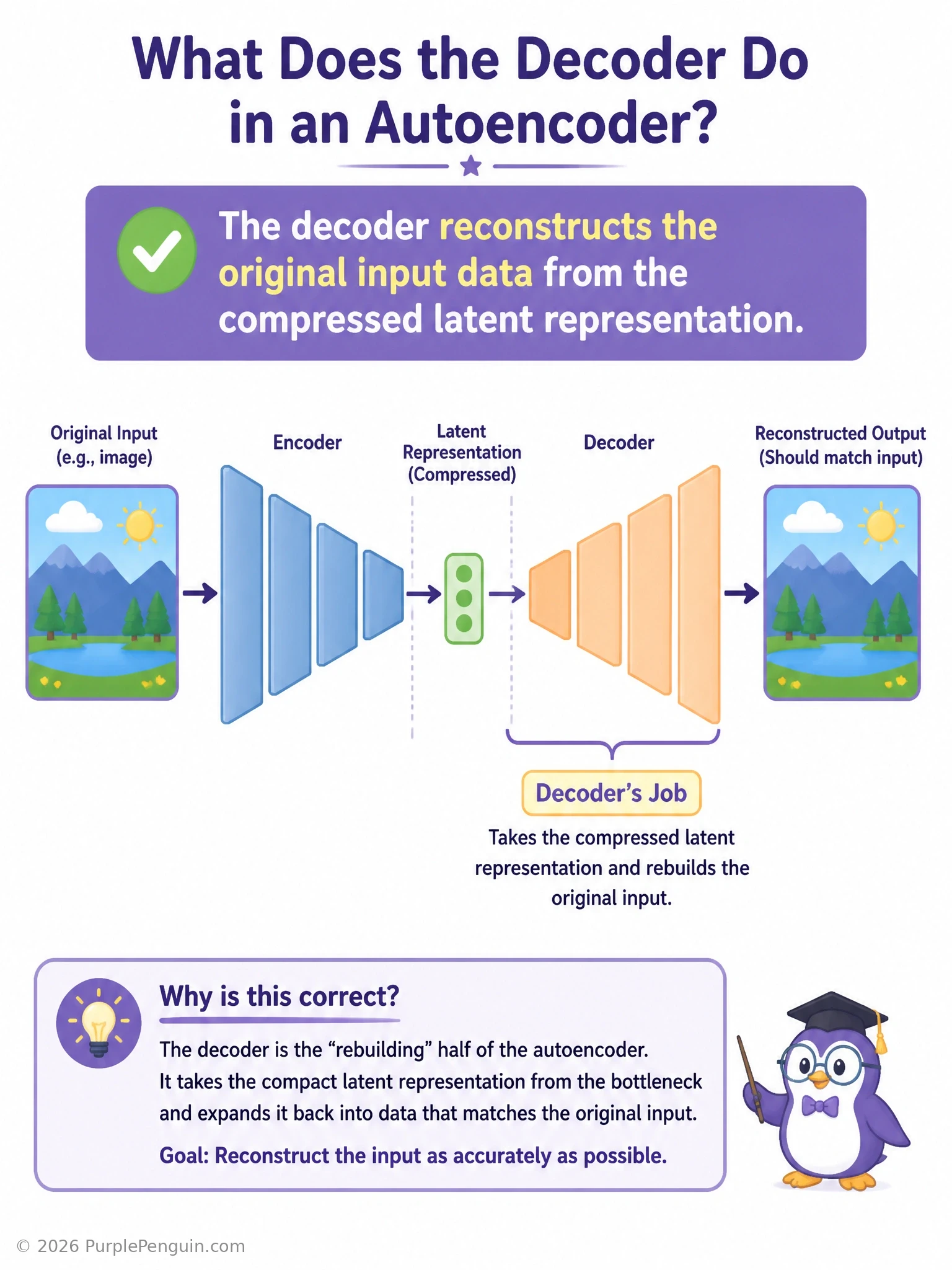
Split an autoencoder into two halves and the decoder is the rebuilder. The encoder already did the hard work of squeezing the input down into a compact latent code; the decoder's whole job is to take that compressed code and expand it back out, reconstructing something as close to the original input as possible. That's the opposite direction from the encoder, which compresses rather than rebuilds. It's also not a classifier picking categories, autoencoders aren't inherently doing classification, and it's not the loss function either, the loss is just a number computed by comparing the decoder's output to the original input, it isn't a component of the network itself.
Full explanation below image
Full Explanation
In an autoencoder, the architecture is split into an encoder and a decoder connected through a bottleneck latent representation. The decoder's role is to take that compressed, lower-dimensional latent code produced by the encoder and progressively expand and transform it back into an output with the same shape and structure as the original input, effectively reconstructing the input data. The decoder is typically a mirror image of the encoder's layer structure, using operations like transposed convolutions or upsampling layers (in image-based autoencoders) or dense layers (in simpler tabular cases) to reverse the compression performed by the encoder.
The first distractor describes the encoder's job, not the decoder's; the encoder is the component that takes the raw, high-dimensional input and maps it down into the compact latent representation, which is the exact opposite direction of information flow from what the decoder does. The classification distractor is wrong because a standard autoencoder is not inherently a classifier; it is trained in an unsupervised or self-supervised manner to reconstruct its own input, with no requirement for labeled category targets. While the compressed latent representation an autoencoder learns can sometimes be fed into a separate classifier as a feature-extraction step, that classification task is not what the decoder itself performs. The loss-computation distractor is wrong because the decoder is a component of the neural network that produces an output (the reconstruction); the reconstruction loss (commonly mean squared error between input and reconstructed output) is a separate mathematical comparison computed after the decoder produces its output, used to guide gradient updates across both the encoder and decoder during backpropagation, but the loss function itself is not part of the decoder's architecture.
A helpful memory aid: think of the encoder as "packing a suitcase" (compressing everything essential into a small space) and the decoder as "unpacking that suitcase" (expanding the compressed contents back into a full outfit). The quality of an autoencoder is judged by how close the decoder's reconstruction is to the original input, and that same decoder pathway, particularly in variational autoencoders, can also be repurposed to generate entirely new data by feeding it sampled latent vectors instead of ones derived directly from a specific input.