What advantage does a GRU offer compared to a standard (vanilla) RNN when working with longer sequences?
Select an answer to reveal the explanation.
Short Explanation and Infographic
A plain vanilla RNN has a rough time with long sequences, gradients either shrink to nothing or blow up as they travel back through all those time steps, so the network basically forgets anything that happened a while ago. A GRU fixes this with update and reset gates that control what information sticks around and what gets tossed, which keeps gradients flowing better and lets the network hold onto long-range dependencies, all with a lighter, more efficient structure than a full LSTM. It's not skipping backprop through time, and it's still recurrent, not parallel, so those other options describe something else entirely.
Full explanation below image
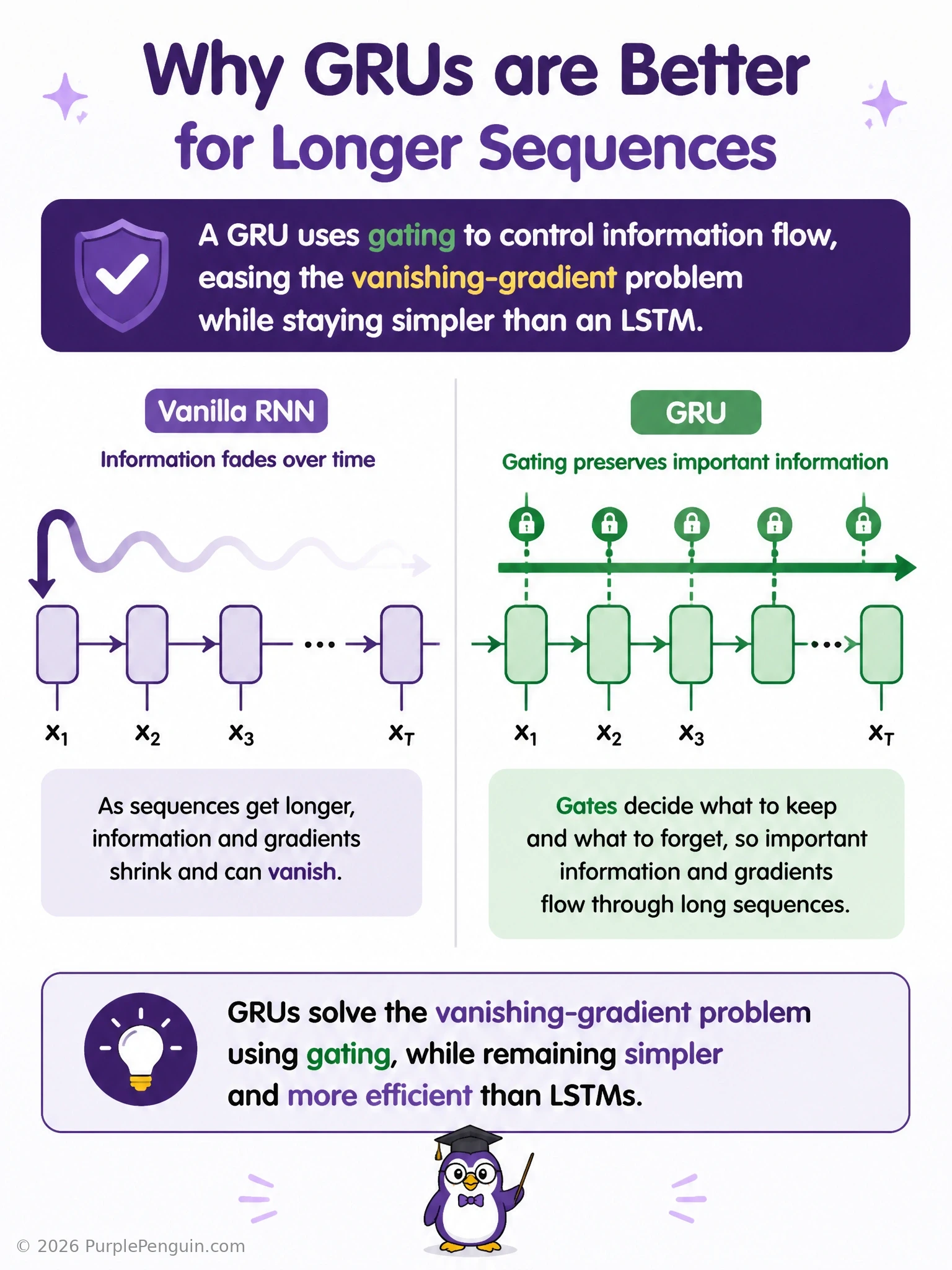
Full Explanation
A Gated Recurrent Unit (GRU) improves on the standard RNN by introducing gating mechanisms, specifically an update gate and a reset gate, that regulate how much past information is carried forward and how much new information is incorporated at each time step. This gating gives the network a controlled pathway for gradients to flow backward through time without being forced through repeated multiplications by the same recurrent weight matrix and nonlinearity at every step, which is the root cause of the vanishing (and sometimes exploding) gradient problem in vanilla RNNs. Because GRUs achieve this with only two gates and no separate cell state, they are computationally lighter and have fewer parameters than an LSTM, while still substantially outperforming vanilla RNNs on tasks involving longer-range dependencies.
The first distractor is wrong because GRUs, like all RNN variants, are still trained using backpropagation through time; gating does not eliminate this training procedure, it simply makes the gradient flow through that procedure more stable. The second distractor about parallel processing with no recurrence is wrong because that describes a fundamentally different architecture, the Transformer, which processes sequence elements simultaneously using attention; a GRU is still inherently sequential, processing one time step at a time and passing a hidden state forward. The receptive-field distractor is wrong because receptive field is a concept from convolutional architectures describing the input region influencing a given neuron; comparing a GRU's temporal memory to a CNN's spatial receptive field conflates two unrelated ideas, and GRUs make no such guarantee.
A good memory aid: GRU is often described as "LSTM-lite," trading the LSTM's three gates (input, output, forget) and separate cell state for a leaner two-gate design (update, reset) that merges hidden and cell state into one. This makes GRUs faster to train and often competitive with LSTMs on many tasks, particularly when data or compute is limited, while still meaningfully mitigating the vanishing-gradient issues that plague simple RNNs on long sequences.