In a typical image-classification CNN, the convolutional layers extract low- and mid-level visual features like edges and textures. Which part of the network is responsible for combining those extracted features into the final, high-level representation used to make the classification decision?
Select an answer to reveal the explanation.
Short Explanation and Infographic
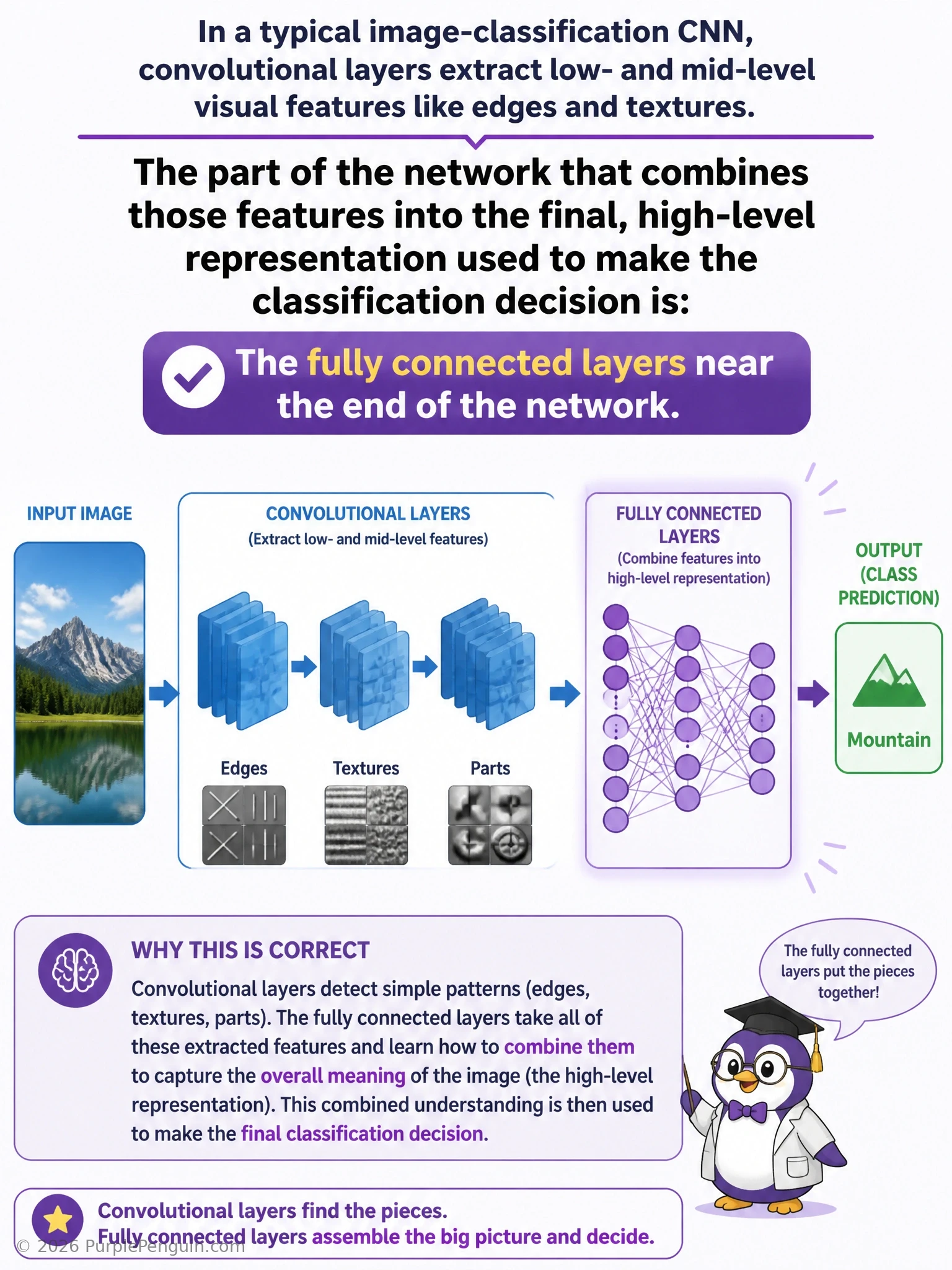
By the time your image data reaches the end of a CNN, the convolutional layers have already done the heavy lifting of pulling out edges, textures, and increasingly complex shapes. But those are still spatially organized feature maps — they need to get combined into an overall judgment. That's the fully connected layers' job: after flattening, every extracted feature gets connected to every neuron in the dense layer, letting the network learn how combinations of features (a wheel-like shape here, a windshield-like texture there) add up to 'this is a car.' Pooling just downsamples, it doesn't classify. Early convolutional filters only catch simple, low-level patterns like edges, not the whole picture. And stride is just a step-size setting for the convolution operation — it has nothing to do with combining features for a decision.
Full explanation below image
Full Explanation
In a standard CNN classifier, the convolutional and pooling layers act as a hierarchical feature extractor: early layers detect simple, low-level patterns (edges, color gradients), middle layers combine these into more complex shapes and textures, and later convolutional layers detect high-level, object-part-like features. However, these feature maps remain spatially structured. The fully connected (dense) layers near the end of the network take the flattened output of this feature-extraction hierarchy and learn to combine those high-level features into the final decision boundary for classification, weighing which combinations of detected features correspond to which output class. This is why CNN classifiers are typically structured as: convolution/pooling blocks for feature extraction, followed by a flattening step, followed by one or more fully connected layers, ending in a softmax (or similar) output layer.
The first distractor, pooling layers, perform spatial downsampling (e.g., max pooling selects the strongest activation in a local region) to reduce computation and add translation invariance, but they do not perform the classification combination step — they operate on and reduce feature maps, not combine them into a decision. The second distractor, the earliest convolutional layer, is responsible for detecting the simplest, most local visual patterns (like edges or color blobs); it operates far too early in the pipeline to be responsible for the final high-level classification decision, and its receptive field is much too small to see the whole object. The fourth distractor, the stride parameter, is simply a hyperparameter controlling how many pixels a convolutional filter shifts between applications — it affects the output feature-map size and computational cost, but it is not itself a layer or a mechanism for combining features into a decision.
Memory aid: think of the CNN as a factory line — convolution/pooling stages are the assembly stations building up parts (edges to shapes to object-parts), and the fully connected layers at the end are the inspector who looks at all the assembled parts together and decides what the final product is.