In a basic autoencoder architecture, how do the encoder and decoder halves of the network relate to one another?
Select an answer to reveal the explanation.
Short Explanation and Infographic
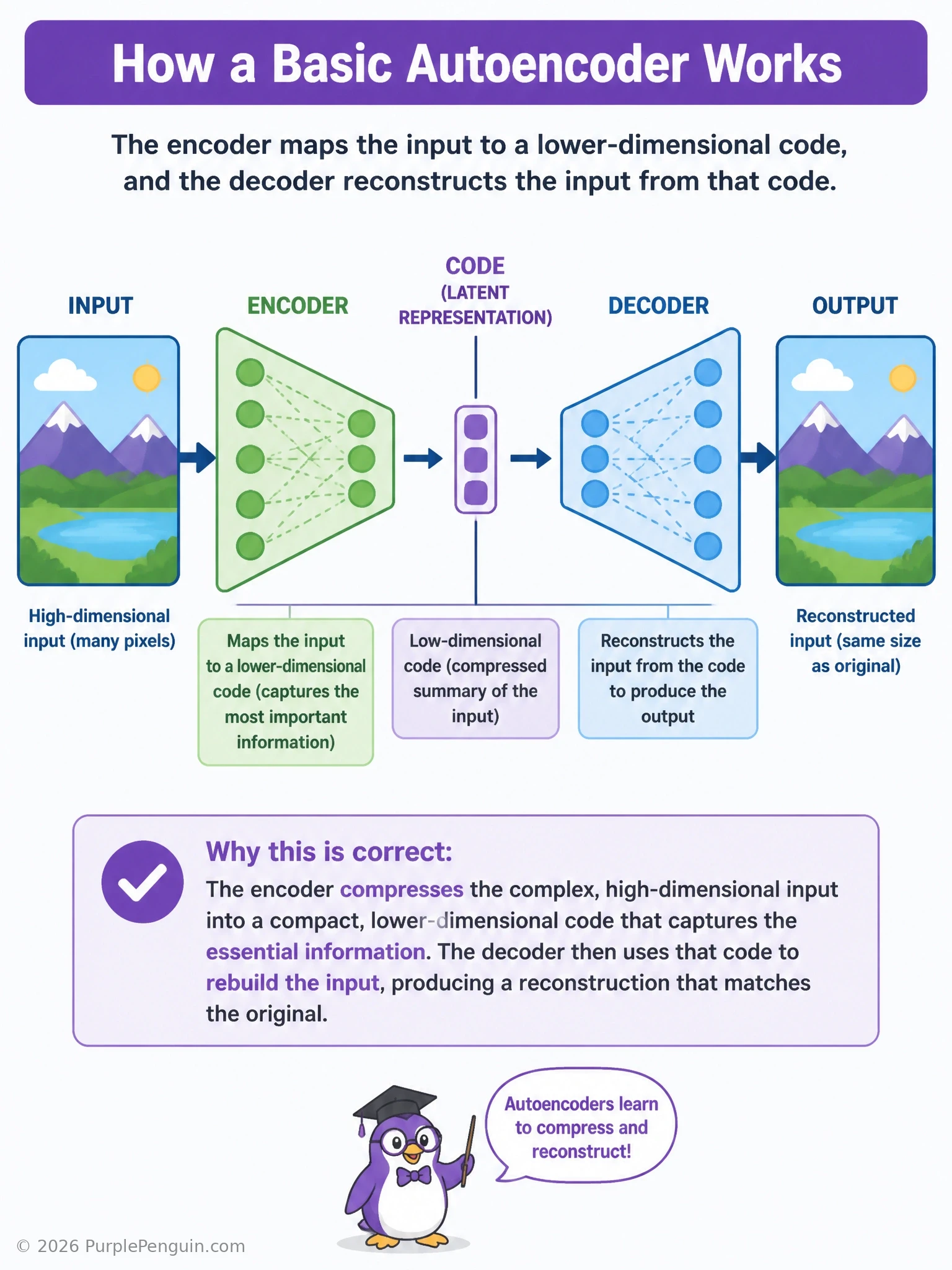
An autoencoder is basically a squeeze-and-rebuild machine. The encoder takes your input and compresses it down into a smaller, lower-dimensional 'code' — the latent representation — squeezing out just the essential information. Then the decoder takes that compressed code and tries to rebuild the original input as closely as possible from it. The whole network is trained end-to-end to minimize reconstruction error, so the code that comes out in the middle has to actually capture what matters about the input. It's not a classify-then-verify setup — there's no classification step at all in a basic autoencoder. The two halves absolutely share a representation (the latent code is the bridge between them, not two separate outputs). And while denoising autoencoders are a real variant that handles noise, that noise-injection framing isn't the general encoder/decoder relationship — it describes one specialized flavor, not the basic architecture.
Full explanation below image
Full Explanation
A basic autoencoder consists of two connected halves trained jointly: the encoder, which maps the input data to a compressed, lower-dimensional latent representation (often called the 'code' or 'bottleneck'), and the decoder, which takes that latent code and reconstructs an approximation of the original input from it. The entire network is trained end-to-end by minimizing a reconstruction loss (commonly mean squared error for continuous data) between the original input and the decoder's output. Because the latent code is forced through a bottleneck of lower dimensionality than the input, the encoder must learn to retain only the most salient, information-dense features of the input, which is why autoencoders are widely used for dimensionality reduction, feature learning, denoising, and anomaly detection.
The second distractor invents a classification-and-verification relationship that doesn't exist in a basic autoencoder; there is no class label involved at all in the standard unsupervised autoencoder setup, and the decoder's job is reconstruction, not verification of a classification decision. The third distractor is incorrect because the encoder and decoder are not independent — they are directly connected through the shared latent code, and the decoder's entire input is the encoder's output; without that shared bottleneck representation, there would be no mechanism forcing the network to learn a compressed, meaningful encoding at all. The fourth distractor describes the denoising autoencoder variant somewhat inaccurately — in a denoising autoencoder, noise is added to the INPUT before it reaches the encoder (not by the encoder itself), and the decoder is trained to reconstruct the original CLEAN input, using a learned reconstruction process rather than a 'fixed filter'; this is a specialized training trick applied on top of the standard architecture, not the fundamental encoder/decoder relationship the question is asking about.
Memory aid: 'encoder compresses, decoder decompresses' — like a zip file and its extraction: the zip (encoder) squeezes data down to a smaller representation, and unzipping (decoder) rebuilds the original from that compressed form, with some information loss in the lossy, learned version an autoencoder represents.