The Naive Bayes classifier, popular for tasks like spam filtering, derives its predictions from which foundational mathematical principle?
Select an answer to reveal the explanation.
Short Explanation and Infographic
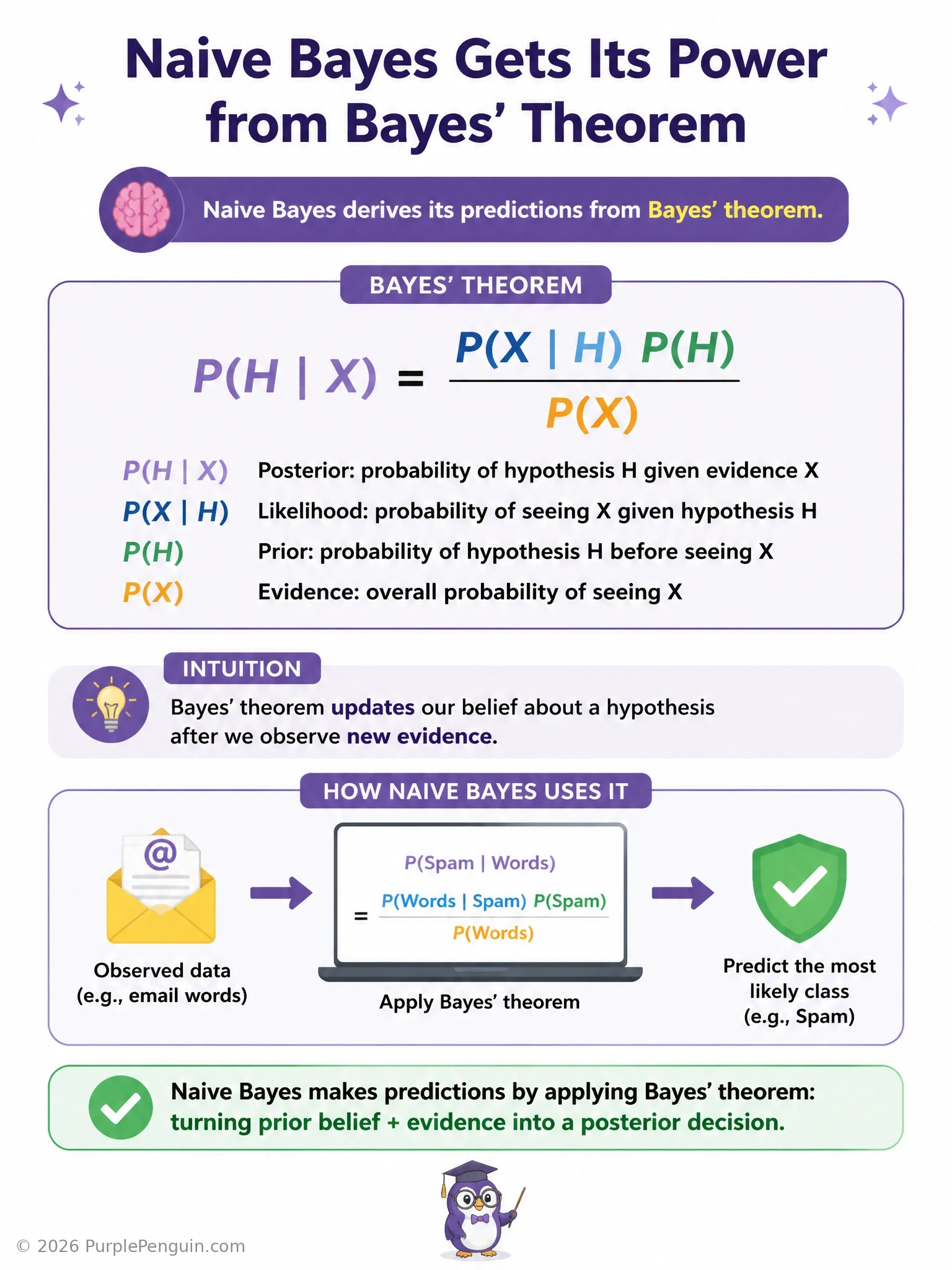
It's right there in the name — Naive Bayes runs on Bayes' theorem, which flips conditional probabilities around: it takes something easy to estimate, like how likely certain words are given that an email is spam, and uses that to work out the harder question, how likely is this email to be spam given the words it contains. The "naive" part just refers to the simplifying assumption that all the features (like individual words) are conditionally independent given the class, which makes the math tractable even though it's not strictly true in real data. So Bayes' theorem is your answer. The chain rule of differentiation is a calculus tool for computing derivatives of nested functions — that's backprop's territory, not Naive Bayes. The central limit theorem describes how sample means behave as sample size grows, unrelated to how Naive Bayes computes class probabilities. And PCA is a dimensionality-reduction technique, not a probability rule — it has nothing to do with how Naive Bayes derives its predictions.
Full explanation below image
Full Explanation
The Naive Bayes classifier is built directly on Bayes' theorem, which relates the conditional probability of a hypothesis given evidence to the conditional probability of the evidence given the hypothesis, weighted by prior probabilities: P(class | features) is proportional to P(features | class) times P(class). Naive Bayes uses this relationship to estimate the posterior probability of each class given the observed feature values, and it classifies an instance as the class with the highest posterior probability. The "naive" qualifier comes from the simplifying (and often technically inaccurate) assumption that all features are conditionally independent of one another given the class label, which dramatically simplifies the computation of P(features | class) into a simple product of individual feature likelihoods, while still performing surprisingly well in practice for tasks like spam filtering and text classification.
The chain rule of differentiation is incorrect because it is a calculus rule used to compute the derivative of a composite function by multiplying the derivatives of its nested parts; it underlies gradient computation in backpropagation for neural networks but has no role in how Naive Bayes derives its class probabilities, since Naive Bayes is a probabilistic model rather than a gradient-optimized one.
The central limit theorem is incorrect because it is a statistical result describing how the distribution of sample means approaches a normal distribution as sample size increases, regardless of the underlying population distribution. This is a foundational idea in inferential statistics and confidence interval construction, but it is not the mechanism Naive Bayes uses to compute class probabilities.
Principal component analysis is incorrect because it is an unsupervised dimensionality-reduction technique that projects data onto directions of maximum variance; it is used for feature reduction or visualization and has no direct relationship to the probabilistic classification rule that defines Naive Bayes.
Memory aid: the name says it all — 'Naive' for the independence assumption, 'Bayes' for the theorem it is built on, turning P(features | class) and prior class probabilities into the posterior P(class | features).