In probability notation, what does the expression P(A|B) represent?
Select an answer to reveal the explanation.
Short Explanation and Infographic
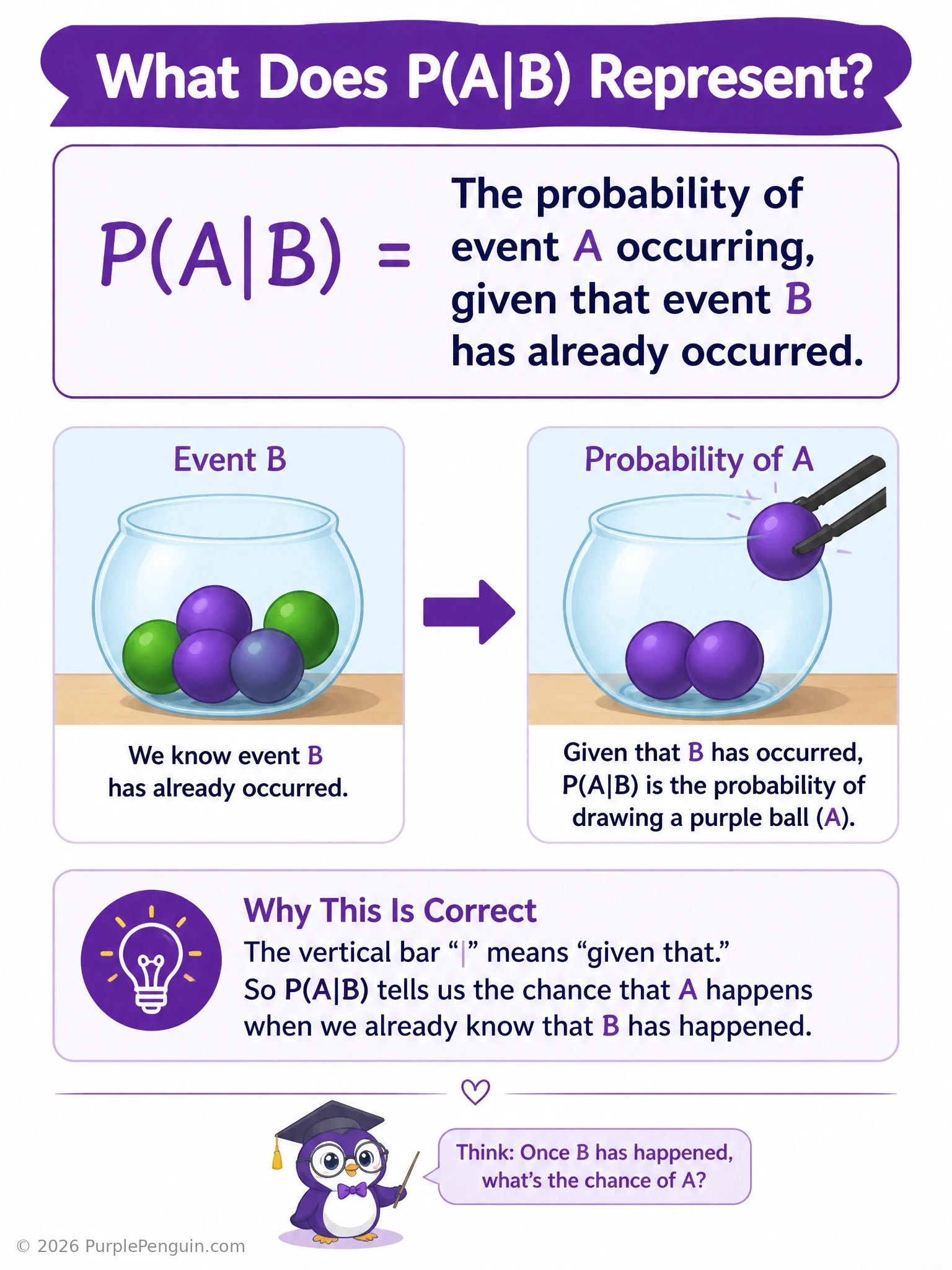
That little vertical bar in P(A|B) is doing a lot of work — read it as "given." So P(A|B) means: assuming B has already happened, what's the probability that A happens too? That conditioning is the whole point of the notation, and it's exactly what powers things like Naive Bayes and any model reasoning about probability under known evidence. So the correct answer is the one about A given B has occurred. The "both A and B together" option is actually describing joint probability, written P(A and B) or P(A ∩ B) — a related but distinct idea. The "either A or B but not both" option is describing exclusive-or probability, which uses a totally different notation and concept. And "A independent of B" is really the opposite situation — independence means P(A|B) equals P(A), i.e., knowing B tells you nothing new about A — but the notation P(A|B) itself doesn't assert independence, it just always means conditioning on B, whether or not the events happen to be independent.
Full explanation below image
Full Explanation
P(A|B) denotes conditional probability: the probability that event A occurs, given that event B is known to have occurred. It is formally defined as P(A|B) = P(A and B) / P(B), provided P(B) is greater than zero, meaning we restrict our attention to the subset of outcomes where B has happened and ask what fraction of those also satisfy A. Conditional probability is the backbone of Bayesian reasoning, Bayes' theorem, and any machine learning method (such as Naive Bayes or logistic regression's probabilistic interpretation) that updates a probability estimate in light of observed evidence.
The joint probability option, describing A and B occurring together, is incorrect because that quantity is written P(A and B) or P(A ∩ B), and while it is used in the definition of conditional probability, it is a different value: joint probability considers both events happening in the full sample space, whereas conditional probability rescales that joint probability by dividing by P(B), effectively asking a question only within the world where B is true.
The exclusive-or option, describing A or B but not both, is incorrect because that describes a symmetric difference of events, generally notated P(A ⊕ B) or computed as P(A) + P(B) − 2·P(A and B); it has no direct relationship to the conditioning bar notation and answers a completely different question about which single event occurs.
The independence option is incorrect because P(A|B) does not assert or require that A and B are independent; it simply denotes conditioning on B regardless of the relationship between the events. In fact, independence is a special case defined by the condition P(A|B) = P(A), meaning knowledge of B provides no information about A. If A and B were dependent (the more common and interesting case), P(A|B) would differ from P(A), which is precisely why conditional probability is useful for capturing dependencies between events.
Memory aid: read the vertical bar as 'given' — P(A|B) is always 'probability of A, given B,' the foundation beneath Bayes' theorem and every probabilistic classifier that reasons from evidence to conclusion.