After computing the covariance between two features, X and Y, an analyst finds it is a large positive number. What does this positive covariance indicate about the relationship between X and Y?
Select an answer to reveal the explanation.
Short Explanation and Infographic
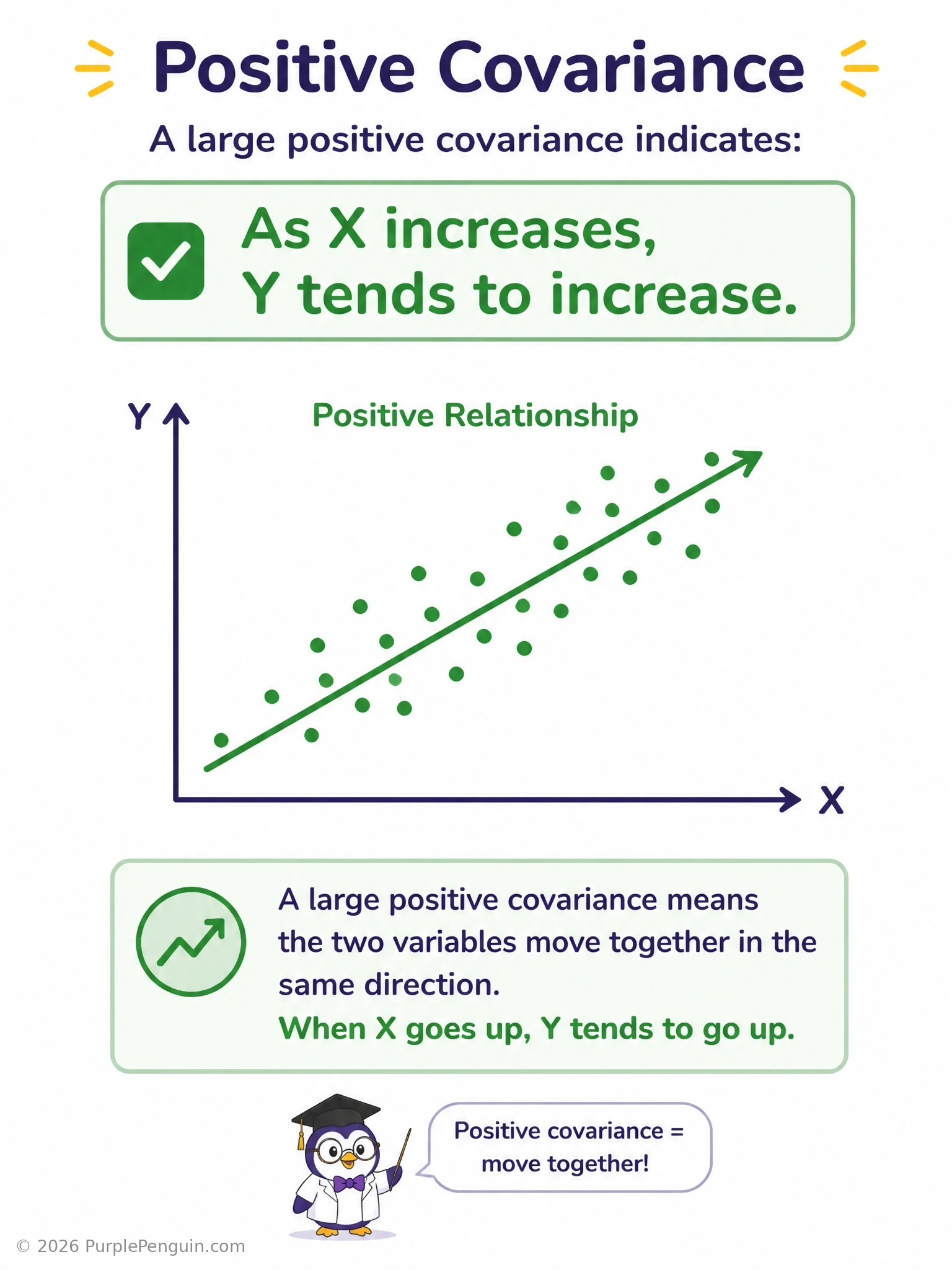
Here's the simple read on covariance: the sign tells you the direction of the relationship. A positive covariance means that when X goes up, Y tends to go up too, and when X goes down, Y tends to follow it down — they move in the same direction on average. So "as X increases, Y tends to increase" is your answer. The opposite pattern, X up while Y tends to go down, would show up as a negative covariance, not a positive one, so that option is backwards. Completely independent variables would give you a covariance at or near zero, not a large positive value, so that's wrong too. And here's the classic trap: covariance (or correlation) only tells you about a statistical association, never about cause and effect — X and Y could move together because of some third factor entirely, so claiming X causes Y is reading more into the number than it actually says.
Full explanation below image
Full Explanation
Covariance measures the direction of the linear relationship between two variables by looking at how their deviations from their respective means align across the dataset. When the covariance between X and Y is a large positive number, it means that observations where X is above its mean tend to also have Y above its mean, and observations where X is below its mean tend to also have Y below its mean — in short, X and Y tend to rise and fall together. This is distinct from correlation, which is covariance normalized to a fixed range (typically -1 to 1) for easier comparison across variable pairs, but the sign interpretation is the same: positive means "move together," negative means "move oppositely."
"As X increases, Y tends to decrease" is incorrect because that describes a negative covariance, where the two variables move in opposite directions. A large positive covariance is the opposite pattern.
"X and Y are completely independent of one another" is incorrect because independent variables produce a covariance at or near zero (in the linear sense), not a large positive value. A strong positive covariance is direct evidence against independence; it shows the variables share a detectable linear relationship.
"X causes Y to increase" is incorrect because covariance (like correlation) is strictly a measure of statistical association, not causation. A positive covariance can arise from X genuinely influencing Y, from Y influencing X, from both being driven by a shared underlying (confounding) factor, or even by coincidence in a limited sample. Concluding causation from covariance alone is a common and important reasoning error to avoid; establishing causation requires controlled experiments or specific causal-inference techniques, not just a computed statistic.
Memory aid: "correlation (and covariance) is not causation" — the sign of covariance only tells you the direction two variables tend to move together, never why.