During training, a framework computes the gradient vector of the loss function with respect to the model's weights. In which direction does this raw gradient vector actually point?
Select an answer to reveal the explanation.
Short Explanation and Infographic
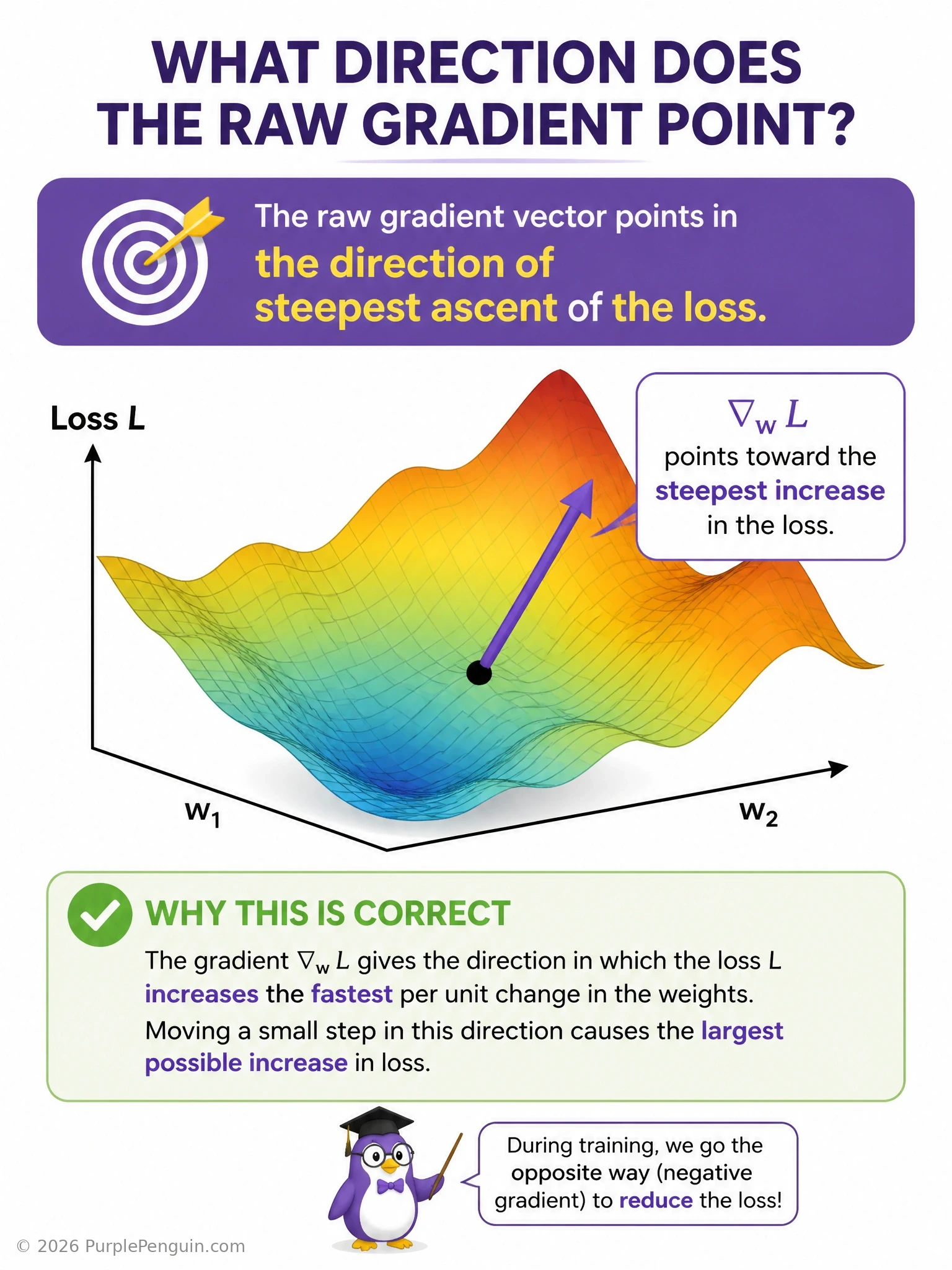
This trips people up all the time, so let's nail it down: the raw gradient always points uphill — toward the direction where the loss increases the fastest, known as steepest ascent. That's just a mathematical fact about gradients, whether you're minimizing or maximizing anything. Since we want to minimize loss during training, gradient descent takes the negative of that gradient and steps downhill instead, but the gradient vector itself, before you flip its sign, points uphill. So "steepest ascent" is the correct answer. It's not perpendicular to the loss surface in the sense of being some fixed geometric constant — that description doesn't match what a gradient is. And it's absolutely not random — the gradient is a precise, deterministic calculation derived directly from the loss function's partial derivatives, which is exactly why gradient-based optimization works at all.
Full explanation below image
Full Explanation
The gradient of a scalar function, such as a loss function, with respect to a set of variables (the model's weights) is a vector composed of the partial derivatives of that function with respect to each variable. A fundamental result from multivariable calculus is that this gradient vector points in the direction of steepest ascent — the direction in which the function increases most rapidly from the current point, and its magnitude indicates how steep that increase is. This holds true universally for any differentiable scalar function, independent of whether the ultimate goal is minimization or maximization.
Because training a neural network involves minimizing the loss, not maximizing it, gradient descent takes a step in the direction of the negative gradient, which points toward steepest descent — the direction the loss decreases fastest. This is why the update rule subtracts the (learning-rate-scaled) gradient from the current weights rather than adding it. Understanding that the raw gradient itself points uphill, and that the negative gradient is what enables descent, is essential to correctly reasoning about optimization mechanics and debugging cases where a sign error accidentally causes loss to increase during training.
"The direction of steepest descent of the loss" is incorrect as a description of the raw gradient vector itself; steepest descent is the direction of the negative gradient, not the gradient as directly computed.
"A direction that is always exactly perpendicular to the loss surface" is incorrect because it misdescribes the geometric meaning of a gradient. The gradient is perpendicular to the level curves (contours of equal loss) of the function, not perpendicular to the loss surface itself in the sense implied here; more importantly, this framing distracts from the gradient's actual defining property, which is that it points toward the direction of maximum rate of increase.
"A randomly chosen direction unrelated to the loss surface" is incorrect because the gradient is a deterministic, precisely defined quantity computed via calculus (partial derivatives) directly from the loss function's local shape. It is the opposite of random; its exact direction and magnitude are what make gradient-based learning a principled, repeatable optimization procedure rather than a guessing game.
Memory aid: "gradient goes up, descent goes down" — take the negative of the gradient to actually reduce loss.