A subscription company wants to predict whether each customer will churn (yes/no) in the next month using account features like tenure, usage, and support tickets. Which classical algorithm is a common, natural first choice for this kind of binary outcome prediction?
Select an answer to reveal the explanation.
Short Explanation and Infographic
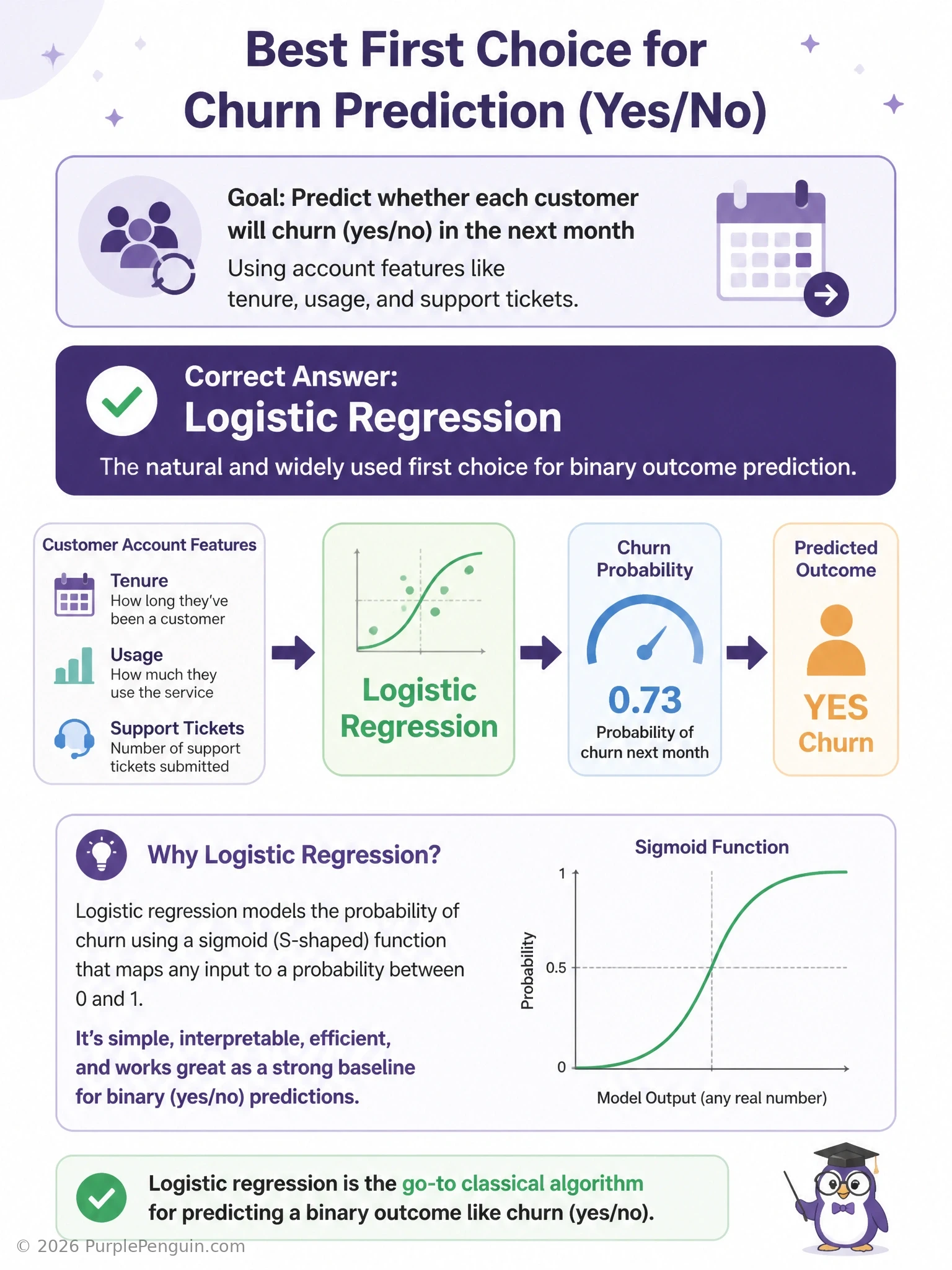
"Will churn or won't churn" is a yes/no question, and logistic regression is the classical go-to model built exactly for that: it takes your features, runs them through a linear combination, then squashes the result through a sigmoid function so you get a clean probability between 0 and 1, like a 73% chance this customer churns. Threshold that probability and you've got your binary prediction. That's why logistic regression is the answer here. Linear regression predicts a continuous, unbounded number, so it isn't naturally suited to a yes/no outcome — nothing stops it from spitting out 1.4 or negative 0.2, which don't make sense as churn probabilities. K-Means is unsupervised clustering with no concept of a labeled churn outcome to predict. And PCA is a dimensionality-reduction technique for compressing features, not a classifier that outputs a churn decision at all.
Full explanation below image
Full Explanation
Logistic regression is a classical, widely used algorithm for binary classification tasks like churn prediction. It models the log-odds of the positive outcome (churn) as a linear combination of input features, then passes that linear combination through the sigmoid (logistic) function to squash the output into a valid probability between 0 and 1. A decision threshold, commonly 0.5, is then applied to convert that probability into a final yes/no prediction. Logistic regression is favored as a first choice for problems like churn prediction because it is fast to train, produces interpretable coefficients (each feature's weight indicates its directional influence on churn probability), and provides well-calibrated probability estimates that are useful for prioritizing which customers to target with retention efforts.
Linear regression is incorrect because it is designed to predict continuous, unbounded numeric outputs by fitting a straight line (or hyperplane) through the data. Applied directly to a binary 0/1 outcome, its predictions are not constrained to the [0,1] probability range and its underlying assumptions (constant variance, normally distributed residuals) are violated by binary targets, making it a poor and non-standard fit for this task compared to logistic regression.
K-Means clustering is incorrect because it is an unsupervised algorithm that groups data points into clusters based on similarity, with no use of or access to a labeled churn outcome. It cannot produce a supervised prediction of churn versus no-churn for a specific customer because it isn't designed to learn from labeled examples at all.
Principal Component Analysis is incorrect because it is an unsupervised dimensionality-reduction technique that transforms features into a smaller set of uncorrelated components capturing maximum variance. It can be a useful preprocessing step before modeling, but on its own it does not produce a churn prediction; it does not use or model any labeled target variable.
Memory aid: linear regression predicts a number on a line; logistic regression predicts a probability on an S-curve — and churn (yes/no) needs that S-curve.