The idea of finding an optimal separating hyperplane between two classes, with the widest possible margin on either side, is the central concept behind which classical algorithm?
Select an answer to reveal the explanation.
Short Explanation and Infographic
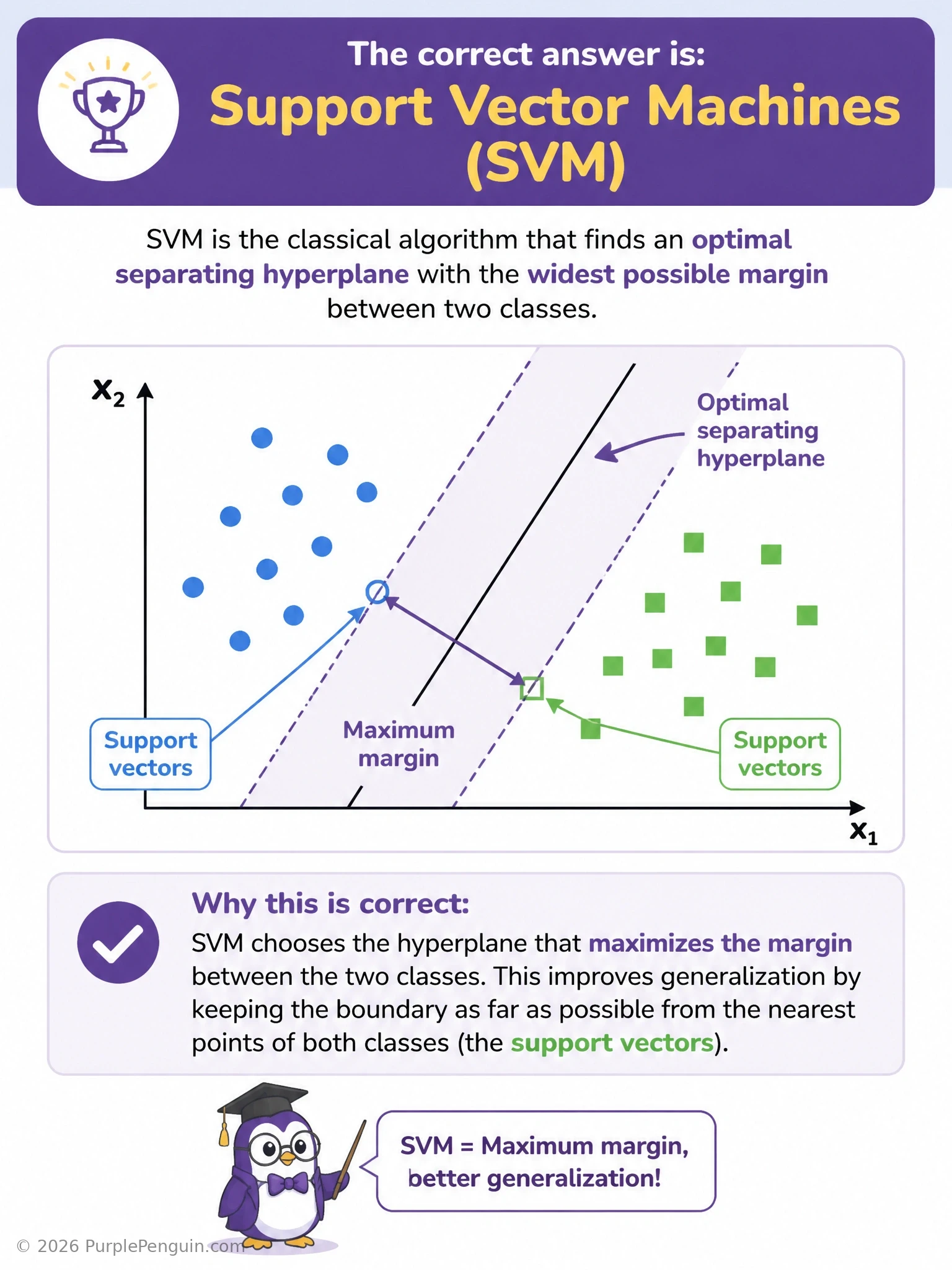
Let's cut right to it: whenever you hear "hyperplane" and "maximum margin" in the same breath, that's the signature of Support Vector Machines. An SVM doesn't just draw any line (or higher-dimensional plane) between two classes — it hunts for the one that leaves the widest possible cushion of empty space on both sides, using only the closest points, the support vectors, to define that boundary. That's why SVM is the answer. K-Means has nothing to do with drawing boundaries between labeled classes; it's unsupervised and just groups nearby points into k clusters. Naive Bayes classifies by comparing probabilities using Bayes' theorem, not by geometrically fitting a boundary at all. And PCA isn't a classifier — it's a dimensionality-reduction technique that finds directions of maximum variance in the data, nothing to do with separating classes.
Full explanation below image
Full Explanation
Support Vector Machines are built around finding the hyperplane that best separates two classes in feature space while maximizing the margin — the distance between the hyperplane and the nearest data points from each class. Those nearest points are called support vectors because they are the only points that actually determine the position of the optimal boundary; moving any other point has no effect on the solution. This margin-maximization principle gives SVMs strong generalization properties, and with the kernel trick, SVMs can find non-linear separating boundaries by implicitly mapping data into higher-dimensional spaces where a hyperplane can separate classes that are not linearly separable in the original space.
K-Means clustering is incorrect because it is an unsupervised algorithm that partitions data into k clusters by minimizing within-cluster distance to centroids. It has no concept of a labeled class boundary or a maximum-margin hyperplane; it simply groups points by proximity without any notion of separating pre-defined classes.
Naive Bayes is incorrect because it is a probabilistic classifier grounded in Bayes' theorem and an assumption of conditional independence between features. It assigns a class by comparing computed posterior probabilities, not by constructing or optimizing any geometric boundary like a hyperplane.
Principal Component Analysis is incorrect because it is an unsupervised dimensionality-reduction technique that finds the orthogonal directions (principal components) along which the data varies the most. It transforms or reduces feature space; it does not classify data or construct a decision boundary between classes at all.
Memory aid: SVM equals "Separate Via Margin" — hyperplane plus maximum margin is the SVM fingerprint, and support vectors are the handful of boundary-defining points that give the algorithm its name.