While profiling a numeric feature before training, an analyst finds that its mean is noticeably higher than its median. What does this gap between mean and median most directly suggest about the feature's distribution?
Select an answer to reveal the explanation.
Short Explanation and Infographic
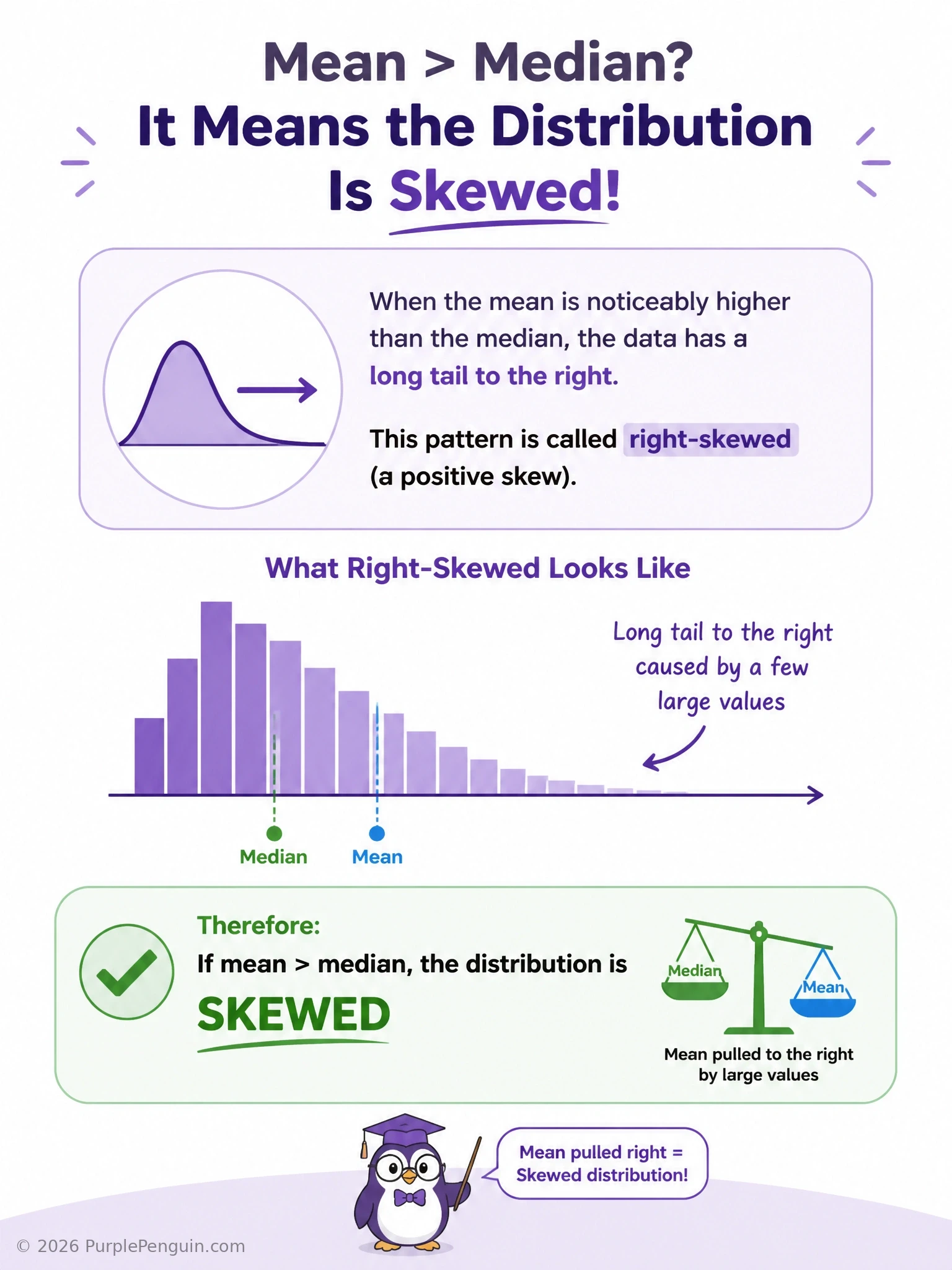
Picture the mean as the average that gets dragged around by extreme values, while the median just sits in the middle of the pack no matter how wild the outliers get. When those two numbers disagree by a lot, that's a big flag that the data isn't symmetric — it's skewed, with a tail stretching out in one direction (often a right, or positive, skew when the mean sits above the median, since a few huge values pull the average up). So "skewed" is the answer here. It's definitely not zero variance — if there were zero variance every value would be identical and mean would equal median exactly. It's the opposite of normally distributed, since in a true normal distribution the mean and median are equal. And this is a numeric-only concept; mean and median aren't even computed on categorical values in the first place.
Full explanation below image
Full Explanation
When a distribution's mean differs substantially from its median, that divergence is a hallmark of skewness. The mean is sensitive to every value in the dataset, including extreme outliers, because it sums all values and divides by the count. The median, by contrast, is the middle value when data is sorted, and it is far more robust to outliers because it only cares about rank order, not magnitude. In a perfectly symmetric distribution, the mean and median coincide. When the mean sits meaningfully above the median, it typically indicates a right (positive) skew, where a small number of unusually large values pull the average upward while the bulk of the data remains lower. Conversely, a mean noticeably below the median typically signals a left (negative) skew. Recognizing skew matters in practice because many models and preprocessing steps (like z-score standardization) assume roughly symmetric, near-normal inputs, and skewed features often benefit from transformations such as a log transform before training.
Zero variance is incorrect because zero variance means every data point is identical, which would force the mean and median to be exactly equal (both equal to that single repeated value), not divergent. A large mean-median gap is actually associated with the opposite condition: high spread combined with asymmetry.
Perfectly normally distributed is incorrect because a defining property of the normal (Gaussian) distribution is that its mean, median, and mode are all equal by construction, due to its perfect symmetry around the center. A substantial mean-median gap directly contradicts normality; it is evidence against, not for, a normal distribution.
Contains only categorical values is incorrect because mean and median are statistics computed on ordered numeric data. Purely categorical (unordered, non-numeric) values don't have a meaningful mean or median to compare in the first place, so the premise of the question presupposes a numeric feature.
Memory aid: symmetric data means mean equals median; the bigger the gap, the more skewed the tail.