In a convolutional neural network, the repeated stacking of convolution layers followed by pooling layers is, at its core, a practical implementation of which broader concept?
Select an answer to reveal the explanation.
Short Explanation and Infographic
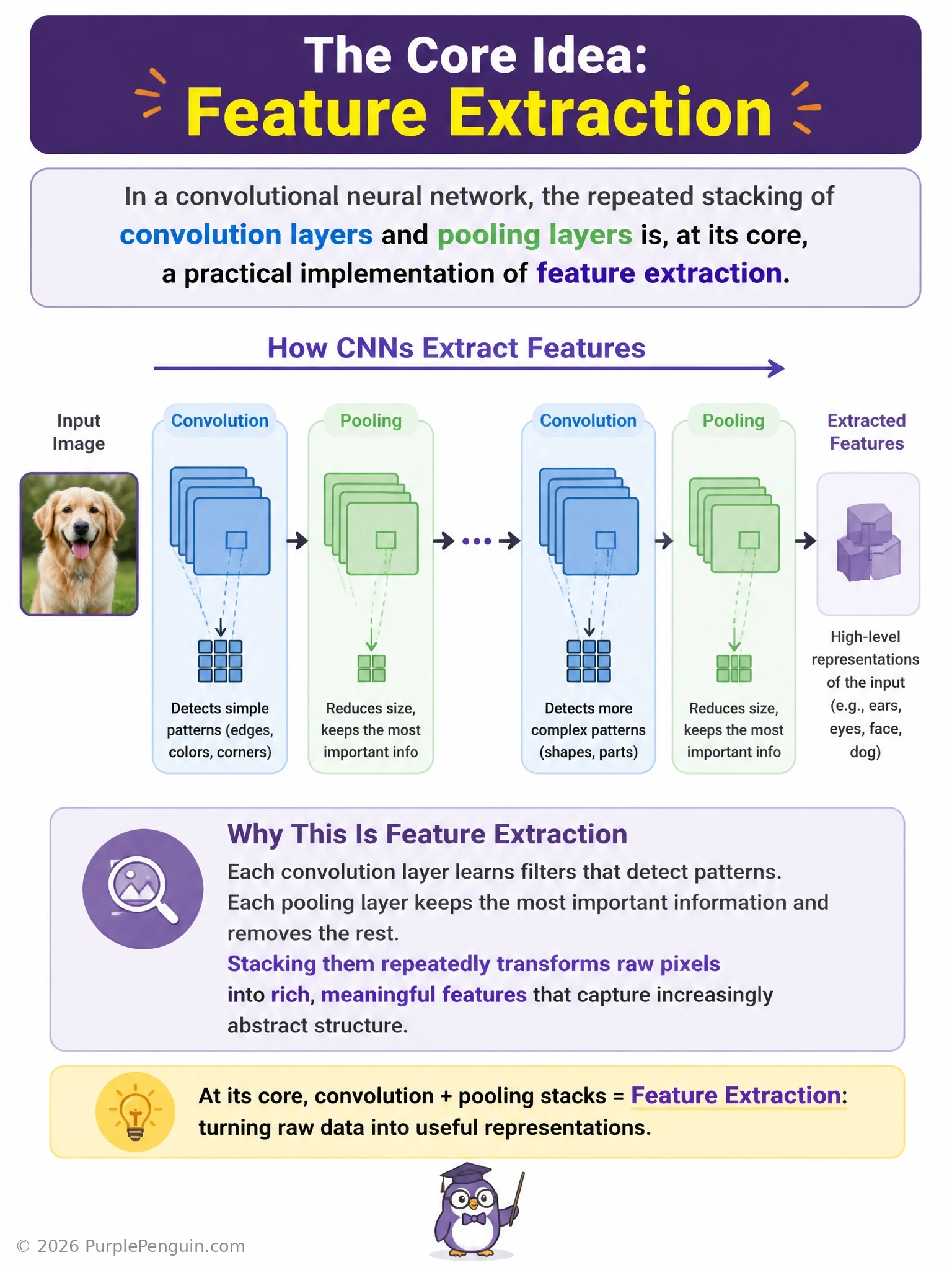
Here's how to see it: every convolution layer slides small filters across the image looking for patterns like edges, textures, and shapes, and every pooling layer condenses that information down while keeping the important signal. Stack a bunch of these together and what you get is a pipeline that automatically pulls increasingly abstract, useful features out of raw pixels — edges become shapes, shapes become object parts, object parts become whole objects. That whole process is feature extraction, so that's your answer. Hyperparameter tuning is about picking settings like learning rate or number of filters, not about what the layers themselves are doing mathematically. Cross-validation is an evaluation technique for estimating how well a model generalizes, unrelated to how conv and pooling layers transform an image. And regularization is about controlling overfitting (think dropout or weight decay), not about pulling patterns out of raw data.
Full explanation below image
Full Explanation
In a convolutional neural network, convolution layers apply learned filters (kernels) across the input, each filter activating strongly wherever it detects a specific local pattern such as an edge, corner, texture, or color gradient. Pooling layers (max or average pooling) then downsample the resulting feature maps, reducing spatial dimensions while retaining the strongest or most representative signal from each local region. When many convolution-plus-pooling blocks are stacked, the network builds a hierarchy: early layers detect simple, low-level patterns, and deeper layers combine those into increasingly complex, abstract representations such as object parts and eventually whole objects. This entire mechanism is fundamentally a learned, automated form of feature extraction — transforming raw pixel values into a compact, informative representation that a downstream classifier (typically fully connected layers) can use to make predictions.
Hyperparameter tuning is incorrect because it refers to the process of selecting configuration values that are not learned directly from data, such as the number of filters, kernel size, learning rate, or number of layers. Tuning is a meta-level activity performed around the architecture; it is not what the convolution and pooling operations themselves accomplish mathematically.
Cross-validation is incorrect because it is a model evaluation and validation strategy that splits data into folds to estimate generalization performance. It has no direct relationship to what convolution and pooling layers compute internally; it is applied around training and evaluation, not inside the feature-extracting layers.
Regularization is incorrect because it refers to techniques explicitly aimed at reducing overfitting, such as dropout, L1/L2 weight penalties, or early stopping. While pooling can have a mild regularizing side effect by reducing parameter count and spatial resolution, its primary and defining purpose within a CNN is to help build the hierarchical feature representation, not to constrain model complexity.
Memory aid: convolution finds the patterns, pooling compresses them, and together they are the feature-extraction engine that lets a CNN see edges, shapes, and objects without being told what to look for.