In the underlying math of a neural network, what role do matrices primarily play?
Select an answer to reveal the explanation.
Short Explanation and Infographic
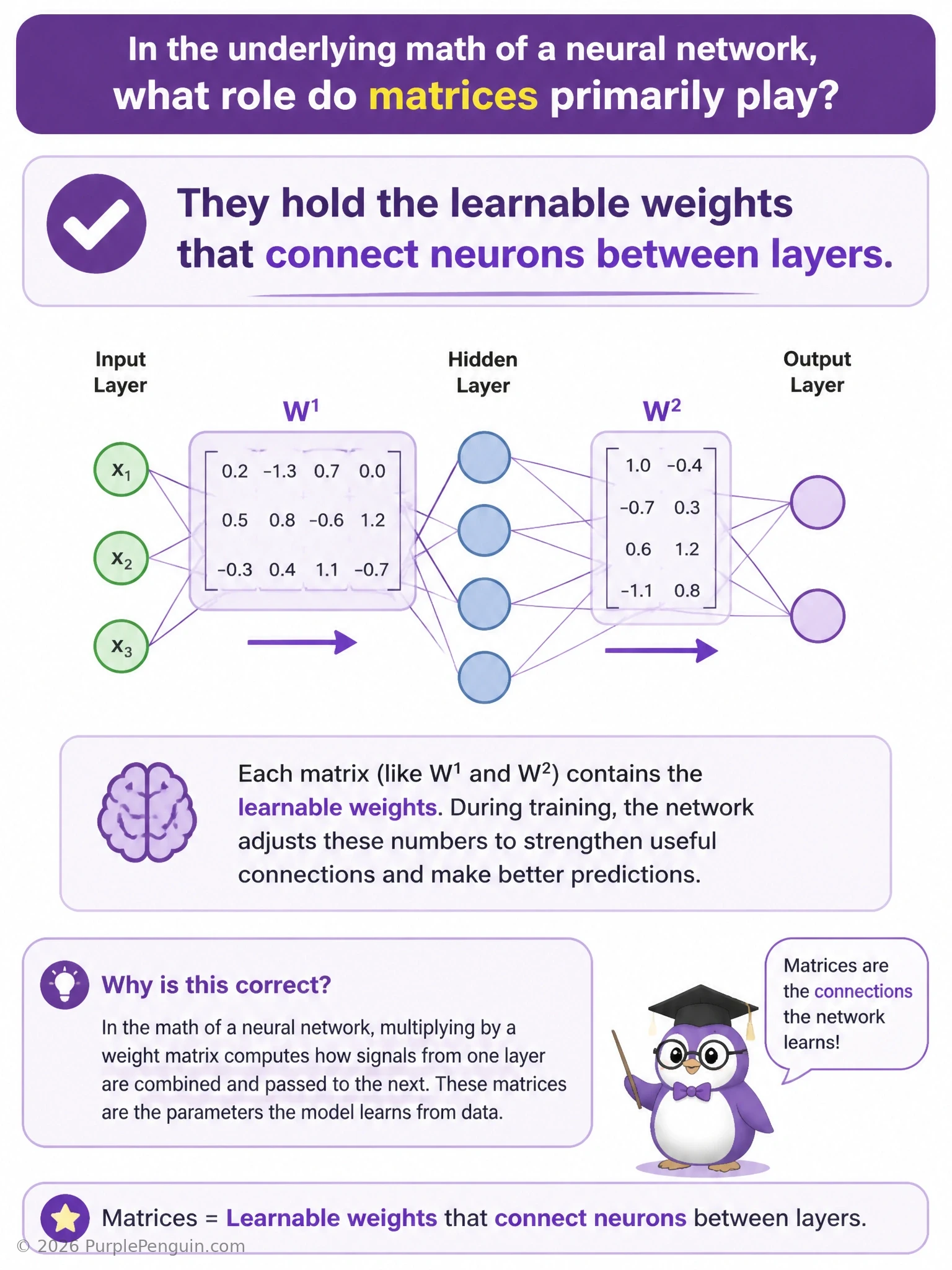
Here's the simplest way to see it: every layer in a neural network is really just a matrix multiplication followed by an activation function. The weights connecting one layer's neurons to the next layer's neurons are packed into a matrix, and when you multiply that weight matrix by the incoming input vector, you get the raw values heading into the next layer. That's the real engine room of the network — matrices are literally where the learned knowledge lives, since training is nothing more than adjusting the numbers inside those matrices. Training loss is just a scalar tracked per epoch, not something stored in a weight matrix. Activation functions are separate nonlinear operations applied after the matrix multiplication, not matrices themselves. And mini-batch ordering is a data-pipeline detail that has nothing to do with what the matrices in the model represent.
Full explanation below image
Full Explanation
In a neural network, matrices are the primary data structure used to hold the learnable weights connecting neurons in one layer to neurons in the next layer. For a fully connected layer, the forward pass is computed as z = Wx + b, where W is a weight matrix (with dimensions matching the number of output neurons by the number of input neurons), x is the input vector, and b is a bias vector. Training a neural network via backpropagation and gradient descent amounts to iteratively updating the values inside these weight matrices (and bias vectors) so that the network's predictions improve. This matrix-based formulation is also what allows deep learning frameworks to leverage highly optimized linear algebra libraries and GPU hardware, since matrix multiplication is easily parallelized.
The 'training loss values' distractor is incorrect because loss is a scalar (or a small set of scalars per batch/epoch) computed by a loss function to measure prediction error; it is logged or tracked separately for monitoring purposes and is not stored within the weight matrices themselves, which hold parameters, not performance metrics.
The 'defines the activation function' distractor is incorrect because activation functions (such as ReLU, sigmoid, or tanh) are separate nonlinear mathematical operations applied element-wise to the output of a matrix multiplication; they are not matrices themselves and are not learned parameters — they are fixed functions chosen as part of the architecture design.
The 'records mini-batch order' distractor is incorrect because the sequence in which mini-batches are presented during training is a data-loading and shuffling detail managed by the training loop or data pipeline, entirely unrelated to what the network's internal weight matrices represent or store.
Understanding that weights live in matrices (and biases in vectors) is foundational to understanding concepts like parameter counts, matrix dimension compatibility between layers, weight initialization strategies, and why deep learning is so compute-intensive: training and inference both boil down to enormous numbers of matrix multiplications. A useful memory aid: 'the weights are the memory, the matrix is the filing cabinet that holds them.'