An engineer is reviewing why a similarity-scoring layer multiplies two embedding vectors element-wise and sums the results. Conceptually, what does this dot product operation give you?
Select an answer to reveal the explanation.
Short Explanation and Infographic
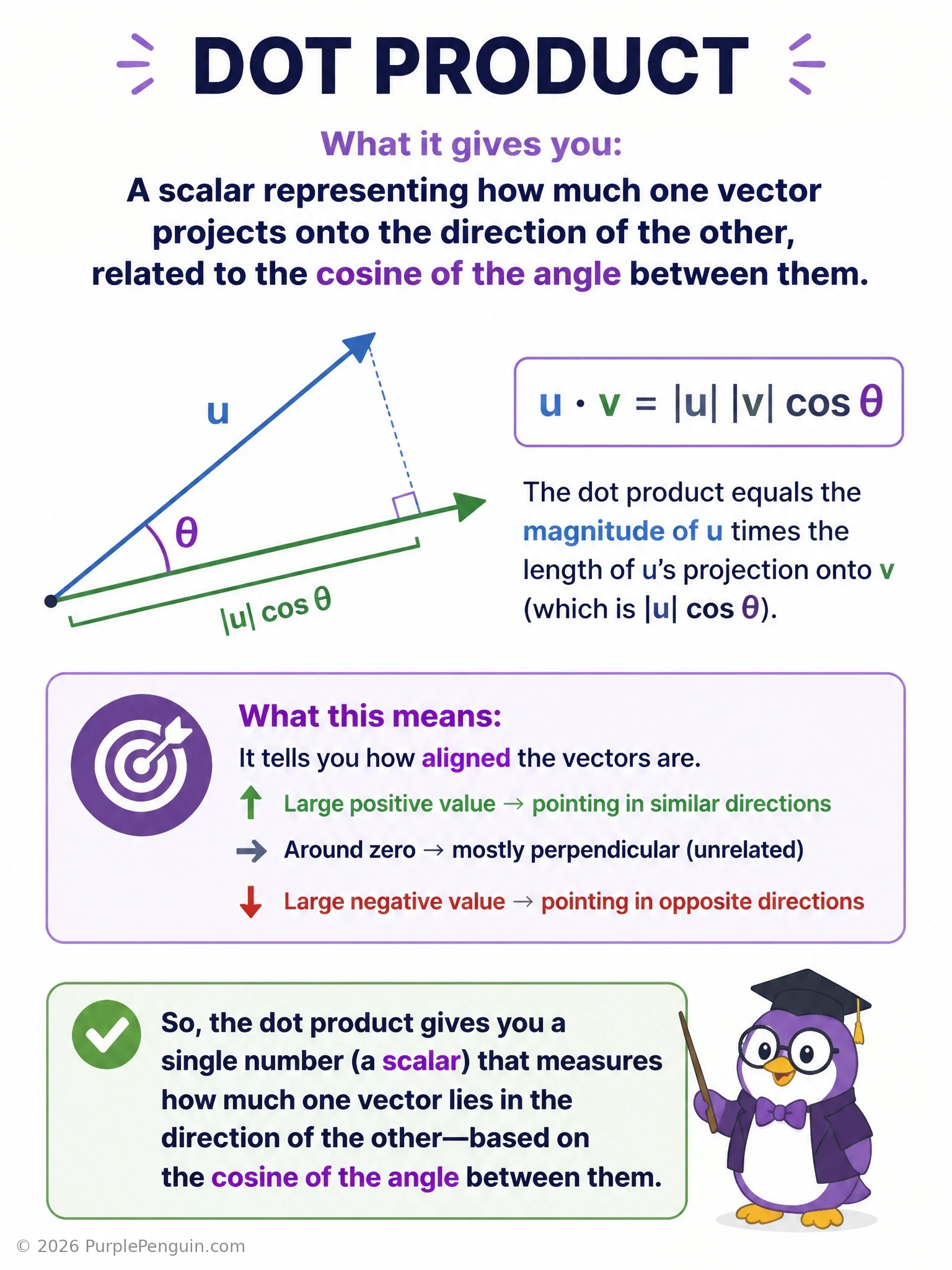
Here's the deal: a dot product is basically asking 'how much does vector A point in the same direction as vector B?' You multiply matching components and add them up, and what falls out is a single scalar that captures both the vectors' magnitudes and the angle between them — it's literally proportional to the cosine of that angle. That's why embeddings with similar meaning end up with a bigger dot product: they're pointing the same way. The cross product gives you a new orthogonal vector (and only in 3D), which isn't what's happening here. Counting shared nonzero dimensions or taking an element-wise max just throws away all the directional information the dot product is built to capture.
Full explanation below image
Full Explanation
The dot product of two vectors a and b is defined as the sum of the products of their corresponding components, and it equals |a||b|cos(theta), where theta is the angle between the vectors. This makes it the natural measure of scalar projection: it tells you the magnitude of the component of one vector lying along the direction of the other, scaled by both vectors' lengths. In deep learning this shows up constantly — attention scores in transformers are dot products between query and key vectors, and cosine similarity between embeddings is just a normalized dot product. When two vectors point in nearly the same direction, cos(theta) approaches 1 and the dot product is large and positive; when they are orthogonal, it is zero; when they point in opposite directions, it is negative. Option 'the element-wise maximum' describes a completely different operation that produces a vector, not a scalar, and discards magnitude/direction relationships entirely. 'A new vector orthogonal to both input vectors' describes the cross product, which is only defined in three dimensions and is not what a dot product computes — it also produces a vector rather than a scalar. 'The total number of nonzero shared dimensions' describes something closer to a sparse overlap count (relevant to set intersection or Jaccard-style measures), not a dot product, and ignores the actual numeric values and their signs entirely. A useful memory aid: dot product answers 'how aligned are these two vectors, weighted by their sizes?' — it collapses two vectors down into one number that reflects both magnitude and direction agreement, which is exactly the scalar-projection interpretation.