In linear algebra, what does taking the transpose of a matrix produce?
Select an answer to reveal the explanation.
Short Explanation and Infographic
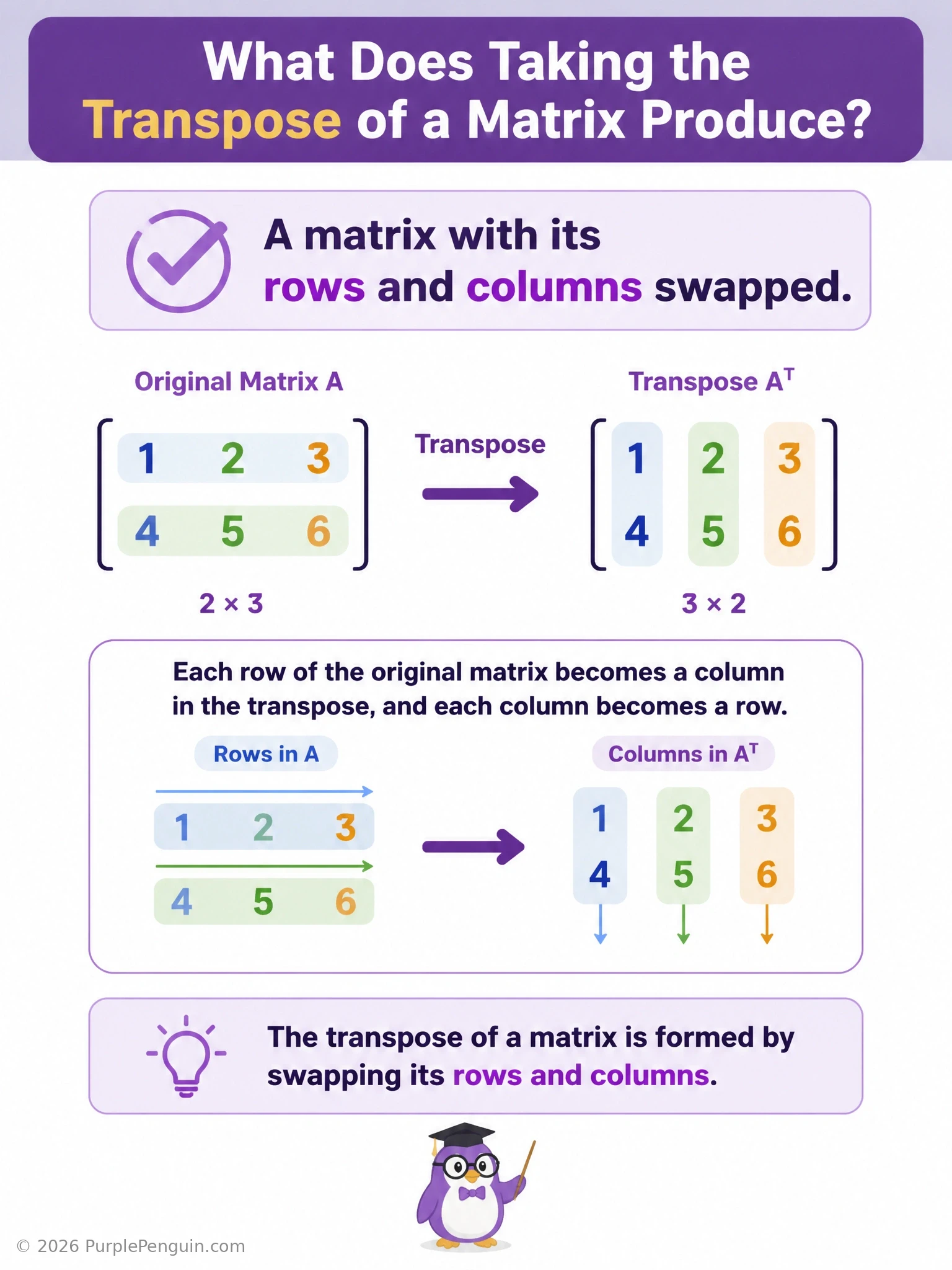
Transpose is one of the easiest operations in linear algebra once it clicks: you just flip the matrix along its diagonal, so what used to be a row becomes a column, and what used to be a column becomes a row. If your original matrix is 3 rows by 5 columns, the transpose comes out 5 rows by 3 columns, and the entry that was at position (row 2, column 4) now sits at (row 4, column 2). That's it — no math on the values, just a reshuffle of position. The 'multiplicative inverse of every element' option is describing something like a reciprocal matrix, which isn't a standard operation and definitely isn't the transpose. Scaling rows to sum to one is normalization, a different beast entirely. And multiplying by negative one just flips signs — it doesn't touch the shape or position of anything.
Full explanation below image
Full Explanation
The transpose of a matrix A, denoted Aᵀ, is formed by swapping its rows and columns: the element at position (i, j) in the original matrix moves to position (j, i) in the transpose. Consequently, an m × n matrix becomes an n × m matrix after transposition. Transposition is a purely structural/positional operation — it does not alter the numeric values of any entry, only their placement. It is used extensively in deep learning: for example, transposing weight matrices when switching between forward and backward computations, computing dot products between row and column vectors, and forming expressions like XᵀX in normal equations or covariance calculations.
The 'multiplicative inverse of every element' distractor describes an element-wise reciprocal operation, which is not a standard or named linear algebra transformation and bears no relationship to transposition; transposition never changes the value of any entry, whereas taking a reciprocal changes every value (and is undefined for zero entries).
The 'scaled so rows sum to one' distractor describes a normalization procedure (e.g., converting a matrix into a row-stochastic matrix, as used in Markov chains), which is a value-altering operation entirely different from the purely positional swap that defines a transpose.
The 'multiply every element by negative one' distractor describes negation, which flips the sign of every value but leaves the matrix's shape and the position of elements completely unchanged — the opposite of what transposition does, since transposition changes position but not value, while negation changes value but not position.
Key properties worth remembering: (Aᵀ)ᵀ = A (transposing twice returns the original), (AB)ᵀ = BᵀAᵀ (the order reverses for products), and a matrix is symmetric if A = Aᵀ. A simple memory aid: 'transpose flips the matrix over its own diagonal, like turning a table on its side — rows become columns, columns become rows.'