A data scientist is choosing between several candidate decision boundaries for a support vector machine classifier. What is the SVM's primary objective when selecting among them?
Select an answer to reveal the explanation.
Short Explanation and Infographic
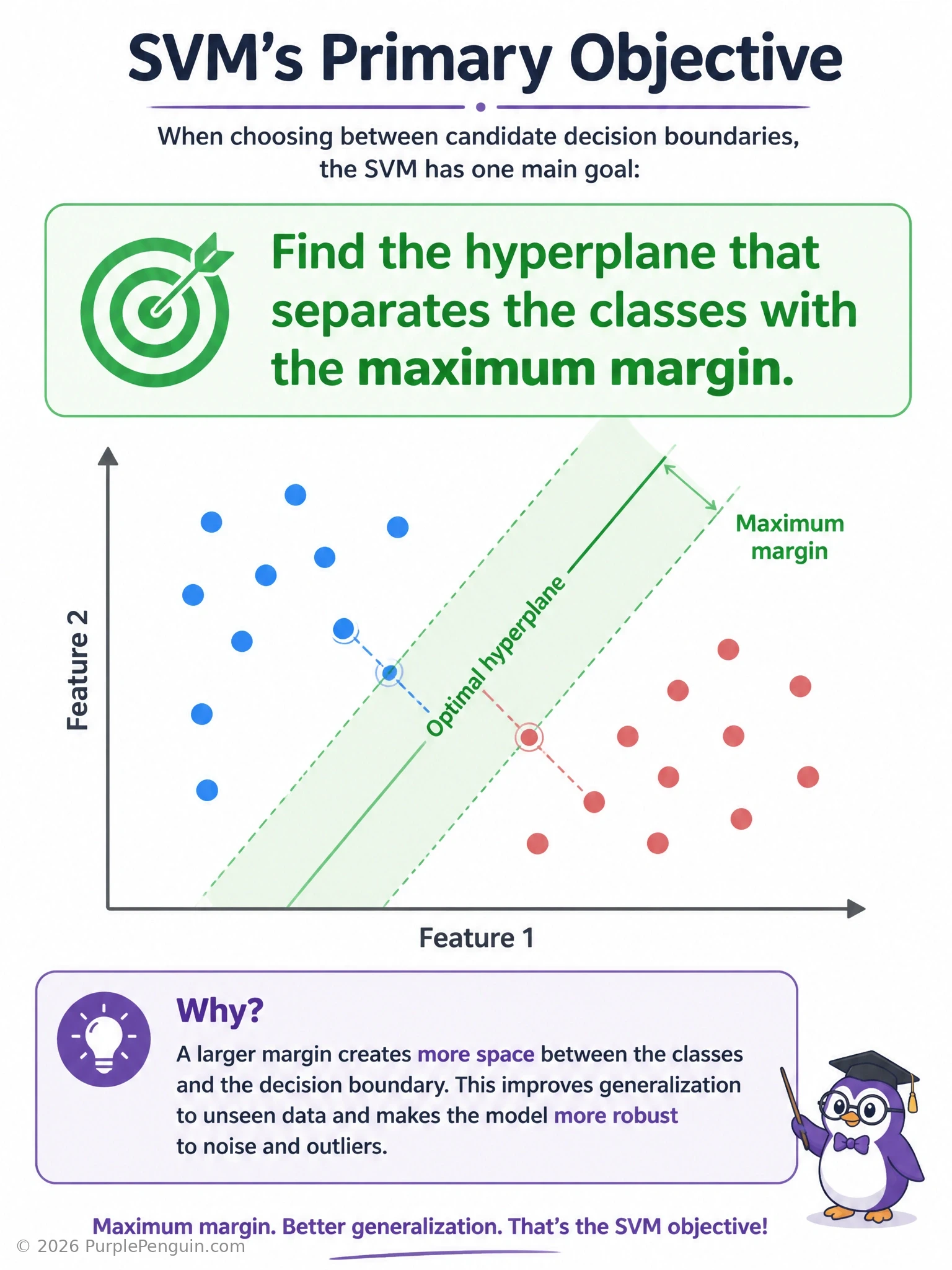
Think of an SVM as trying to build the widest possible 'no-man's-land' between two groups of points. It's not just looking for any line that separates the classes — plenty of lines could do that. It wants the one line (or hyperplane, in higher dimensions) that leaves the biggest cushion, the maximum margin, between itself and the closest points from each class. Those closest points are your support vectors, and they're what pin the boundary in place. Minimizing the count of support vectors isn't the goal — that's more of a side effect. Aiming for the mean of all points ignores the actual class boundary entirely. And minimizing squared distances to the boundary is basically describing a regression fit, not a classifier's margin. Maximum margin is the whole point of SVM.
Full explanation below image
Full Explanation
The core objective of a support vector machine (SVM) is to find the separating hyperplane that maximizes the margin — the distance between the hyperplane and the nearest data points from each class. These nearest points, which lie closest to (and effectively define) the decision boundary, are called support vectors. Maximizing this margin is believed to improve generalization: a wider margin means the classifier is less sensitive to small perturbations in the data and tends to produce a more robust decision boundary on unseen examples. This is formalized as a constrained optimization problem, typically solved via its dual formulation, and extended with a soft-margin (allowing some misclassification, controlled by a regularization parameter C) or with kernel functions to handle non-linearly separable data.
The 'minimize the number of support vectors' distractor is incorrect because the number of support vectors is not the direct optimization target; it is an emergent property of the solution. In fact, more support vectors can sometimes result from a wider or more complex margin, and the count is not something the algorithm explicitly tries to minimize.
The 'closest to the mean of all points' distractor describes something closer to a centroid-based method (like nearest-centroid classification or k-means), not an SVM. SVMs only care about the boundary points nearest the decision surface (the support vectors), not the overall centroid of the data.
The 'minimize sum of squared distances to the boundary' distractor describes a least-squares style regression or fitting objective, which is a fundamentally different mathematical goal from margin maximization; it does not represent a classification-margin criterion and would not produce a maximum-margin separator.
A useful memory aid: 'SVM' should make you think 'Streets between Vehicles and Margins' — it's always hunting for the widest street between two crowds of points, using only the closest points on each curb (the support vectors) to define where that street runs.