Which mathematical concept allows backpropagation to compute how the loss at the output layer should adjust the weights buried deep in earlier layers of a network?
Select an answer to reveal the explanation.
Short Explanation and Infographic
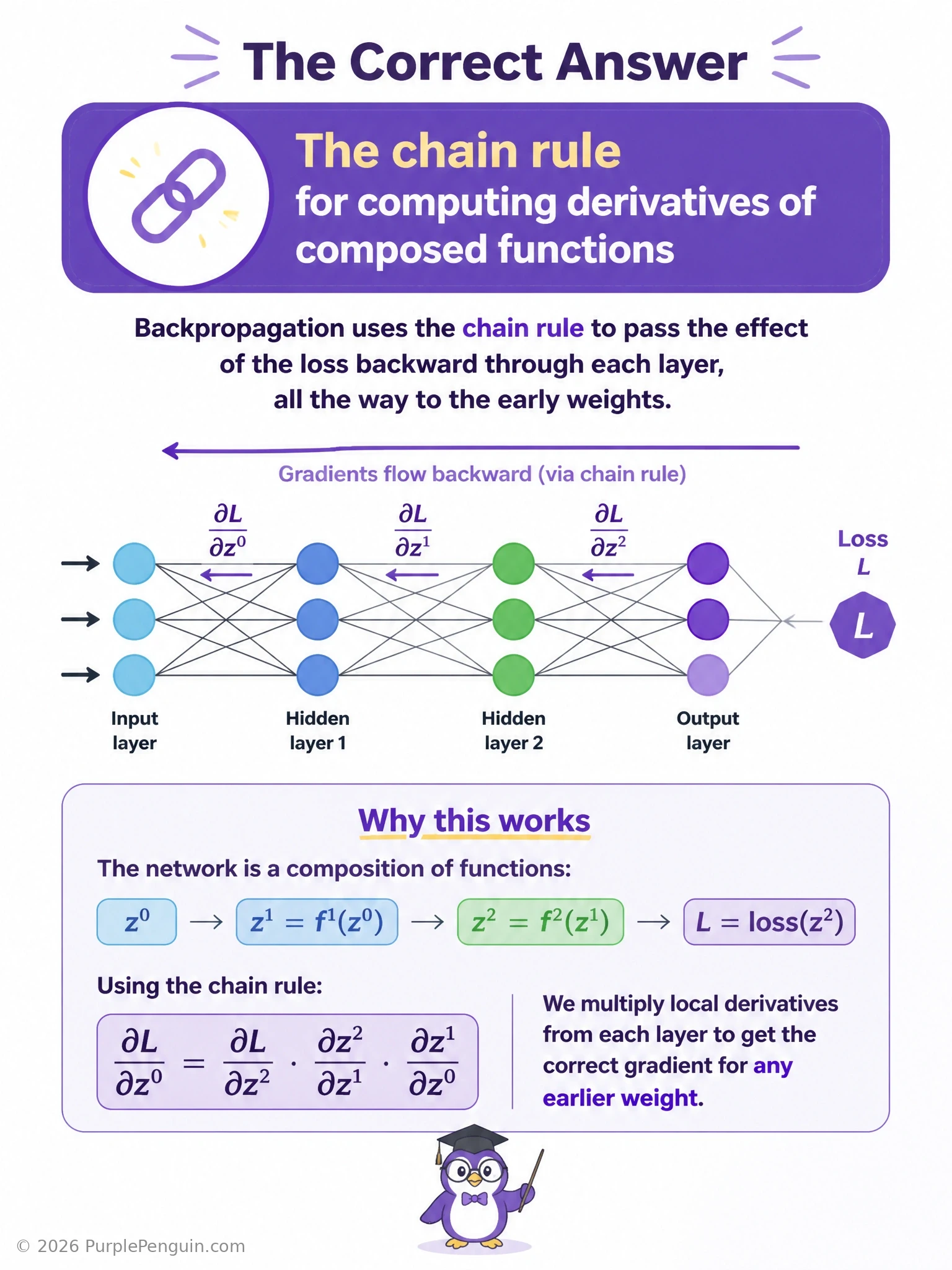
Picture a neural network as a long chain of functions, one layer feeding into the next. When you want to know how a tweak to some weight way back in layer two affects the final loss, you have to trace that influence forward through every layer in between. The tool for tracing that chain of influence is exactly what it sounds like: the chain rule. It lets you multiply together the local derivatives layer by layer, working backward from the output, so gradients can flow all the way back to the earliest weights. The central limit theorem is about how sample averages behave statistically — nothing to do with derivatives. Bayes' theorem updates probabilities given evidence, and the law of large numbers is about averages converging with more data. Neither touches how gradients propagate through a computational graph — only the chain rule does that job.
Full explanation below image
Full Explanation
Backpropagation computes the gradient of the loss function with respect to every weight in a neural network by applying the chain rule of calculus. Because a neural network is essentially a deep composition of functions (each layer's output feeds into the next layer's input), the derivative of the loss with respect to an early-layer weight must account for every intermediate transformation between that weight and the final loss. The chain rule formalizes this: it states that the derivative of a composed function equals the product of the derivatives of its parts. Backpropagation exploits this by computing local gradients at each layer and multiplying them together while moving backward from the output toward the input, efficiently accumulating the total gradient for every parameter in a single backward pass.
The central limit theorem is a statistical result describing how the distribution of a sample mean approaches a normal distribution as sample size grows; it has no role in computing derivatives or propagating error signals through a network's layers.
Bayes' theorem describes how to update the probability of a hypothesis given new evidence (posterior proportional to likelihood times prior). While Bayesian methods exist in machine learning, Bayes' theorem itself is not the mechanism that enables gradient computation through a multi-layer network.
The law of large numbers states that as more samples are drawn, the sample average converges to the expected value; it underlies why mini-batch gradient estimates approximate the true gradient over many batches, but it does not explain how gradients are computed and propagated backward through a composed function.
A useful memory aid: think of backpropagation as passing a 'blame signal' backward layer by layer, and the chain rule is the mathematical rule that tells you exactly how much blame each earlier layer's weights deserve, by multiplying local derivatives along the path from the loss back to that weight.