A team splits their labeled data into three groups before training a neural network. What is the main reason they carve out a validation set separate from the training and test sets?
Select an answer to reveal the explanation.
Short Explanation and Infographic
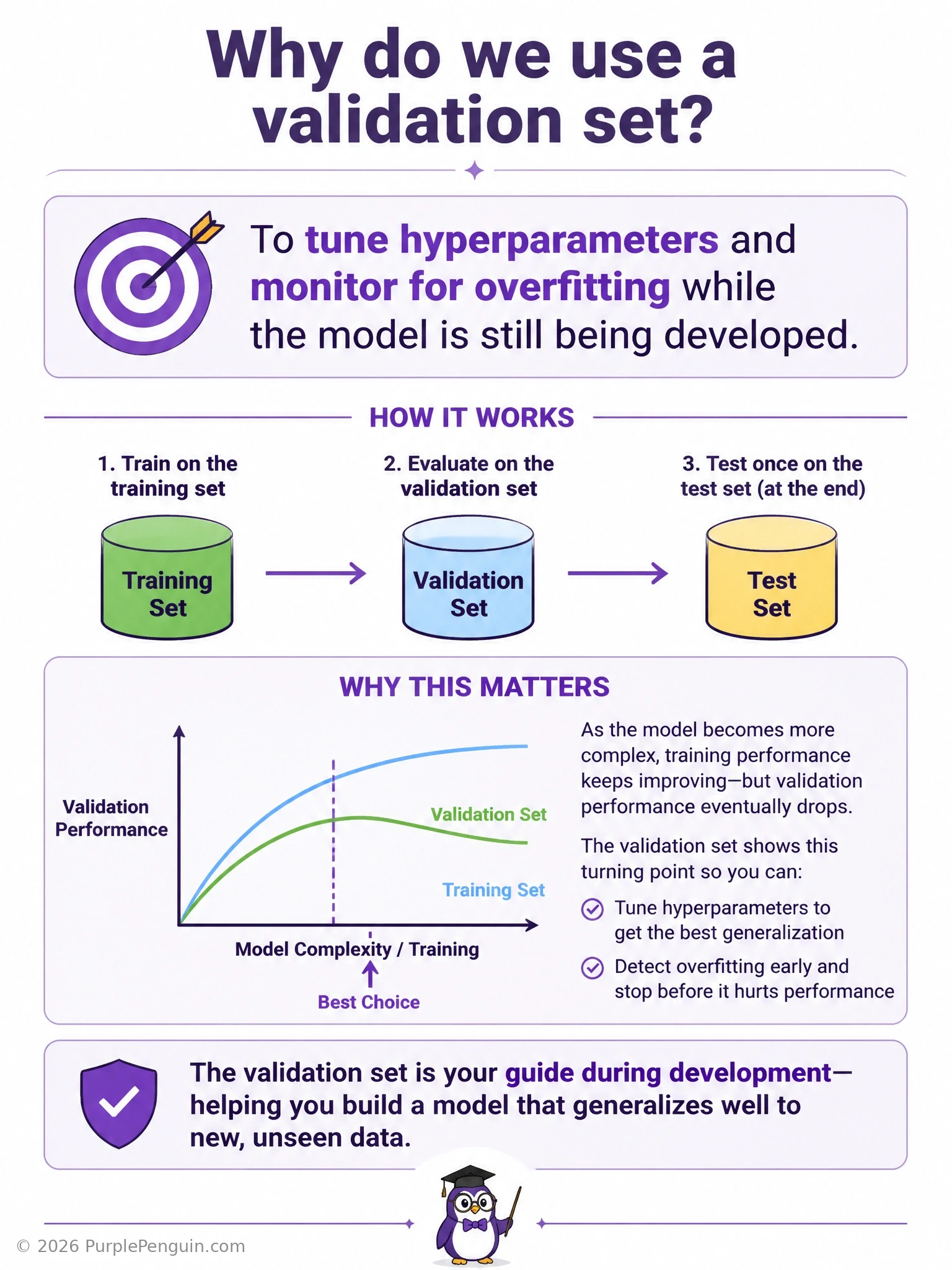
Think of the validation set as your practice referee. While you're still tinkering with the model — adjusting learning rate, number of layers, dropout, whatever — you need a way to check your work that isn't the training data itself, because the training data will always look great and lie to you about overfitting. That's what the validation set is for: you run the model against it after each round of tuning to see if it's actually generalizing or just memorizing. The test set is the one you save for the very end, untouched, for the true final grade. The 'store a backup' and 'more training examples' answers are both distractors that misunderstand the whole point of holding data back in the first place.
Full explanation below image
Full Explanation
The correct answer is that a validation set exists to guide hyperparameter tuning and catch overfitting during model development. When you're experimenting with architecture choices, regularization strength, learning rate, batch size, or number of epochs, you need a dataset the model hasn't been trained on to check whether your choices are actually improving generalization. The training set can't serve this purpose because a sufficiently complex model can fit training data almost perfectly while still performing poorly on new data — the validation set exposes that gap early, letting you course-correct before you've locked in a bad configuration. The first distractor, about backing up raw data in case files are corrupted, has nothing to do with machine learning methodology; it confuses a data-hygiene concern with an experimental-design concern, and no ML textbook lists 'backup' as a reason to create a validation split. The second distractor describes the test set, not the validation set — the test set is held out entirely until the very end and used exactly once to report an unbiased performance estimate; using it more than once, or using it to guide tuning decisions, contaminates it and defeats its purpose. The fourth distractor gets the logic backwards: the validation set is data withheld from training, so it does not add to the training pool, and its role isn't to speed convergence but to provide honest, repeated feedback during development. A useful way to remember the distinction: training data teaches, validation data tunes, and test data grades. Losing sight of this separation is one of the most common sources of inflated, misleading model performance claims in applied deep learning.