During training of a multi-class classifier, why does the output layer typically apply the softmax function rather than leaving the raw scores untouched?
Select an answer to reveal the explanation.
Short Explanation and Infographic
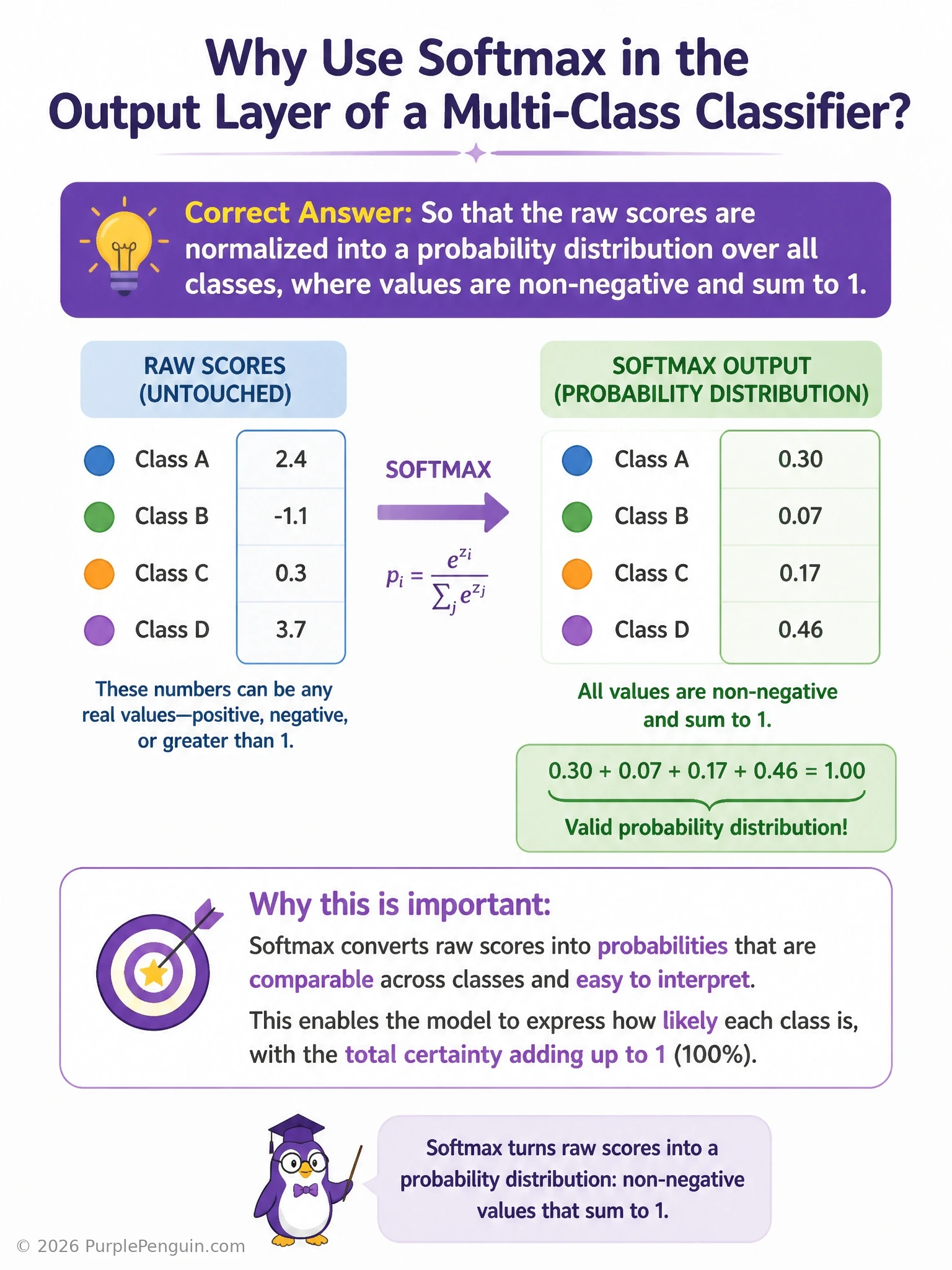
Without softmax, your network's final layer just spits out arbitrary numbers, positive, negative, huge, tiny, that don't mean much on their own. Softmax fixes that by converting them into a proper probability distribution: every value comes out non-negative, and the whole set adds up to exactly 1, so you can read them as 'here's how confident the model is in each class.' That's the fourth option, and it's correct — and it's also exactly what a loss function like cross-entropy expects to work with. It's not about summing outputs for logging; that's not what activation functions do. It's not about doubling the top score and zeroing the rest either; that's a much more aggressive winner-take-all operation, closer to argmax, and it throws away useful information. And softmax doesn't force every value negative — quite the opposite, it produces probabilities, which are always between 0 and 1, never negative.
Full explanation below image
Full Explanation
Softmax is applied to the output layer of a multi-class classifier to transform an arbitrary vector of raw scores, or logits, into a valid probability distribution across the set of possible classes. It does this by exponentiating each logit and dividing by the sum of all exponentiated logits, which guarantees that every resulting value is non-negative and that the full set of values sums to exactly 1. This normalized output is essential for two reasons: it gives a human-interpretable confidence score per class, and it is precisely the input format that cross-entropy loss, the standard loss function for classification, expects, since cross-entropy compares a predicted probability distribution against a one-hot (or soft) target distribution. This makes the fourth option correct. The first option, describing softmax as a way to sum outputs across the batch dimension purely for logging, misunderstands what softmax operates on; softmax normalizes across the class dimension for a single example, not across the batch, and it directly shapes the values used in the loss computation, not just a logging artifact. The second option, describing softmax as doubling the largest score and zeroing all others, describes a much more extreme, non-differentiable operation resembling a hard argmax with arbitrary scaling; real softmax output changes smoothly and proportionally with the input scores, preserving relative confidence rather than picking one aggressive winner. The third option, claiming softmax makes every output negative to match cross-entropy's sign convention, is incorrect because probabilities are by definition non-negative (bounded between 0 and 1), and cross-entropy loss is computed using the negative log of the predicted probability for the true class, meaning the negativity appears in the loss formula itself, not in softmax's output values. A useful memory aid is to think of softmax as splitting a fixed-size pie (representing a total probability of 1) among all the classes, where classes with higher raw scores get proportionally bigger slices, but every class still gets some non-zero, non-negative sliver of the pie, preserving relative ranking while producing a normalized, interpretable distribution.