In the context of training a neural network, what does the term 'epoch' refer to?
Select an answer to reveal the explanation.
Short Explanation and Infographic
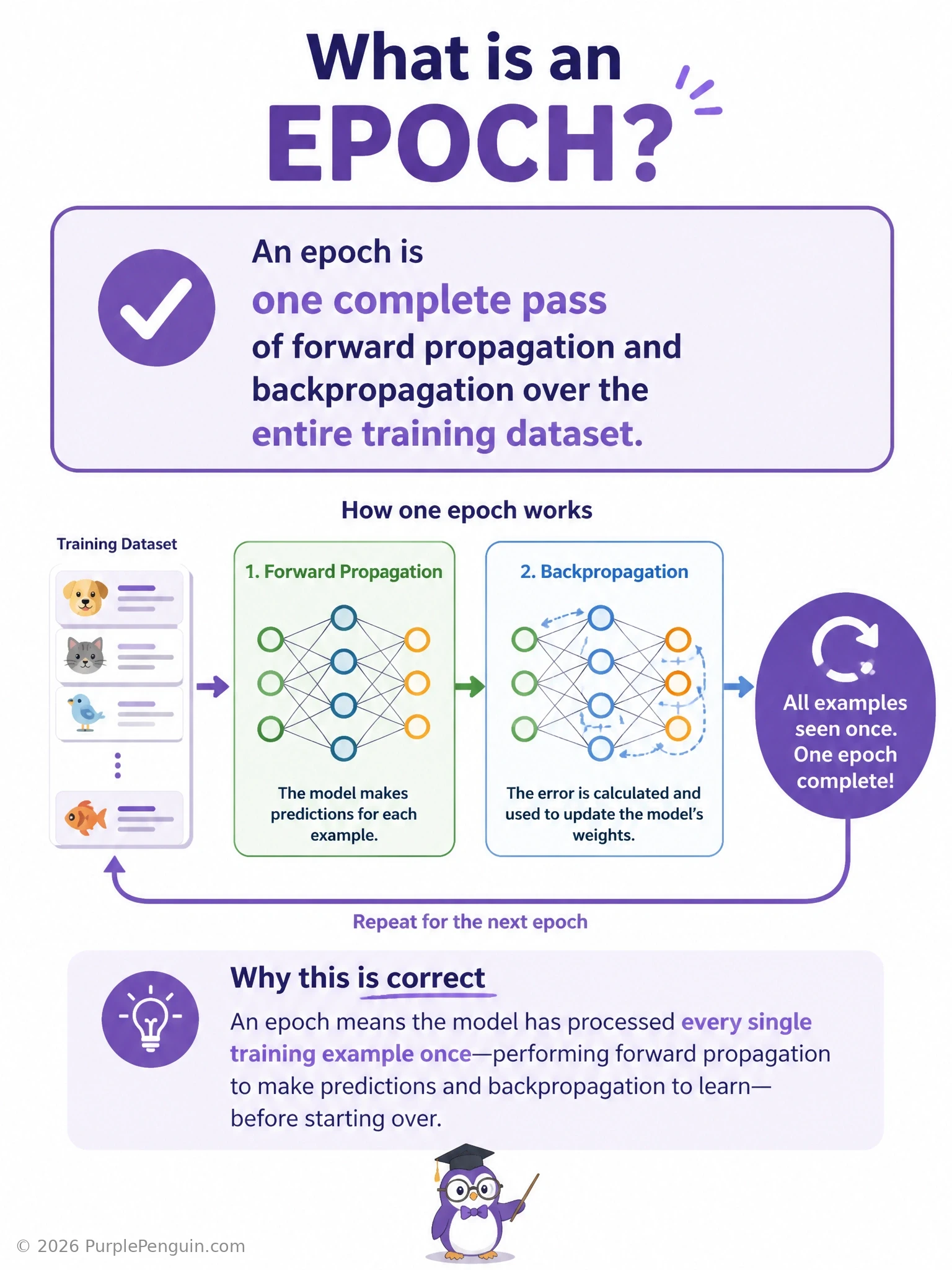
An epoch is one lap around the whole training set. Picture flashcards: an epoch is finishing the entire stack once, front to back, running each card through the network forward, checking how wrong the answer was, and adjusting the weights backward. Do that again and you're on epoch two. That's different from a 'step' or 'iteration,' which is just one mini-batch worth of updates — you'll usually have many steps inside a single epoch. It's also not the layer size, and it's definitely not a stopwatch reading; training time varies by hardware and has nothing to do with what an epoch counts. When you see 'trained for 20 epochs,' that means the whole dataset was shown to the model 20 separate times.
Full explanation below image
Full Explanation
The correct answer defines an epoch as one full forward-and-backward pass over the complete training dataset. During a single epoch, every training example is fed through the network (forward propagation), the loss is computed, and the gradients are backpropagated to update the weights, until the model has seen every example in the training set exactly once. Multiple epochs are typically required because a single pass rarely allows the weights to converge to a good solution; training curves are usually plotted with epochs on the x-axis specifically because it is a meaningful, hardware-independent unit of training progress. The second distractor, describing neuron count in a hidden layer, confuses epoch with a completely unrelated architectural hyperparameter — the number of neurons per layer has no bearing on how much of the dataset has been processed and is instead a design choice about model capacity. The third distractor describes an 'iteration' or 'step,' not an epoch. When training uses mini-batches (which is standard for large datasets), one epoch consists of many iterations — if you have 10,000 training examples and a batch size of 100, one epoch equals 100 iterations. Conflating epoch with iteration is one of the most common terminology mix-ups for newcomers, so it's worth fixing early: an iteration updates weights once per batch, while an epoch is the outer loop that completes once the entire dataset has been cycled through. The fourth distractor, describing wall-clock training time, fails because an epoch is a count of dataset passes, not a duration — the same number of epochs could take minutes on a GPU cluster or days on a laptop CPU, yet it would still be 'one epoch' either way. Understanding the epoch/iteration/batch relationship is foundational to reading training logs, setting early-stopping criteria, and diagnosing whether a model is underfitting (too few epochs) or overfitting (too many).