A team is building a system that takes an English sentence as input and produces its French translation as output. Which type of model architecture is best suited to this task?
Select an answer to reveal the explanation.
Short Explanation and Infographic
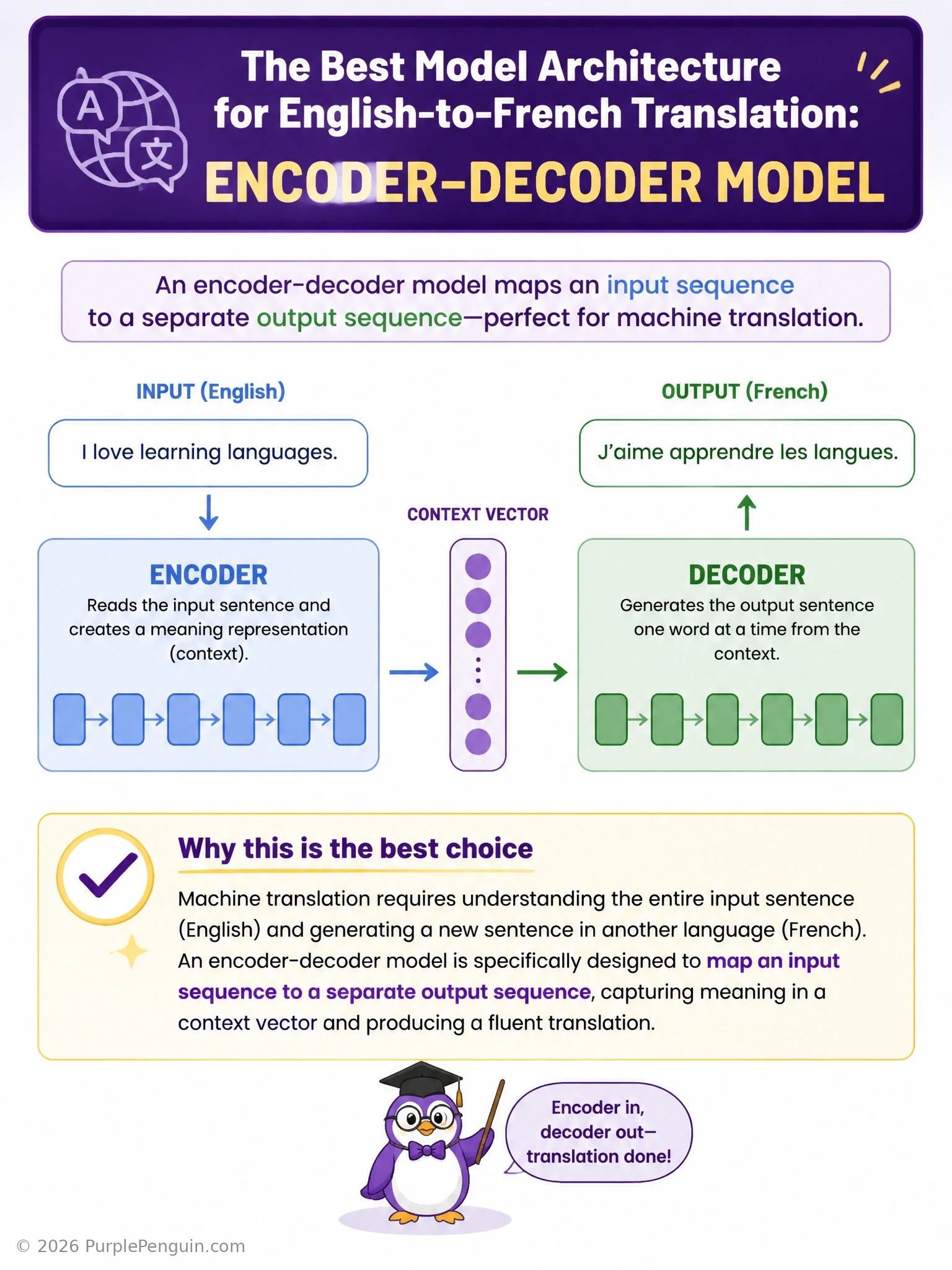
Translating a sentence means turning one sequence, English words, into a different sequence, French words, and that's exactly the job an encoder-decoder model is built for. The encoder reads the whole English sentence and compresses its meaning into an internal representation, then the decoder generates the French sentence from that representation, one token at a time. That's why the second option is correct — it's the classic sequence-to-sequence setup used for translation, summarization, and similar tasks. An autoencoder won't work here because it's trained to reconstruct its own input, not produce a different output sequence in another language. A convolutional classifier is built for fixed, single-label outputs like image categories, not for generating full variable-length sentences. And clustering just groups similar sentences together; it doesn't generate any output sequence at all, so it can't produce a translation.
Full explanation below image
Full Explanation
Machine translation is a canonical sequence-to-sequence task, where a variable-length input sequence (a sentence in English) must be mapped to a variable-length output sequence in a different domain (the corresponding sentence in French). The encoder-decoder architecture is specifically designed for this: the encoder processes the entire input sequence and compresses it into a context representation (historically a fixed-length vector, and in attention-based models like the Transformer, a set of contextualized token representations), and the decoder then generates the output sequence step by step, conditioning each generated token on both the encoder's representation and the tokens it has already produced. This makes the second option correct, since it directly names the encoder-decoder pattern and its use in tasks like machine translation. The first option, describing a single autoencoder trained to reconstruct its own input, is incorrect because an autoencoder's training objective is to reproduce the same input it was given, which is fundamentally different from producing a semantically equivalent sentence in a different language; there is no mechanism in a standard autoencoder for cross-lingual mapping. The third option, describing a standalone convolutional classifier producing one fixed class label per input, is incorrect because classification produces a single discrete label from a fixed, predefined set of categories, not a full variable-length sentence composed of a sequence of word or subword tokens; translation requires generating an open-ended sequence, which a fixed-output classifier cannot do. The fourth option, describing a clustering algorithm that groups similar sentences without producing output sequences, is incorrect because clustering is an unsupervised technique for discovering groupings within data, and it has no generative capability at all; grouping similar sentences tells you nothing about how to construct a correct translation of any individual sentence. A helpful memory aid is to picture the encoder as a translator listening to and fully understanding an English sentence before saying anything, forming a complete mental summary, and the decoder as that same translator then speaking the French sentence aloud, drawing on that mental summary one word at a time until the full translated sentence is produced.