A network's final layer produces one raw score per class for a 10-class image classification problem. What is the purpose of applying softmax to these scores?
Select an answer to reveal the explanation.
Short Explanation and Infographic
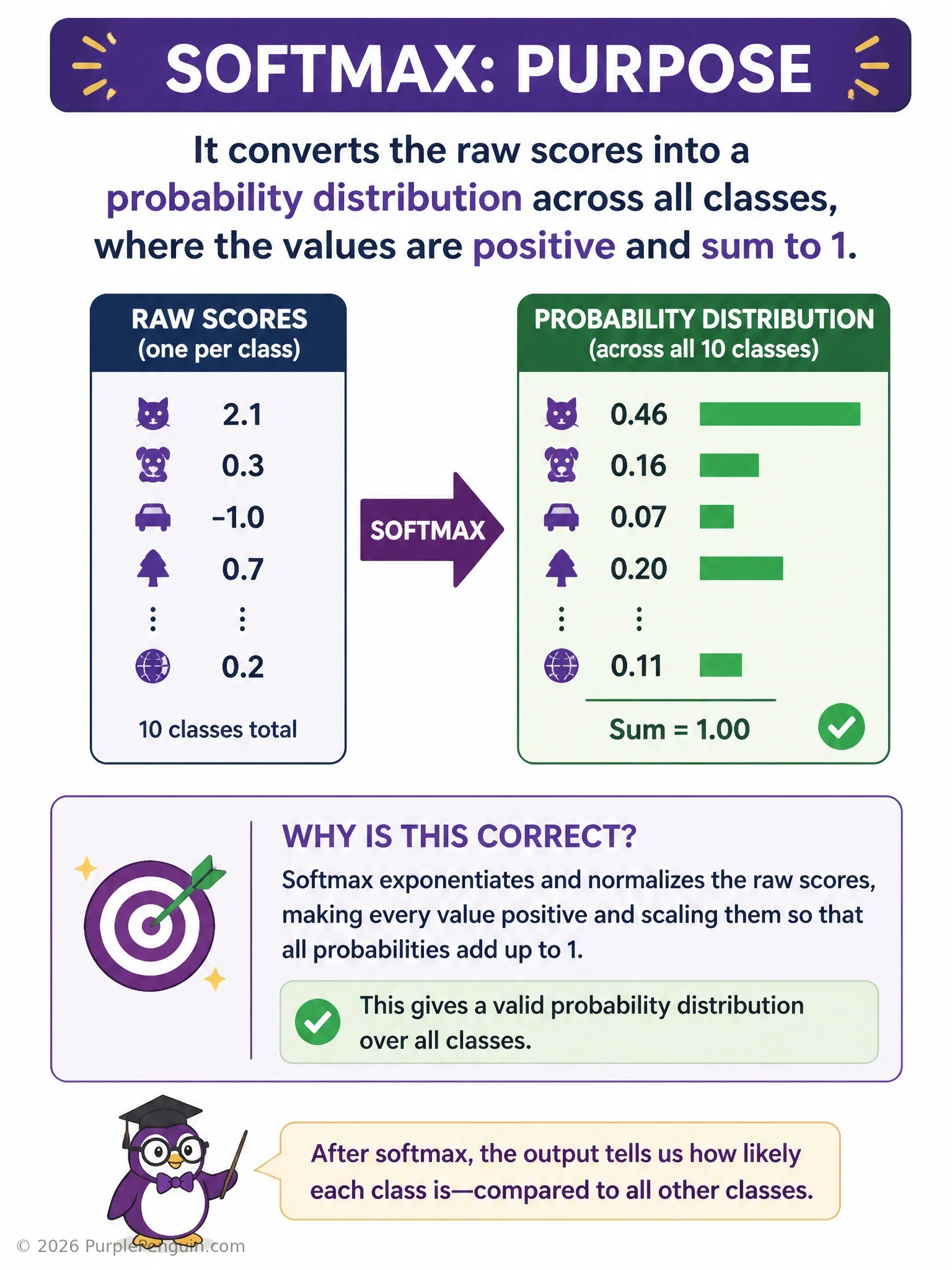
Raw output scores, often called logits, can be any real number — negative, huge, tiny, whatever the math produces. Softmax's job is to turn that messy list into something you can actually interpret: a clean probability distribution where every value is positive and the whole set adds up to 1, so you can say 'there's a 92% chance this is a cat.' That's why the third option is correct. It's not simply zeroing out negatives like ReLU does — that would ignore relative differences between classes and wouldn't sum to 1. It's also not a hard winner-take-all rule that forces the top score to exactly 1.0 and everything else to 0.0 — that's closer to argmax, and it throws away useful confidence information. And softmax has nothing to do with shuffling scores; overfitting prevention is handled by things like dropout or regularization, not the output activation.
Full explanation below image
Full Explanation
Softmax is the standard activation function applied to the final layer of a multi-class classifier when the classes are mutually exclusive, and its purpose is to convert an arbitrary vector of raw scores (logits) into a valid probability distribution over all candidate classes. Mathematically, softmax exponentiates each logit and divides by the sum of all exponentiated logits, which guarantees two properties: every output value is strictly positive, and all output values sum to exactly 1. This lets the network's output be interpreted directly as class probabilities, such as 92% confidence for 'cat' and smaller residual probabilities spread across the other nine classes, which makes the third option correct. The first option, describing softmax as simply zeroing out negative values while leaving the rest unchanged, actually describes ReLU, an activation function used in hidden layers, not softmax; ReLU does not normalize values into a distribution and does not guarantee outputs sum to 1. The second option, describing softmax as forcing the maximum score to 1.0 and everything else to 0.0, describes a hard argmax operation instead; argmax is not differentiable and discards the relative confidence information between classes that softmax preserves, which is essential for computing a meaningful loss (such as cross-entropy) during training. The fourth option, describing softmax as randomly shuffling scores to reduce overfitting, is unrelated to what softmax does; techniques like dropout, weight decay, or data augmentation address overfitting, while softmax purely reshapes the output distribution and has no random component in its standard form. A helpful memory aid is that softmax is the 'soft' version of argmax: instead of picking one winner outright, it spreads belief smoothly across all classes in proportion to their scores, which is exactly what's needed for probabilistic interpretation and gradient-based training with cross-entropy loss.